
 Google
 Yelp
 Facebook
 Twitter
 ChEnected
332701 CFD Simulation of Heat Transfer in a Microchannel Reactor for Fischer-Tropsch Synthesis Process
CFD Simulation of Heat Transfer in a Microchannel Reactor for Fischer-Tropsch Synthesis Process
K. Kshetrimayum, C. Park, I. Jung, S. Park, J. Na, C. Han
School of Chemical & Biological Engineering, Seoul National University,
Seoul 151-744, Republic of Korea.
Introduction
Microreactors can have enhanced process intensification due to its reduced mass and heat transfer distances, when compared to conventional technology. In this work, heat transfer effect in a microchannel reactor adapted for Fischer-Tropsch (FT) synthesis process is being studied. The process involves substantial heat effect due to high exothermic nature of FT- reacion (heat of reaction = 165 kJ/mol of reactant CO). Computational Fluid Dyanmic (CFD) modeling and simulation of heat transfer in a microchannel can give insights on the thermal behavior of such a reactor. The knowledge of heat transfer effect can then be used to develop a design and obtain tuning parameters for a desired reactor performance. Understanding the heat effect is essential to achieving an efficient coolant system design that is considered key to the performance of microreactor for FT synthesis applications. The main objectives of the present work have been i) to study the heat transfer effect in a cross flow microchannel reactor for different types of coolants (subcooled vapor, liquid water and saturated water) and ii) to investigate the tuning parameters and best operating conditions that can maintain the reactor internals to a near isothermal condition for a desired reactor productivity.
Methodology
Reaction scheme and kinetics as proposed by Marvast et al.(2005) was considered for the present study. Heat generation profile was independently calculated by simulating the simultaneous reactions in an isothermal plug flow model using commercial software-ASPEN. The generated heat profile is implemented as source condition in the process channels of a microchanel block comprising of alternate layers of process channel planes and coolant channel planes [Arzamendi et al., (2010) for detail geometry of microchannel block considered]. In the microchannel block, heat is transferred from the process channel (where the exothermic reaction is occurring) to the adjacent coolant channels through channel walls. For this purpose, a 3D Computational Fluid Dyanmic (CFD) model of a cross flow microreactor was developed in commercial CFD software- ANSYS FLUENT.
Results
The heat transfer effect within or interior of the microchannel block was examined for various scenarios that can be adapted to the actual industrial operation of compact microchannel reactor for Fisher-Tropsch synthesis purpose.
Figure 1. Temperature profile over the micro-reactor block.
| Table 1: Effect of heat generation rates (Q)
|
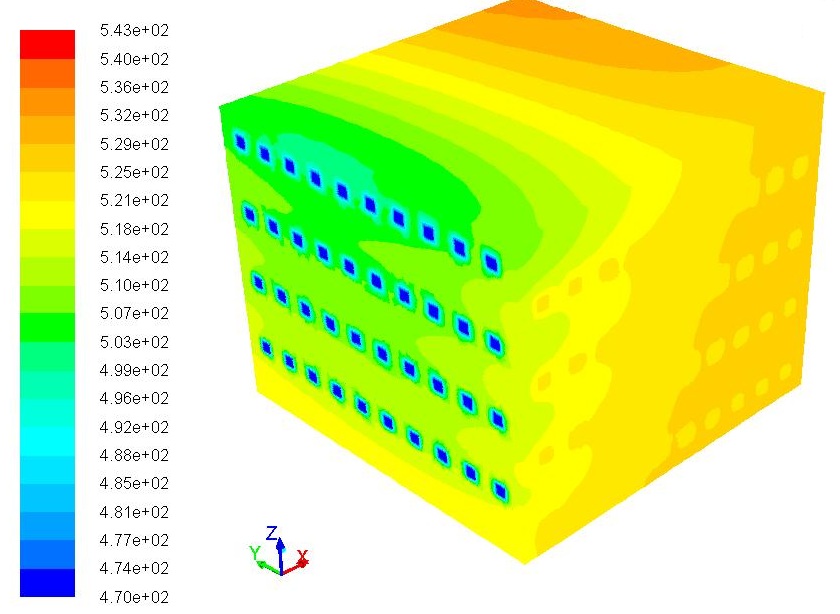
Table 2: Effect of coolant types
Single phase
| Multiphase
| ||
Vapor(v) | Water(l)
| Sat. Water
| |
Heat flux rates, J/s.m2 | 16000 | 13700 | 168200
|
Syn gas exit temp, K | 528 | 494 | --
|
Coolant exit temp, K | 530 | 497 | 458
|
Discussion
CFD simulation of heat transfer in a microchannel with process channel as heat source(due to exothermic FT- reaction), gives insights on the flow and thermal behaviors of a microchannel reactor. Using the developed CFD model for cross flow microchannel block, effects of different heat generation rates (implying effect of different syn-gas feed rates) were studied. The results help to identify the appropiate coolant flowrate to be used for a given syn-gas feed rate. Effects of coolant type (subcooled water vapor, liquid water and saturated water) were also studied. The result indicates that saturated water as coolant can be the right choice to maintain near isothermal conditions in the reactor internal. Further, using the CFD model, tuning parameters and operating conditions for a desired reactor performance are being investigated.
References
1. M.A. Marvast, M. Sohrabi, S Zarrinpashneh, G. Baghmisheh, (2005) J. Chem Engg., Vol 28.
- G. Arzamendi, P.M. Dieguez, M. Montes, J.A. Odriozola, E.F. Sousa-Aguiar, L.M. Gandia, (2010). J. Chem Engg., Vol 160.
See more of this Group/Topical: Process Development Division