
 Google
 Yelp
 Facebook
 Twitter
 ChEnected
332714 Studies On a Newly Developed Modular Packed Absorption Column
Studies on a newly developed modular packed absorption column
1. Motivation
 Increasing product differentiation and changing from
commodities to specialized products are reasons for shortened product life
circles in chemical engineering. Traditionally, large scale-plants possess
inadequate flexibility in capacity and product portfolio based on their ‘one
purpose' development. Therefore apparatus with increased flexibility, like
modular devices, becomes necessary to handle fluctuating customer demands. Due
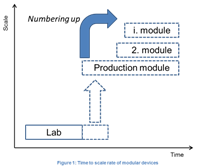
to modular assembly capacity can be increased either by equaling up modules from general structures or by numbering up equipment. Hence, a ‘smart scale-up' of the complete
modular apparatus becomes possible. In favor of smart scale-up only the
operating parameters of the single module are necessary and thus reduced
time-to-market periods for the products (see figure 1). In fact the challenge
on scaling-up modular devices is an equal feed flow for every single module.
Modular devices are state of the art in chemical engineering. Apparatus types like plate heat exchangers or filter presses are established technologies with a long history of development. Nevertheless, most of other apparatus principles are not modular in terms of adaptable capacity and operational flexibility. Even continuously working multiphase reactors and separation units are scale-up by the traditional similarity analysis. Therefore our chair is running several research projects presently dealing with the modularization of multiphase units like packed columns and bubble column reactors for example.
In this contribution first experimental studies on a newly developed packed absorption module are compared with the operation behavior of a conventional packed column.
2. Experimental Studies
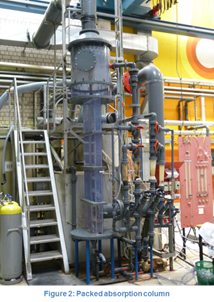 For the experimental studies
a packed absorption module with rectangular cross-section was developed (see
figure 2). Firstly, experimental studies regarding hydrodynamics and mass
transfer efficiency of the module have been performed. Those studies have been
performed with dumped and structured packings for
liquid and gas loads up to the flooding point. In detail, this work presents
results of measurements with Pall Ring 25 M and Raschig
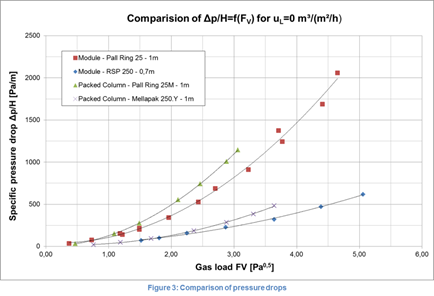
Super-Pak 250. A comparison of experimental results between a packed absorption
module and conventional packed columns shows the practicality of this new
apparatus (see figure 3). With regard to identical packings,
the module's results are comparable to conventional packed columns. Although
the single module shows the expected losses in capacity for the gas and liquid
load, it shows comparable results for the mass transfer efficiency in
consideration of the reduced cross-section. Particularly with regard to the
distribution of the fluids in the module, experimental studies have been
performed to show the influence of the rectangular cross section and thus the
shortened distance for liquid and gas to the wall. For qualitative and quantitative investigations of
the wall effect a new in-situ measurement method for the thickness of the wall near liquid film in
packed columns will be developed. By a detailed examination of the wall effect
inside the module, internals will be designed to minimize the wall film thickness
and increase the mass transfer efficiency.
For an investigation of the gas distribution, studies have been performed with fog to visualize the stream of the gas inside the rectangular absorption module. The tests with fog will show the need of a gas distributor and the behavior of gas stream inside the newly module.
3. Interconnection of the modules
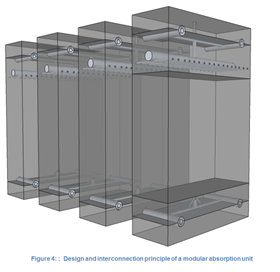 As aforementioned the utilization
of the packed absorption module can be increased by a multiple connection of
single modules, the so-called numbering-up.
Purpose of this work is to show possible design studies to connect single
modules (see figure 4). These studies indicate the conduction of gas and liquid
flows and possible integration of the modules into existing modular concepts
like frames of plate heat exchangers.
See more of this Group/Topical: Separations Division