
 Google
 Yelp
 Facebook
 Twitter
 ChEnected
332980 The Influence of Solid Inertants On the Explosion Behavior of Dusts From Mechanical Waste Treatment Facilities
Conservation of natural resources is a main target in today's lives wherefore the reusing and recycling of waste is very important. To recycle waste material it is necessary to treat the mass flows in special ways. In most instances the waste material passes through mechanical treatments. Especially for the production of substitute fuel mechanical treatment is a common treatment operation. During this mechanical treatment the fractions get shredded, separated and prepared for further recycling. Nevertheless, besides all those positive effects, the mechanical treatment of waste material also generates a fraction of fine particles, which gets dispersed in air. These occurring dusts either have to be separated with suction cleaning or they get deposit unregulated on plant components. Anyway all occurring dusts are fraught with the risk of dust explosions if they are burnable and dispersed in air.
Dusts from different waste treatment facilities were investigated in order to identify the dust explosion potential and its influencing factors. Dusts deposited on plant components as well as filter dusts were sampled. The reason for taking samples from deposit dusts is that they can cause dust explosions if they get dispersed in air. Filter dusts are relevant materials because they are dispersed in air when they get suctioned and might form hazardous explosive atmospheres. Burnable dust dispersed in air can cause dust explosions if the dust cloud is getting in contact with an effective ignition source.
The explosibility characteristics for the investigated dusts were determined by Siwek 20-Liter testing. Experiments were conducted to identify the influence of solid inertants, as well as the influence of their particle size and particle shape. These investigations are done from the intention to predict the explosion behavior of dusts based on the amount, size and shape of their inert fraction.
Because of batch wise delivery of the recycling material and similarly input there is a variation of composition of the treated material over time. That is why it was necessary to check if the occurring dusts respective the explosion behavior of the occurring dusts is altering with time. Beside of short-term fluctuations caused by varying input material also seasonal changes were considered. The comparison of samples taken from the same plant within different periods of time showed that despite of changes in charge material, the explosion behavior of occurring dusts within one operation unit in a plant is reproducible.
Solid Inertants
A known way of reducing the risk of dust explosions is to mix the burnable dust with a solid inertant [1]. This method is either used to generate a resulting mixture, that is rendered non-explosible or the admixture is done in purpose of mitigation of the consequence of a dust explosion [2, 3]. Although there is good knowledge of solid inerting, it is not widely used in process industries. In most applications mixing with solid inertants can lead to unacceptable product contamination so this procedure is only in rare cases practical from a technical perspective.
In the case of dusts from mechanical waste treatment facilities risk reduction due to solid inertants is an interesting approach, because of the fact, that the dusts itself contain a huge amount of inert fraction. The inert fraction is on average at least 40 mass percent.
To identify the influence of inert fraction, dust samples from a mechanical sorting plant were investigated. The ash content of the samples was increased and an inhabitation as shown in Figure 1 could be seen. On this basis it could be shown that the explosion behavior of dust samples from different operation units in the same plant are just differing due to the different inert fractions. So the inert fraction is within one plant a valuable parameter for the prediction of the explosion characteristics of the occurring dusts.
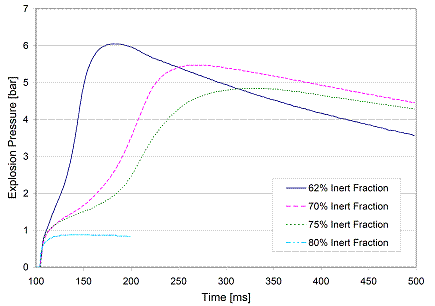
Figure 1: Pressure-time trace for the reaction of dust sample from mechanical sorting with different inert fractions
Particle Size and Particle Shape
Beside the high amount of inert particles, the fraction of coarse particles in the occurring dusts is very high. Most of the dusts show very wide particle size distributions. For the investigations of the explosion behavior in the 20-Liter Siwek Apparatus as well as in the modified Hartmann Apparatus only particles beyond 500 µm were mentioned. However because of the fact that the particle class of 500 – 1000 µm is of the same magnitude as the particle class smaller 500 µm, the influence of coarse particles in the mixture was investigated.
An increased mean particle diameter of an explosible dust caused by an increase of particle size over the whole size distribution can significantly decrease the inerting level [1]. Larger particles are more difficult to disperse than smaller particles, which is another relevant aspect of the characterization of dust explosions in mechanical waste treatment plants. Especially, in due consideration of the high LEL (lower explosion limit) of the outlined dust samples a restraint in dispersion properties is considerable.
In Figure 2 the notable results are given. Already at a coarse fraction content of 5 % the explosion characteristics switches to the characteristics of the coarse fraction. Therefore, regardless of separation phenomena, an inhibition of the explosion intensity can be expected because of the presence of coarse particles in the dust samples.
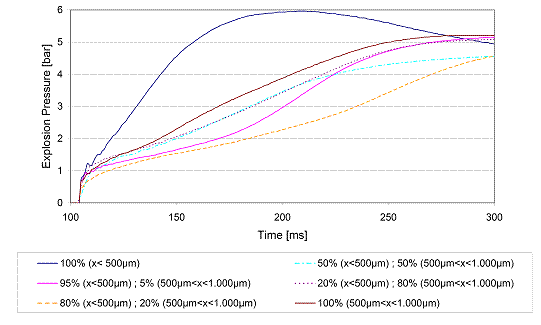
Figure 2: Effect of coarse particles on the explosion characteristics of dust samples from mechanical waste treatment facilities
Particle Size and Particle Shape of Solid Inertants
According to the influence of inert fraction and particle size investigations concerning the particle size and particle shape of solid inertants in the dust samples were done. Therefore a sample from a document destruction plant with an ash content of 42 % was prepared by admixture of glass beads and glass fibers respectively. Due to this the inert fraction of the sample was raised by 5 %.
With an addition of 5 % it could be seen that the effect of beads is nearly negligible while the admixture of fibers has considerable effect. The added materials are of the same equivalent diameter, which is comparable with the particle size distribution of the original sample. Although the explosion pressure of the prepared samples is equal the explosion intensity in terms of rate of pressure rise is strongly weakened (cf. Figure 3). This shows the importance of the particle shape of solid materials that act as inhibitors.
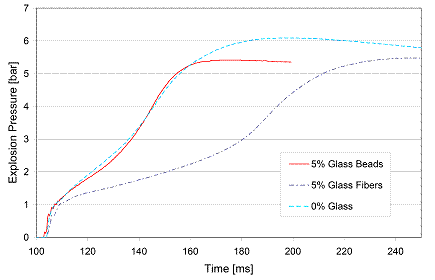
Figure 3: Effect of the admixture of inert material of different particle shape on the pressure rise over time
As seen in Figures 4 and 5 the Siwek 20-Liter testing of the document destruction dust sample with the admixture of 5 % glass beads are compared to those of the same dust sample mixed with 5 % glass fibers. The explosion hazard is therefore significantly magnified by the particle shape of the present inert material.
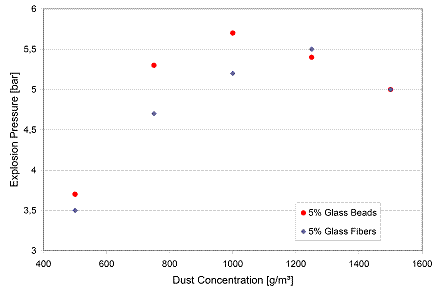
Figure 4: Explosion pressure as a function of dust concentration for dust from document destruction mixed with 5 % glass beads and accordingly 5 % glass fibers
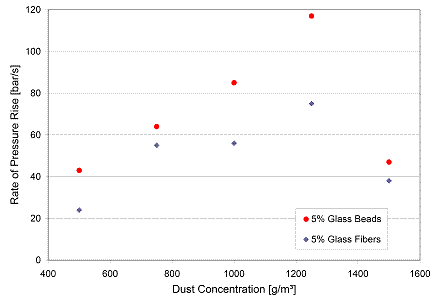
Figure 5: Rate of pressure rise as a function of dust concentration for dust from document destruction mixed with 5 % glass beads and accordingly 5 % glass fibers
These investigations show that the explosion behavior of dusts from mechanical waste treatment facilities is strongly influenced by the presence of inert material and its particle shape as well as its particle size. Previously analyses of different dusts of mechanical waste treatment facilities and the effect of their influencing factors on the explosion reactions were done. This is the basis for further investigations on the effect of particle size and shape of the ash content, which should permit the estimation of the explosion behavior.
Further analyses with variation of the particle size distribution and particle shape as well as the material of the solid inertants will be done. The investigations will be done with dusts from document destruction as well as dusts from substitute fuel production and other mechanical waste treatment facilities. The comparison of the influencing effects provides important information on the characterization of these dust explosions.
References
[1] Amyotte, P., Pegg, M., et al. (2007). Moderation of dust explosions. Loss Prevention in the process industries, 20. 675-687
[2] Chatrathi, K. & Going, J. (2000). Dust deflagration extinction. Process Safety Progress, 19. 146-153
[3] Dastidar, A. & Amyotte, P. (2002). Determination of minimum inerting concentrations for combustible dusts in a laboratory scale chamber. Process Safety and Environmental Protection, 80. 287-297
See more of this Group/Topical: Sustainable Engineering Forum