
 Google
 Yelp
 Facebook
 Twitter
 ChEnected
333144 Synthesis of 3-Methylbut-3-En-1-Ol Acetate On Anchored SnCl2 Catalyst and Its Hydrolysis to Alcohol
Synthesis of 3-methylbut-3-en-1-ol acetate on anchored SnCl2 catalyst and its hydrolysis to alcohol
Zhaoyang Fei1,2, Zhe Zhou2, Xian Chen2, Jihai Tang2, Mifen Cui 2, Xu Qiao1,2*
(1. State Key Laboratory of Materials-Oriented Chemical Engineering, Nanjing University of Technology, Nanjing, Jiangsu 210009, China 2. College of Chemistry and Chemical Engineering, Nanjing University of Technology, Nanjing, Jiangsu 210009, China;)
Key words£º3-methylbut-3-en-1-ol; 3-methylbut-3-en-1-ol acetate; anchored tin dichloride; MCM-48; esterification-hydrolysis
3-methylbut-3-en-1-ol (MBOH) is an important chemical intermediate for producing organic compounds such as pesticides, water-reducing agent and citral. MBOH is available by the Ene condensation reaction, condensation reaction of isocrotylchloride and formaldehyde or isomerization of 2-methylbut-3-en-1-ol. However, those processes are with high equipment investment, expensive raw material or critical operated conditions. The Prins condensation reaction overcomes above-mentioned problems, but the large dosages of catalyst and solvent limit its industrialization. Based on Prins condensation reaction, innovative esterification-hydrolysis two-step method was employed to efficiently synthesize MBOH in this work.
Firstly, MB-AC is synthesized through the condensation reaction of formaldehyde, isobutene with acetic acid on a novel catalyst, 0.03 mmol/g-cat tin dichloride anchored on quaternary ammonium chloride functionalized MCM-48. The influences of reaction time, reaction temperature and the molar ratio of acetic acid and formaldehyde on the MBOH and MB-AC yields are presented in Fig. 1. The optimal reaction conditions for the reaction time is 6 h, the reaction temperature is 140 °æ and the molar ratio of acetic acid and formaldehyde(MA/MF) is 4, the yield of MBOH and MB-AC are 13.8% and 55.5%, respectively.
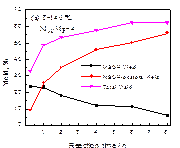
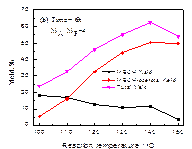
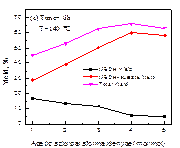
Fig. 1 The influences of reaction time (a), reaction temperature (b) and the molar ratio of acetic acid and formaldehyde (c) on the yields of MBOH and MB-AC. 2.4 g catalyst, 16 g paraformaldehyde and 90 g isobutene.
The final condensation reaction solution is rectified to remove front fraction and acetic acid. Then, the obtained mixed liquor with 51.7 wt% MB-AC and 8.6 wt% MBOH, is hydrolysized under alkali solution. The influences of concentration of alkali solution and feed speed are investigated under 50 °æ, with the molar ratio of NaOH and MB-AC is 1.9. The yield of hydrolysis is 94.5% under optimal reaction condition ( table 1). The final yield of MOH by esterification-hydrolysis two-step method reaches to 65.5%.
Table 1 The influence of hydrolysis conditions on the yield of hydrolysis
NO. | Temperature/ °æ | Feed rate of alkali solution/ mL°¤h-1 | Concentration of alkali solution/ wt% | MBOH yielda, % |
1 | 50 | 40 | 20 | 92.3 |
2 | 50 | 60 | 20 | 94.3 |
3 | 50 | 80 | 20 | 87.2 |
4 | 50 | 60 | 15 | 87.4 |
5 | 50 | 60 | 20 | 94.5 |
6 | 50 | 60 | 25 | 82.6 |
a. 
Using this catalyst for Prins condensation to produce MBOH under the same reaction condition, except the dioxane instead of the acetic acid as solvent, the yield of MBOH is only 13.6%.
MBOH is efficiently produced, employing innovative esterification-hydrolysis two-step method. MB-AC is firstly synthesized through the condensation reaction of formaldehyde, isobutene with acetic acid on tin dichloride anchored on quaternary ammonium chloride functionalized MCM-48. Then, the obtained MB-AC is hydrolysized under alkali solution. The final yield of MOH by esterification-hydrolysis two-step method is much higher than that of traditional Prins condensation reaction.
Reference
[1] Jyothi Thundi M., Kaliya Mark L., Landau Miron V., et al. A comparative study of an MCM-41 anchored quaternary ammonium chloride/SnCl4 catalyst and its silica gel analogue [J]. Chemical Communication, 2001(11):992-993.
[2] Zhu Jiang, Liu Ruibin, Xu Jun, et al. Preparation and characterization of mesoporous silicon spheres directly from MCM-48 and their response to ammonia [J]. J Mater Sci, 2011, 46:7223-7227.
[3] Jyothi Thundi M., Kaliya Mark L., Landau Miron V.. A Lewis acid catalyst anchored on silica grafted with quaternary alkylammonium chloride moieties [J]. Angew. Chem. Int. Ed, 2001, 40(15):2881-2884.
[4] Ji Min, Li Xuefeng, Wang Junhu, et al. Grafting SnCl4 catalyst as a noverl solid acid for the synthesis of 3-methylbut-3-en-1-ol [J]. Catalysis Today, 2011, 173:28-31.
[5] Blomquist A.T., Verdol Joseph A.. The thermal isobutene-formaldehyde condensation [J]. J. Am. Chem. Soc., 1955, (77):78-80.
See more of this Group/Topical: Catalysis and Reaction Engineering Division