
 Google
 Yelp
 Facebook
 Twitter
 ChEnected
333173 Coupled Lbm-DEM Simulations of Gas Fluidised Beds
COUPLED LBM-DEM SIMULATIONS OF GAS FLUIDISED BEDS
J. R. Thirda* and C. R. Muellera**
a ETH Zuerich
Leonhardstrasse 27
Zuerich, CH-8092
* jthird@ethz.ch, **muelchri@ethz.ch
Gas-fluidised bed reactors feature in numerous industrial processes, with the fluidised catalytic cracking of hydrocarbons being perhaps the most important example. Other notable applications of fluidised beds include fertiliser manufacture, the production of high purity silicon and the gasification of coal. Despite the importance of fluidisation to industry, many aspects of the behaviour of fluidised particles remain poorly understood. Consequently, there is significant industrial and academic interest in the computational modelling of gas-fluidised beds.
Since its introduction by Tsuji et al. (1), the coupled computational fluid dynamics-discrete element method (CFD-DEM) technique has become one of the most widely used techniques for modelling gas-fluidised beds. In these simulations each particle is modelled as a distinct entity, whereas the fluid flow is modelled in a volume-averaged manner using a large cell size, typically 3 times the particle diameter. Due to the low spatial resolution of the fluid model, it is not possible to compute the fluid-particle interactions directly in these simulations with the result that these models require a closure relationship, often called the drag law. In recent years closure relationships have been developed for CFD-DEM simulations using the lattice Boltzmann method (LBM), e.g. Beetstra et al. (2). However, the drag law remains the greatest source of error in CFD-DEM methods since even the most sophisticated expressions describe only the average force experienced by a particle and make no allowance for particle rotation or relative motion between the particles. The aim of this work is to examine the ability of the CFD-DEM technique accurately to model gas-fluidised beds. The predictions of a CFD-DEM model are compared with those of a coupled lattice Boltzmann method-discrete element method (LBM-DEM) technique, which does not require a closure relationship for the fluid-particle interactions.
Significant differences can be observed between the results of the two modelling approached. For example, figure 1 shows the height of the centre of mass of the particles above the distributor as a function of time for CFD-DEM and LBM-DEM models. These data indicate that the LBM-DEM model predicts larger fluctuations in the average height of the particles than the CFD-DEM model. Furthermore, on a time-averaged basis the location of the centre of mass of the particles is higher for the LBM-DEM model, suggesting that this model predicts a larger bed expansion. This is consistent with a detailed analysis of the fluid-particle interaction forces, which indicates that the force acting on the particles in the LBM-DEM simulation is approximately 125 % of the force that would be predicted by the equation proposed by Beetstra et al. (2).
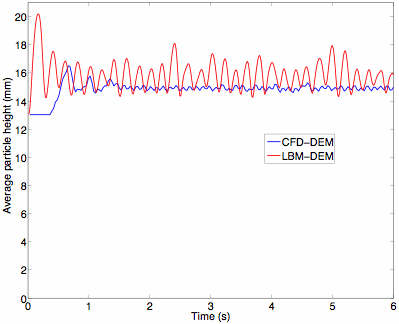
Figure 1: Height of the centre of mass of the particles above the distributor as a function of time for CFD-DEM and LBM-DEM models.
REFERENCES
1. Y. Tsuji, T. Kawaguchi and T. Tanaka, Discrete particle simulation of 2-dimensional fluidized beds. Powder Technol., 77(1): 79- 87, 1993.
- R. Beetstra, M. A. van der Hoef and J. A. M. Kuipers, Drag force from lattice Boltzmann simulations of intermediate Reynolds number of past mono and bidisperse arrays of spheres. A.I.Ch.E. Journal 53(2): 489-501, 2007.
See more of this Group/Topical: Particle Technology Forum