
 Google
 Yelp
 Facebook
 Twitter
 ChEnected
333259 Degradation of Artificial Humidity Condensate in the Confined Space Using Large-Area Boron Doped Diamond Electrode
Degradation of artificial humidity condensate in the confined space using large-area boron doped diamond electrode
Hao Li, Lecheng Lei, and Bin Yang*
(keyangb@zju.edu.cn)
Key Laboratory of Biomass Chemical Engineering of Ministry of Education, Department of Chemical and Biological Engineering, Zhejiang University, Hangzhou 310027, China
Key words: BDD electrode; Ta substrate; electro-catalytic oxidation; water reuse
The confined space is a particular location that is cut off from the atmosphere or without any gas exchange with the outside. It will be a large cost if the water is provided only by means of external supplements when human being lives there for a long time, therefore water reuse is the most realistic and economical way to produce drinking water. Humidity condensate generated by the body mainly from breathing, sweating, skin evaporation and so on is of a relatively good quality which can be used as drinking water after treatment[1]. It has been reported that humidity condensate has a major composition of small molecule alcohol, acid, and inorganic salt, and the total organic concentration are relatively low[2]. The methods of activated carbon adsorption and the medium temperature catalytic oxidation are employed to treat humidity condensate. However, a large amount of adsorbents are consumed for the former method and while the energy consumption for the later method is relatively high. Therefore, we consider of choosing the electro-catalytic oxidation technology to remove organic pollutants in water efficiently, economically and reliably. The key to this technology is to fabricate high quality of anode. The boron doped diamond (BDD) electrode has been proved as a candidate owing to a wide potential window, low background current, high electrochemical stability and corrosion resistance[3, 4].
Due to the limitation of space in the confined space, the treatment facilities should be compact and easy to install and operate. Herein, we devoted to fabricating large-area BDD electrode. BDD films are usually deposited on the substrate of Si, Ti, Nb, Ta, W and so on. The substrate of Si is most widely used at present, however it is brittle and its conductivity is poor[5]; Ti is a much cheaper material with good electrical conductivity, but the adhesion of diamond film between Ti is poor due to the formation of TiC transition layer[6]. In particular, Ti substrate show serious deformation when fabricating large-area diamond films (see Figure 1a and 1b). The substrate materials of Nb, Ta and W can be utilized, because they have good mechanical strength, high electrical conductivity and good chemical stability. In the present study, large-area BDD films (the size of tantalum plate: ¦µ100°Á1mm) are grown on Ta substrates (see Figure 1c and 1d) using hot filament chemical vapor deposition. The surface of the Ta/BDD electrode is smooth and uniform distribution, and there don't have any deformation on the electrode. On the basis of some literatures[7], the main composition of artificial humidity condensate is shown in Table 1.
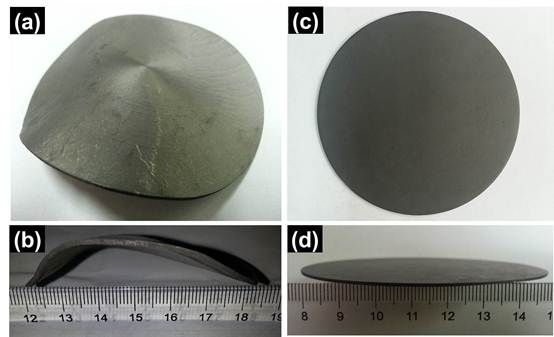
Figure 1. The BDD electrode deposited on Ti (a: top view; b: front view) and Ta (c: top view; d: front view) substrates
Table 1 The composition of artificial humidity condensate
Component | Concentration(mg/L) | Component | Concentration(mg/L) |
ethanol | 160 | formaldehyde | 10 |
acetic acid | 60 | acetone | 5 |
ethylene glycol | 30 | caprolactam | 5 |
isopropanol | 30 | sodium chloride | 16.5 |
propylene glycol | 25 | potassium sulfate | 11.2 |
methanol | 20 | sodium sulfate | 26.3 |
formic acid | 15 | ammonium carbonate | 112.9 |
Figure 2 shows the SEM picture of the surface morphology of BDD electrode. It is obvious that the substrate is totally covered by the clear-cut facet diamond crystals with hexangular, triangular and rectangular habits in the diameter range from 1 to 3µm. The XRD profile (see Figure 3) reveals that a diamond (111) facet preferential orientation. Moreover the diffraction peaks of TaC and Ta2C are observed which are interlayers formed during the deposition process. Raman spectrum and XPS are further investigated to identify the structure of BDD electrodes. It is also shown that diamonds have a compact structure, homogeneous composition and high levels of content.
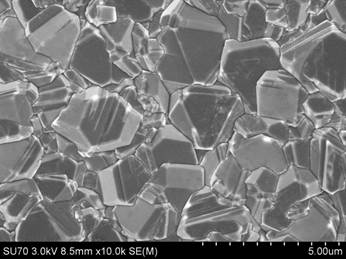
Figure 2. The SEM image of the surface morphology of BDD film
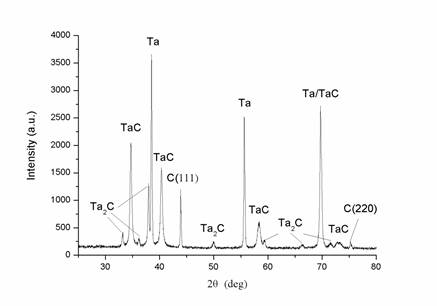
Figure 3. The XRD diagram of the surface of BDD film deposited on Ta substrate
200 mL artificial humidity condensate was treated through circular manner with the velocity of 50mL/min by using the BDD electrode as anode and the stainless steel plate as cathode. The final TOC removal efficiencies against the operating time for different current densities are shown in Figure 4. The removal efficiency for each current reaches up to 95%. The residual treated solution was further identified by HPLC. It reveals that the degradation products are composed of oxalic acid, formic acid and acetic acid, and among them oxalic acid is the dominant component. The operating time are approximately 120, 90, 70 min, respectively in order to obtain the TOC removal efficiency of 80% in the current density of 5, 10, 15 mA/cm2 (the corresponding power is 3.8, 9.9, 17.8 W). Accordingly, the energy consumptions are 7.6, 14.8, 20.8 J respectively. Although the energy consumptions in these three conditions are all relatively low, the current density of 10mA/cm2 is optimal with the consideration of treated time together.
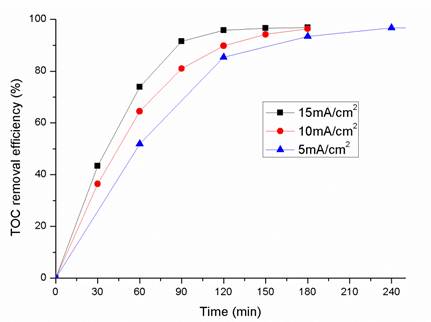
Figure 4. Influence of the current density on the TOC removal efficiency during degradation of 200mL artificial humidity condensate
One of the biggest problems of using electro-catalytic oxidation technology is the generation of large amount of hydrogen gas. When the space is filled with hydrogen, it will induce combustion, explosion or other safety hidden troubles, so hydrogen must be cleaned clearly in time. The generation of hydrogen under operating condition is listed in Table 2. 0.61 L hydrogen gas was generated after 2 hours' treatment in current density of 10mA/cm2 where the TOC removal efficiency reaches about 90%. In particular, no more than 1°ë of the volume is occupied in the confined space of 20m3, where 18L hydrogen will be produced in case that 6kg water will be treated every day. It demonstrates that the volume of generated hydrogen is small in comparison to the size of the confined space. It can be collected and removed easily by other purification means in the space.
Table 2 Hydrogen and total gas generation under different current density with treating 200mL artificial humidity condensate in 2 hours
Current density (mA/cm2) | Gas generation rate (mL/min) | Gas volume (L) | H2 Volume (L) |
5 | 4.3 | 0.51 | 0.34 |
10 | 7.7 | 0.92 | 0.61 |
15 | 12 | 1.44 | 0.96 |
The accelerated life test was carried out in 1mol/L sulfuric acid solution. The result shows that the working life of the BDD electrode can reach hundreds of hours, which indicates that the BDD electrode is stable and effective when long-term using. What's more, to ensure our daily water demand, we can use multiple sets of electrodes in combination in order to achieve the effective treatment in a short period of time. In conclusion, using the electro-catalytic oxidation technology to degrade artificial humidity condensate is an efficient and economic method.
References:
See more of this Group/Topical: Environmental Division