
 Google
 Yelp
 Facebook
 Twitter
 ChEnected
333654 Synthesis and Characterization of Thermo-Responsive Bioconjugates: Immobilized Enzyme for Galacto-Oligosaccharide Formation
Synthesis and characterization of thermo-responsive bioconjugates: immobilized enzyme for galacto-oligosaccharide formation
Tapas Palai1, Ashok Kumar2 and Prashant K. Bhattacharya1*
1 Department of Chemical Engineering, Indian Institute of Technology Kanpur, Kanpur-208016, India.
2
Department of Biological Sciences and
Bioengineering, Indian Institute of Technology Kanpur, Kanpur-208016, India.
* Corresponding author:
E-mail: pkbhatta@iitk.ac.in Tel.:
+91-512-2597093; Fax: +91-512-2590104
Abstract Thermo-responsive
polymers, also known as smart/intelligent/environmentally sensitive/and reversible
polymer, have received much attention in biotechnology, medicine and
engineering applications. With a change in temperature around its lower
critical solution temperature (LCST), the polymer undergoes a reversible phase
change form soluble to insoluble form or vice versa [1].
This property was considered in immobilizing enzymes on such reversible
polymers which are known as polymer-protein bioconjugate and the attachment of
enzymes may be via physical or chemical means. Further, such bioconjugates may
effectively carry out enzymatic reactions under immobilized states [2].
In order to test one such enzymatic reaction, the formation of
galacto-oligosaccharides from lactose [3]
was considered with β-galactosidase (EC 3.2.1.23; commercial name: Biolacta
FN5) on reversible polymer, poly-N-isopropylacrylamide (PNIPAAM). In the
present study, apart from PNIPAAM, a non-thermo-responsive polymer
poly-acrylamide (PAAM), was chosen as control polymer [4].
Experimental evidences too confirm the formations of PNIPAAM-β-galactosidase
bioconjugates, exhibiting thermo-responsive behavior, whereas PAAM-β-galactosidase
bioconjugates do not exhibit such thermo-response. Oligosaccharides and their
derivatives are important nutraceuticals and prebiotic food ingredient, having
a range of important functions in biological systems. The utility of
thermo-responsive bioconjugates help in carrying out the reaction under
homogeneous condition (below LCST) and effectively help in separating enzymes above
LCST.
The synthesis of bioconjugates
was carried out in three steps [4]
using commercial grade β-galactosidase from Bacillus circulans.
Firstly, acryl group was introduced to enzyme by treating with itaconic anhydride
in phosphate buffer (pH 6.0). Furthermore, unreacted itaconic anhydride was
removed by dialysis. The extent of enzyme modification was estimated by
2,4,6-trinitrobenzenesulphonic acid (TNBS) method [5].
Then, PNIPAAM and PAAM-β-galactosidase
bioconjugates were copolymerized from their respective monomers (N-isopropylacrylamide
(NIPAAM) and acrylamide (AAM)). The reaction was catalyzed and initiated with
N,N,N',N'-tetramethylethylenediamine (TEMED) and ammonium persulphate (APS),
respectively. Finally, the bioconjugates thus formed were separated from their respective
monomers by salt-induced thermal precipitation (for PNIPAAM) and dialysis (for
PAAM). The activities of native enzyme, PNIPAAM and PAAM bioconjugates were determined
using o-nitro-phenyl-β-D-galactopyranoside (ONPG) as substrate at
40oC and pH 6.0. [3].
Bioconjugation yield was estimated by measuring the amount of conjugated protein
using bicinchoninic acid method. The yield of PNIPAAM- β-galactosidase
bioconjugate was measured as 75% at an enzyme modification level of 50%. A
decreased LCST of 29.5oC, in comparison to 32.5oC for the
pure PNIPAAM polymer, was observed for PNIPAAM-enzyme bioconjugate. This decrease
may be due to the increase in hydrophobicity of the polymer during bioconjugation
with enzyme [4].
The catalytic activities
of PAAM, PNIPAAM-enzyme bioconjugates and native enzyme were measured at
varying temperature (20-80oC) and pH (4.0-6.0) using ONPG as
substrate. The activities of all the three preparations were observed to
increase with increasing temperature till 60oC and thereafter it a
decrease was observed only for PAAM-enzyme bioconjugate and native enzyme. On
the other hand, the activity of PNIPAAM-enzyme bioconjugate increased till 70oC
and thereafter it starts decreasing. Furthermore, it was observed that the
activities of both the PAAM, PNIPAAM bioconjugates were less sensitive to pH variation
than its native form. Thermal stability was also performed; in two different
ways. In the first case, enzyme solutions were incubated at different
temperature (20-80oC) for 15 min, followed by residual activity measurement.
PNIPAAM-enzyme bioconjugates retained ~100% activity at 50oC;
however, it is around 50% of initial activity at 80oC. On the other
hand, PAAM-enzyme retained ~60% and ~8% activity at 50oC and 80oC,
respectively; whereas, the native enzyme retained ~60% and 0% at 50oC
and 80oC, respectively. In the second case, the enzyme solutions
were heated continuously at 55oC for 90 min and residual activity
was measured at regular time intervals. The PNIPAAM-bioconjugate offered a maximum
resistance to thermal deactivation by keeping 67.5% of initial activity after
90 min of incubation as compared to PAAM-enzyme (24%) and native enzyme
(16.5%). Furthermore, study on operational stability showed the residual
activities of PNIPAAM-enzyme, PAAM-enzyme and native enzyme after 24 cycles
were 91%, 88.5% and 86%, respectively. The effect of organic solvents (ethylene
glycol and ethanol) on activity of PNIPAAM-bioconjugate was studied by keeping
it at varying concentrations of organic solvents (2-25% v/v) for 24 h at 30oC.
Residual activity was measured at a regular interval of time. It was observed
that the activity of PNIPAAM-bioconjugate got increased by 45% with 20% (v/v)
ethylene glycol; whereas, with ethanol, it showed negative trend.
The storage stability
was monitored by keeping the enzyme solution at 20oC for 30 days.
PNIPAAM-bioconjugate retained ~90% of its initial activity; whereas,
PAAM-bioconjugate retained ~80% till 30 days. The native enzyme however lost
its full activity within 20 days.
Further, Michaelis-Menten
constant (Km) and maximum reaction rate (Vm)
values were also estimated (from Lineweaver-Burk method) using ONPG as
substrate at 30oC. The values were found to be: Km
= 1.1 mM, Vm = 2.61 x 10⁻⁵ mM s-1.
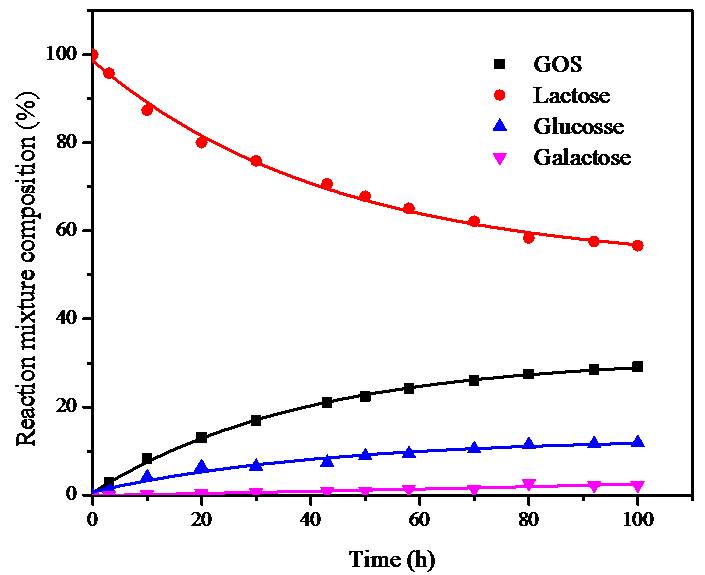
Fig. 1:
Time-course reaction mixture composition
Finally, the synthesis
of GOS from lactose was carried out with the application of PNIPAAM-β-galactosidase
bioconjugates. Utilizing such bioconjugates for the enzymatic formation of GOS,
thus considered the system would provide not only a homogeneous system also an
immobilized system too. Accordingly, the enzyme β-galactosidase converts lactose
via two simultaneous reactions; trans-galactosylation reaction, which produces
GOS and hydrolysis reaction, which forms glucose and galactose [2].
The reaction was carried out under simple batch mode at 30oC and pH
6.0 for 100 h. Samples were collected at a regular interval and analyzed
through high performance liquid chromatography (HPLC). A maximum of 29.5% GOS (dry
basis) with 44.0% of lactose conversion was obtained after 100 h reaction time
at 50 g/L initial lactose (Fig. 1). The equilibrium reaction mixture contained
7.0% tetra-saccharide, 22.5% tri-saccharide, 12.0% glucose, 2.5% galactose
along with 56.0% unreacted lactose.
Keywords: Bioconjugate,
Responsive polymer, enzyme immobilization, Galacto-oligosaccharide, Lactose
References: [1]
A. Kumar, A. Srivastava, I.Y. Galaev, B. Mattiasson, Smart polymers: Physical
forms and bioengineering applications, Progress in Polymer Science 32 (2007)
1205-1237. [2] T. Palai, P.K. Bhattacharya,
Kinetics of lactose conversion to galacto-oligosaccharides by
β-galactosidase immobilized on PVDF membrane, Journal of Bioscience and
Bioengineering 115 (2013) 668-673. [3] T. Palai, S. Mitra, P.K.
Bhattacharya, Kinetics and design relation for enzymatic conversion of lactose
into galacto-oligosaccharides using commercial grade β-galactosidase,
Journal of Bioscience and Bioengineering 114 (2012) 418-423. [4] A.K. Shakya, P. Sharma, A.
Kumar, Synthesis and characterization of thermo-responsive
poly(N-isopropylacrylamide)-bovine liver catalase bioconjugate, Enzyme and
Microbial Technology 47 (2010) 277-282. [5] L. Fischer, F. PeiBker, A
covalent two-step immobilization technique using itaconic anhydride, Applied
Microbiology and Biotechnology 49 (1998) 129-135.
See more of this Group/Topical: Food, Pharmaceutical & Bioengineering Division