
 Google
 Yelp
 Facebook
 Twitter
 ChEnected
333830 External Reset Feedback for Constrained Economic Process Operation
External Reset Feedback for Constrained Economic Process Operation
Rahul Jagtap1, Nitin Kaistha1 and William L Luyben2
1 Department of Chemical Engineering, Indian Institute of Technology Kanpur, Kanpur 208016, India
2 Department of Chemical Engineering, Lehigh University, Bethlehem PA 18015, USA
ABSTRACT:
Today's fierce competition for maximizing profit and strict environmental norms dictate plant operation at the optimum steady state, where typically multiple process constraints are active. This set of constraints changes depending upon the production objectives, which include the production rate (throughput) and the product grade. Override control schemes, where two or more controllers compete through a low/high select for the manipulation of a control input, are conventionally employed to manage the switching between the constraints.
Generally the competing controllers in an override scheme have integral action which results in reset windup in the unselected controllers causing large swings (bumps) in controller output as control is transferred from one controller to another. To avoid the large swings, the use of “external reset feedback” was proposed by Shinskey/Buckley1,2 for smooth (bumpless) switching between active constraints over 45 years ago. Even as the concept has existed for over four decades, there are surprisingly very few quantitative studies in the open literature on the dynamic control and consequent economic benefits of external reset feedback as applied to typical constraint scenarios in continuous chemical processes. Commercial dynamic process simulators such as Aspen / Hysys also do not provide external reset feedback controllers.
The objective of this work is to quantitatively demonstrate the significant improvement in dynamic control and consequent process economic performance (compared to internal reset)with the help of three process case studies of increasing complexity. In the process we also illustrate how to implement external reset feedback in Aspen dynamics, a popular commercial simulator.
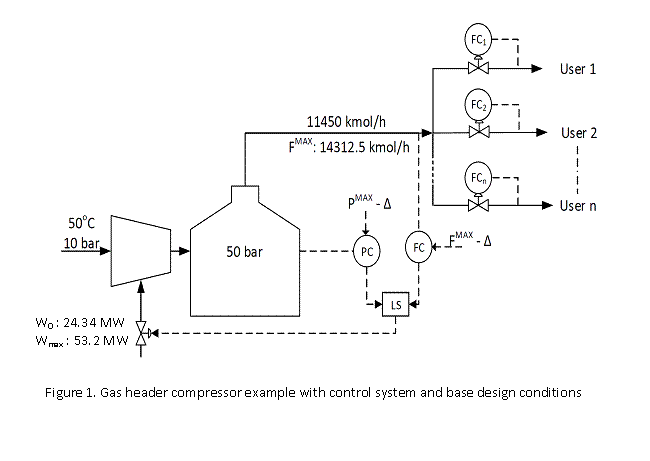
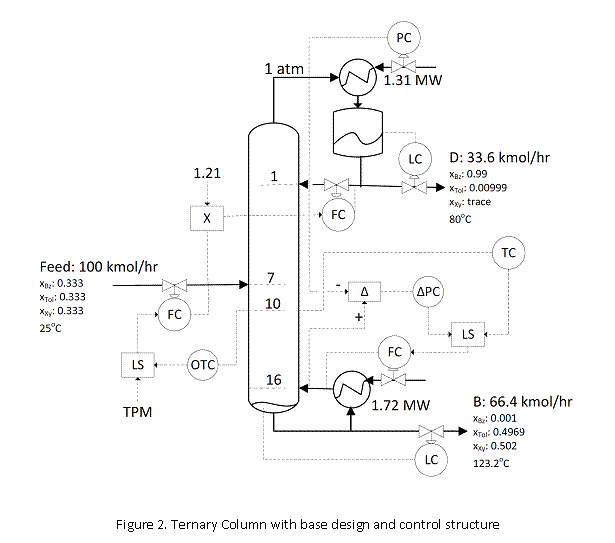
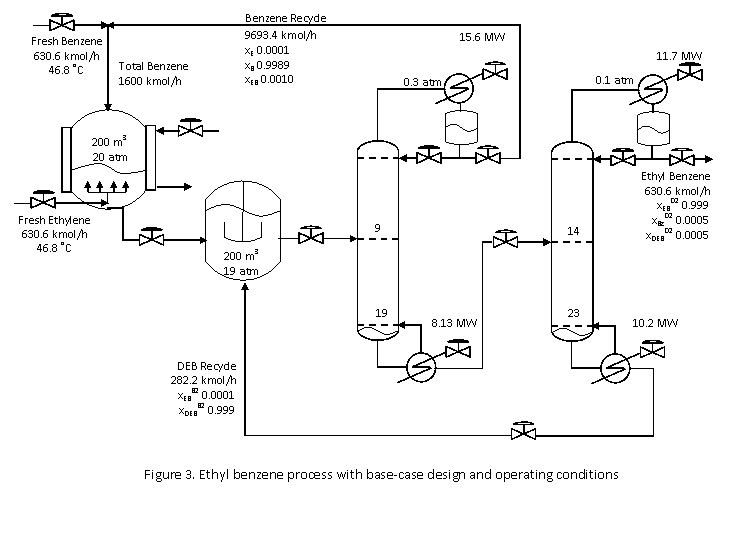
The first case study investigates a compressor gas-header (Figure 1) supplying pressurized gas to multiple downstream users. At low downstream demand, the compressor work is manipulated for maintaining the gas-header at maximum pressure. As downstream demand exceeds the maximum permissible flow without damaging the compressor drive, the manipulation of the compressor work is taken over by a maximum flow controller. The second example is a ternary distillation column(Figure 2) separating a benzene-toluene-xylene mixture with column flooding hard constraining the maximum achievable throughput. In the last case study, the override control scheme on a complete ethyl benzene process (Figure 3) is evaluated for maximum throughput operation with flooding in the first (recycle) column acting as the bottleneck constraint.
Rigorous dynamic simulations in Aspen plus are used to compare the dynamic control and economic benefit of external reset feedback over conventional internal reset feedback in override control structures. Results show that the overall transient response is significantly smoother, which allows process operation to be driven closer to hard process constraints. This usually leads to one or more economic benefits in terms of significantly higher maximum achievable throughput, improved energy efficiency and tighter product quality control. Override controllers have a wide area of application since the optimum operation of most processes involves operating at constraints. External reset controllers should therefore be of considerable industrial and academic importance.
References:
1. Shinskey FG. Process Control Systems. New York: McGraw-Hill, 1967.
2. Buckley PS, Luyben WL, Shunta JP. Design of Distillation Control Systems. Instrument Society of America, 1985.
See more of this Group/Topical: Computing and Systems Technology Division