
 Google
 Yelp
 Facebook
 Twitter
 ChEnected
333904 Implementation of Optimal Experimental Design in Chemical-Looping Experimentation
Implementation of Optimal Experimental Design in chemical-looping experimentation
Lu Han, Zhiquan Zhou, George M. Bollas
Department of Chemical & Biomolecular Engineering, University of Connecticut, Storrs, CT
Abstract
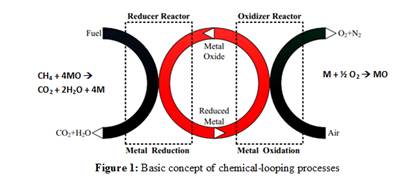
Chemical-looping combustion (CLC) has been identified as a novel process for power production using fossil fuels with low energy penalty and inherent CO2 separation. The air and fuel are un-mixed with a solid oxygen carrier in the form of a metallic oxide transporting the oxygen from the air to the fuel. The concept behind CLC is shown in Figure 1, as the CLC is usually implemented as two interconnected fluidized bed reactors. In the Reducer, fuel is oxidized by the metal oxide into combustion products (CO2, H2O) and upon condensation of the water vapor, a pure stream of CO2 is ready for sequestration without any separation step or significant energy penalties. The spent oxygen carrier is transported to the Oxidizer to be re-oxidized in air, with the effluents (N2, some O2) vented to the atmosphere. The oxygen carrier is returned to the Reducer to continue the looping scheme.
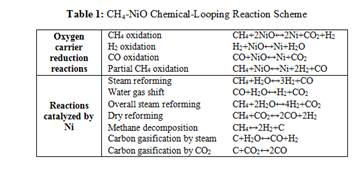
Research in CLC has largely focused on developing oxygen carriers that are highly reactive with fuel and oxygen and are resistant to mechanical and thermal degradation in the aggressive CLC environment. Supported NiO-based oxygen carriers have shown high promise due their high reactivity in combustion of methane and high melting point that allows for high working temperatures. Understanding of the kinetics of the reduction and oxidations reactions is essential for the design of CLC systems. Table 1 outlines the main NiO reduction reactions with CH4 and Ni-catalyzed reactions [1]. The gas-solid reaction rates can be interpreted using different models, such as volumetric, shrinking core, changing grain size, and nucleation models. However the majority of reactivity data found in literature are carried out at specific temperatures and gas concentrations so a limited amount of information can be applied to other experiments [2].
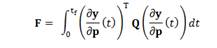
In this work, a model-guided experimentation approach is proposed as an effort to explore the kinetics under different operating conditions of temperature, solid inventory, and gas concentration. The novelty of this approach is to design optimal experiments through dynamic optimization of a set of time-varying control variables that maximize the information content contained with the experimental data. The cost function reflecting the statistical quality of the parameters is,
where
F is the corresponding Fischer information matrix reflecting the
sensitivity matrix of the model outputs (y) with respect to the
parameters (p) and Q is the inverse of the measurement error
covariance matrix.
The objective function is written as: 
Subject to: f[x,y,p,u,t] = 0, x(t0) = x0
h[x,y,p,u,t] = 0
g[x,y,p,u,t] ≤ 0, xL ≤ x ≤ xU, uL ≤ u ≤ uU
where F is the performance index, x is the vector of state variables, u the vector of manipulated variables, f is the system of ordinary differential equations, h and g are equality and inequality algebraic constraints, and U and L are the upper and lower bounds for x and u.
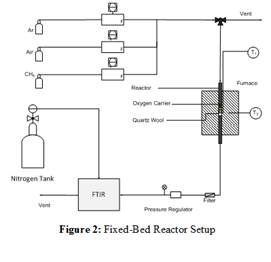
Results of the optimal experimental design (OED) algorithm will be verified by experiments in a fixed-bed reactor unit, illustrated in Figure 2. The fixed-bed reactor is an Inconel tube (10 mm diameter and 250 mm length) housed inside in an electrical furnace. The gas flows (Ar, CH4, air) are manipulated with mass flow controllers and the pressure is regulated by a back pressure valve. The CLC products are continuously detected by a mass-spectrometer downstream of the reactor. At the start of the experiment, Ar flows through the reactor while the furnace reaches setpoint. To initiate reduction, the four-port valve is switched to a mixture of Ar and CH4. After the reduction completes, Ar is used to purge the reactor. The purge is followed by an oxidation period, and the valve is switched allowing air to proceed to the reactor. In this configuration, over 20 cycles are typically conducted to analyze the stability of the oxygen carrier.
This presentation will showcase the advantages of utilizing a dynamic model to design experiments that will ultimately lead to reliable kinetic parameters. A step-wise approach to experimental design will be taken where one experimental variable will be varied at a time. The outcome of the optimal experimental design will be analyzed based on the impact to the reaction kinetics, carrier utilization, and diffusion limitations. Experimental observations of the optimal and non-optimal cases will be shown, highlighting on the improvement to the statistical quality of the fitted kinetic parameters. Lastly, the kinetic parameters derived from the optimal experiment will used to predict experiments at a wide range of conditions and the deviations will be addressed.
Acknowledgement: This material is based upon work supported by the National Science Foundation under Grant No. 1054718.
References
[1] Zhou Z, Bollas GM. Holistic Kinetic Study of the Reduction of CH4 with NiO in Chemical-Looping Combustion. AIChE annual meeting, Pittsburg, PA. 2012.
[2] Dueso, C., Ortiz, M., Abad, A., García-Labiano, F., de Diego, LF., Gayán, P., Adánez, J. Reduction and oxidation kinetics of nickel-based oxygen-carriers for chemical-looping combustion and chemical-looping reforming, Chemical Engineering Journal, 2012, 188 (15), 142-154.
See more of this Group/Topical: Catalysis and Reaction Engineering Division