
 Google
 Yelp
 Facebook
 Twitter
 ChEnected
334073 Acetic Acid Esterification Kinetics With Methanol Catalyzed By Lewatit K1221
Acetic acid esterification kinetics with methanol catalyzed by Lewatit K1221
The reaction kinetics of the liquid-phase esterification of acetic acid with methanol to methyl acetate and water have been investigated using the acidic ion-exchange resin Lewatit K1221 as catalyst. Ion exchange resins are gaining popularity as catalyst for esterification as they are ecofriendly, noncorrosive, heterogeneous and have a good stability and reusability. This polysterene-based resin is crosslinked by divinylbenzene bridges. Due to this particular structure, the resin exhibits a remarkable swelling phenomenon when contacted with polar solvents, such as water and methanol. The effects of the resin swelling, the initial reactant molar ratio (1:1 – 10:1) and the temperature (303.15 – 333.15 K) on the reaction kinetics were investigated. Rival kinetic models accounting for the underlying phenomena with different degrees of detail, such as a pseudo-homogeneous model (PH), adsorption based models c.q. Eley-Rideal (ER) and Langmuir-Hinshelwood (LH) and an exchange based model, were used to describe the reaction rate.
The exchange based kinetic model, see Figure 1, accounting for all chemical elementary steps as well as for solvent sorption and, hence, the resin's swelling , was found to best describe the observed kinetics. According to the this model (1) all active sites are occupied by methanol in protonated form, (2) acetic acid undergoes a proton exchange with the protonated methanol and (3) the esterification occurs through an Eley-Rideal mechanism with the surface reaction of protonated acetic acid with methanol from the bulk as the rate-determining step. The activation energy was determined at 45 kJ mol-1. While methyl acetate is only very weakly bonded to the resin's acid sites, the ion-exchange equilibrium coefficients for acetic acid and water respectively amount to 4.8 and 6.8, as could be expected based on their polarity.
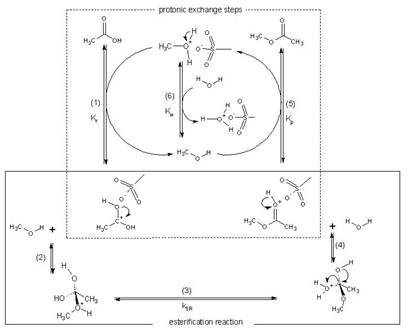
Figure 1: Heterogeneous acid ion-exchange resin catalyzed reaction mechanism for the esterification of acetic acid and methanol.
See more of this Group/Topical: Catalysis and Reaction Engineering Division