
 Google
 Yelp
 Facebook
 Twitter
 ChEnected
334098 High Throughput Solvent Screening for Ethylcellulose Barrier Membranes in Pharmaceutical Applications
Cody A. Schoener, Jaime Curtis-Fisk, True L. Rogers
Dow Pharma and Food Solutions, The Dow Chemical Company, Midland, MI, USA
Purpose: Solvent is a process variable that can influence barrier membranes composed of ethylcellulose for modified-release pharmaceutical applications. Due to a wide variety of solvents used in barrier membrane coating, high throughput research (HTR) can be utilized to quickly screen and identify successful or unsuccessful solvent systems. Therefore, HTR screening was used to explore a variety of solvent systems wherein a subset of those solvent systems were used for rheological, mechanical, and performance testing of ethylcellulose barrier membranes.
Methods: HTR robots were used to prepare 31 formulations in a Design of Experiments approach. The solvent systems were composed of ethanol, isopropanol, methanol, acetone, and/or water in which 10 wt% of ethylcellulose 10 cps (ETHOCELTM Std 10 Premium, Dow Chemical) was dissolved by shaking overnight. Phase Identification and Characterization Analysis HTR instrumentation was used to image and analyze clarity of the solutions. A subset of these samples was selected that represented the range of clarity observed for Dynamic Light Scattering (DLS) analysis. From this set, samples that exhibited unique light scattering characteristics were subjected to rheological measurements, tensile tests, water permeation, and drug transport studies.
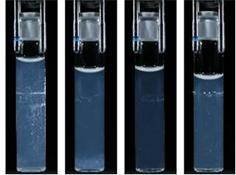
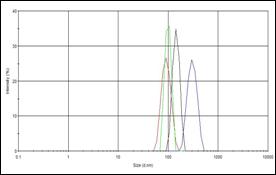
Results: Using HTR, the 31 formulations (solvent + ethylcellulose) were developed and imaged to determine their clarity. Samples ranged from nearly translucent to hazy, and in some cases the ethylcellulose remained un-dissolved (Figure 1). 10 samples ranging from translucent to hazy were further tested with DLS. DLS enabled characterization of monomodal and bimodal distributions of ethylcellulose conformation and reduced the DLS subset to 4 samples for further investigation (Figure 1). The pre-screening HTR methods resulted in formulations exhibiting unique properties, and allowed us to focus on four formulations for film tensile and permeation testing. Further results will be presented demonstrating how altering solvent combinations alter final modified-release performance.
Conclusion: This research will demonstrate relationships between solvent selection and modified release performance, and results can help pharmaceutical formulators identify harmful or advantageous formulation parameters. Furthermore, HTR reduces research time significantly, whether it is used to explore unique polymer/active pharmaceutical ingredient interactions or to optimize barrier membrane formulations.

See more of this Group/Topical: Food, Pharmaceutical & Bioengineering Division