
 Google
 Yelp
 Facebook
 Twitter
 ChEnected
334152 Ionic Liquid Mediated Electrochemical Reduction of CO2 in a Microbial Electrolysis Cell
Ionic liquid, 1-ethyl-3-methylimidazolium tetrafluoroborate (EMIM-BF4) has been proved to be a promising catalyst for CO2 electrochemical reduction with a silver nanoparticle deposited electrode ADDIN EN.CITE <EndNote><Cite><Author>Rosen</Author><Year>2011</Year><RecNum>30</RecNum><DisplayText>[1]</DisplayText><record><rec-number>30</rec-number><foreign-keys><key app="EN" db-id="95dffxdd1zszaqeve5aprzxndxp0zr52awzv">30</key></foreign-keys><ref-type name="Journal Article">17</ref-type><contributors><authors><author>Rosen, Brian A.</author><author>Salehi-Khojin, Amin</author><author>Thorson, Michael R.</author><author>Zhu, Wei</author><author>Whipple, Devin T.</author><author>Kenis, Paul J. A.</author><author>Masel, Richard I.</author></authors></contributors><titles><title>Ionic Liquid-Mediated Selective Conversion of CO2 to CO at Low Overpotentials</title><secondary-title>Science</secondary-title></titles><periodical><full-title>Science</full-title></periodical><pages>643-644</pages><volume>334</volume><number>6056</number><dates><year>2011</year><pub-dates><date>Nov 4</date></pub-dates></dates><isbn>0036-8075</isbn><accession-num>WOS:000296494700047</accession-num><urls><related-urls><url><Go to ISI>://WOS:000296494700047</url><url>http://www.sciencemag.org/content/334/6056/643.full.pdf</url></related-urls></urls><electronic-resource-num>10.1126/science.1209786</electronic-resource-num></record></Cite></EndNote>[1]. As Brian et. al., reported, by applying 1.5 V cell voltage, efficient CO2 reduction to CO can be achieved in a two-chamber electrolysis cell with EMIM-BF4 as the electrolyte ADDIN EN.CITE <EndNote><Cite><Author>Rosen</Author><Year>2012</Year><RecNum>29</RecNum><DisplayText>[2]</DisplayText><record><rec-number>29</rec-number><foreign-keys><key app="EN" db-id="95dffxdd1zszaqeve5aprzxndxp0zr52awzv">29</key></foreign-keys><ref-type name="Journal Article">17</ref-type><contributors><authors><author>Rosen, Brian A.</author><author>Haan, John L.</author><author>Mukherjee, Prabuddha</author><author>Braunschweig, Bjoern</author><author>Zhu, Wei</author><author>Salehi-Khojin, Amin</author><author>Dlott, Dana D.</author><author>Masel, Richard I.</author></authors></contributors><titles><title>In Situ Spectroscopic Examination of a Low Overpotential Pathway for Carbon Dioxide Conversion to Carbon Monoxide</title><secondary-title>Journal of Physical Chemistry C</secondary-title></titles><periodical><full-title>Journal of Physical Chemistry C</full-title></periodical><pages>15307-15312</pages><volume>116</volume><number>29</number><dates><year>2012</year><pub-dates><date>Jul 26</date></pub-dates></dates><isbn>1932-7447</isbn><accession-num>WOS:000306725200014</accession-num><urls><related-urls><url><Go to ISI>://WOS:000306725200014</url><url>http://pubs.acs.org/doi/abs/10.1021/jp210542v</url></related-urls></urls><electronic-resource-num>10.1021/jp210542v</electronic-resource-num></record></Cite></EndNote>[2]. Here, in this work, we tried to evolve the electrolysis cell to a microbial electrolysis cell to decrease the cell voltage employed for CO2 reduction process. Microbial electrolysis cell (MEC) is a type of bioelectrochemical system, in which oxidation reaction is catalyzed by electrochemical active bacteria with the solid anode as the electron acceptor in anode chamber and then the electrons pass through the out circuit power supply to cathode. Finally, the electrons drive the reduction reaction in cathode chamber. With the help of electrochemically active bacteria, the active energy for anodic oxidation reaction can be significantly reduced and thus results in a more negative anode potential. Because the cathodic reduction reaction has a lower redox potential than anodic oxidation reaction in MEC, more negative anode potential can decrease the cell potential that needed for driving the cathodic reduction reaction. Based on this principle, a typical electrochemically active bacteria shewanella oneidensis MR-1 was grown in the anode chamber using a carbon cloth electrode. 100 ml 18 mol% EMIM-BF4 was filled into the cathode chamber and the headspace is 20 ml. The cathode is silver nanoparticle deposited graphite block electrode. After sparging CO2 overnight, different levels of cell voltage were applied and the gas composition in the headspace was analyzed by GC. To evaluate the effect of different electrode potential on CO2 reduction, the two chamber reactor was firstly operated in abiotic three-electrode system for 12 hours. The counter electrode was a carbon cloth electrode and a Ag/AgCl reference electrode was placed in the anode chamber. The potential of the working electrode (a silver nanoparticle deposited graphite block electrode) was controlled at a range from 0 to -0.8 V (vs. Ag/AgCl ) by a potentiostat. As shown in figure 1, when the working electrode potential was controlled at -0.4 V, the CO production rate was the highest. After 12 hours operation, the accumulated CO concentration was around 0.0035%. Surprisingly, decreasing the potential to a more negative level did not enhance the CO production but methane production was trigged. The methane production rate reached the maximal level at -0.5 V. Further decreasing the working electrode potential to -0.8 V decreases the methane production rate dramatically. As an alternative reduction reaction in cathode chamber, hydrogen evolution reaction became the predominant reaction at a potential more negative than -0.7 V (Fig. 2). These results are different from Brian et. al. reported. In their case, no methane production was detected in the gas phase and hydrogen production could be inhibited. The possible reason is our reactors were operated in batch mode for more than 12 hours for each test. During the long term operation, the pH, water content and other conditions might be varied. For example, the pH decreased from 5.69 to lower than 2.5 in 12 hours operation. These changes leads to methane and hydrogen production at different potential levels. Besides operating the reactor in the three electrode mode, the same experiments were conducted in a MEC mode. The anode potential during all the MEC tests was around -0.3 V and all experiments were operated for 24 hours. The cell voltage was varied from 0 to -0.5 V. In MEC mode tests, CO, methane, and hydrogen production rates follow a similar trend as that in three electrode mode. Especially for methane production, the final concentration in the gas phase in headspace was almost 100 times higher than that in the three electrode mode (Fig. 3). This is due to higher current density in MEC mode than in abiotic three electrode system with the help of electrochemically active bacteria catalyst. Also this high methane production rate indicated that methane production can be an important CO2 reduction pathway besides CO2 to CO reduction mechanism. Based on all these results, integrating ionic liquid mediated CO2 electrochemical reduction with MEC can be a promising technology for CO2 utilization and fixation.
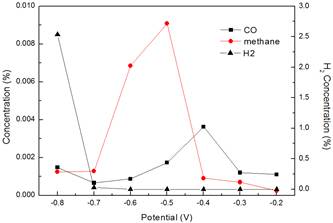
Figure 1. CO, methane and H2 production in the three electrode system
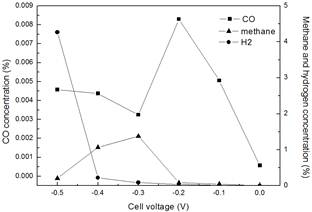
Figure 2. CO, methane and H2 production in MEC
References
ADDIN EN.REFLIST [1] B.A. Rosen, A. Salehi-Khojin, M.R. Thorson, W. Zhu, D.T. Whipple, P.J.A. Kenis, R.I. Masel, Science 334 (2011) 643.
See more of this Group/Topical: Environmental Division