
 Google
 Yelp
 Facebook
 Twitter
 ChEnected
334411 Photocatalytic Enhancement of Titania Via Deposition of Metal Nanoparticles
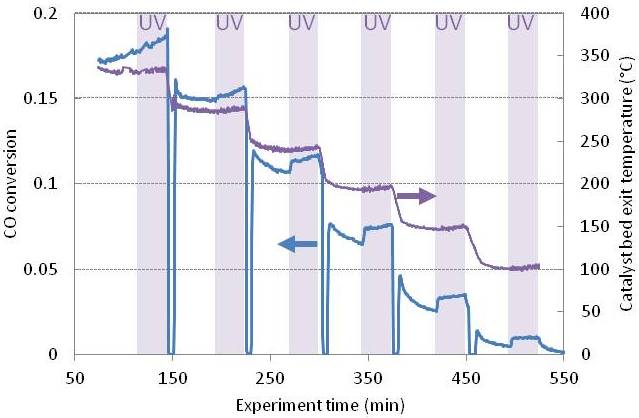
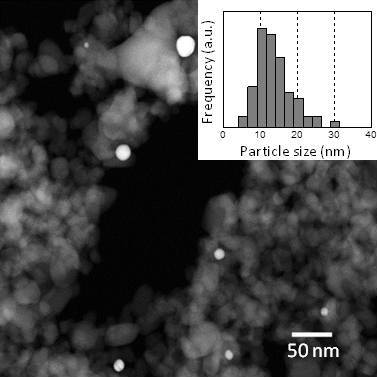
Due to concerns about sustainable energy use, photocatalysis has attracted increased research interest in recent years. In principle, photocatalysis can offset some of the demand on fossil fuels compared to conventional catalysis by using solar energy to provide the activation energy for catalysts. Major efficiency improvements are still needed, however, before photocatalysis becomes a practically and economically viable technology. Much current research focuses on increasing the photo-efficiency of semiconductors by either decreasing their band gaps or by decreasing exciton recombination rates. Our group has previously shown for the first time that photoactivity persists and even increases at higher temperatures (i.e., above 100°C). This work shows that the photoactivity can be further enhanced in the range of 100-300°C via the deposition of metal nanoparticles such as Au and Ag on the surface of TiO2. It is proposed that the mechanism of enhancement is the migration of photo-generated electrons to the unfilled bands of deposited metal particles, which reduces the electron-hole recombination rate. Catalysts are characterized via HAADF STEM and DRIFTS, and their photoactivity is evaluated by CO oxidation in a novel quartz-cell plate reactor. Results for these materials show that during UV illumination, CO oxidation activity is higher for TiO2 with deposited metal particles than at the same temperature without UV, and at the same temperature for bare TiO2, with a maximum photocatalytic enhancement observed around 190°C. The effect of metal loading and type on the enhancement is also investigated. Preliminary results for (Ag,Au)@TiO2 with core-shell structure will be shown.
See more of this Group/Topical: Catalysis and Reaction Engineering Division