
 Google
 Yelp
 Facebook
 Twitter
 ChEnected
334491 Advanced Kinetic Monte Carlo Optimization of the Synthesis of Well-Defined (co)Polymers Via Atom Transfer Radical and Nitroxide Mediated Polymerization
In the last two decades, the kinetic Monte Carlo (kMC) technique has emerged as a powerful tool for the simulation and optimization of polymerization processes.1-5 Benefiting from its natural sampling of reaction events, the polymeric microstructure can be simulated in molecular detail. Not only the chain length of the different macrospecies can be predicted but other important characteristics such as their topology, overall comonomer content and incorporated functionalities can be described too. Moreover, the recent evolution of advanced computer technologies has further increased the potential of the kMC technique by opening up the possibility to track the evolution of the complete polymeric microstructure during the polymerization.
Based on the work of Szymanski5 on living polymerization and the work of Wang and Broadbelt3,4 on nitroxide mediated polymerization (NMP), we have developed a general kMC methodology allowing to track the history of sampled reaction events for a representative group of macromolecules. For example, tracking kMC propagation events yields the monomer sequences of every macromolecule in this group throughout the polymerization process.6,7 Such detailed information enables the calculation of new molecular properties e.g. macromolecular deviations from ideal targeted monomer sequences. In particular, for copolymers gradient (<GD>) and block deviation (<BD>) criteria were introduced to characterize, respectively, their linear gradient en diblock quality using atom transfer radical polymerization (ATRP) as polymerization technique. The main merit of the kMC methodology is its objective evaluation of the structural properties of synthesized microstructures, paving the way to unambiguously rank different copolymer products according to their quality. The latter is a challenging task in view of experimental difficulties encountered in the characterization of the polymeric microstructure in molecular detail.8
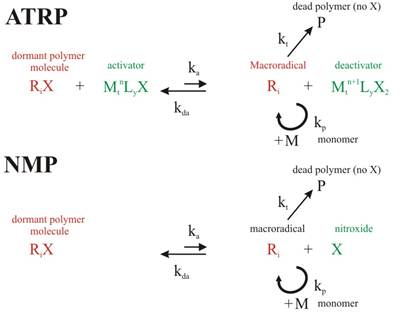
Scheme 1: Main reactions in (a) atom transfer radical polymerization (ATRP) (b) nitroxide mediated polymerization (NMP); R0X (i=0): ATRP/NMP initiator (halogenide/alkoxyamine); i: chain length; MtLyX: ATRP catalyst in low oxidation state (activator); Mt: transition metal; L: ligand; X: halogen atom/nitroxide: end-group functionality (EGF); P: dead polymer; RiX (i>0): dormant polymer molecule; ideally no P formed and all dormant polymer molecules possess equal chain length.
The main reactions occurring in ATRP and NMP, two important controlled radical polymerization (CRP) techniques, are depicted in Scheme 1. Initiator radicals (R0; i=0) are generated from ATRP/NMP initiator molecules (R0X). In ATRP, this activation requires the presence of an ATRP catalyst (MtLyX; activator) as mediating agent whereas in NMP a sufficiently high polymerization temperature is used to create the mediating nitroxide (X) by cleavage of the labile C-ON bond of an alkoxyamine initiator. The formed R0 species ideally take up only a few monomer units before they are temporarily deactivated to a dormant form (RiX) thereby introducing end-group functionality (EGF; X) in the polymeric species. For high deactivation rates, a low radical concentration is established ensuring a high livingness, i.e. the formation of dead polymer molecules with concomitant loss of EGF is reduced. Also, for fast ATRP/NMP initiation, dormant species with almost uniform chain length can be obtained at sufficiently high conversion, i.e. tailored polymer molecules both with respect to livingness and chain length result for CRPs after careful selection of the polymerization conditions and mediating agent.
Figure 1 illustrates the added value of the <GD> calculation in CRP processes. For the batch ATRP of methyl methacrylate (MMA) and n-butyl acrylate (nBuA), of MMA and styrene (STY) and of STY and nBuA, it has been shown that the <GD> at complete monomer consumption correlates with the dispersity (also known as polydispersity index).9 For the three copolymerizations studied, the <GD>decreases for decreasing dispersity indicating that a good control over chain length is needed for optimal gradient polymer synthesis. The highest linear gradient quality is obtained for MMA/nBuA, as can be expected based on the inherent preference of the secondary “nBuA radicals” to propagate with MMA with formation of tertiary “MMA radicals”. Additionally, a fed-batch approach allows to improve the linear gradient quality in agreement with earlier deterministic simulations10 at the expense of polymerization rate. Hence, the optimal addition profile can be predicted by means of kMC simulations, taking into account practical limitations.
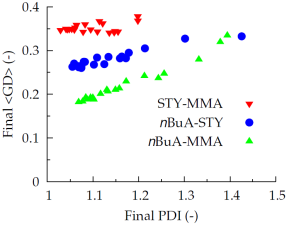
Figure 1: Correlation between linear gradient quality (expressed via <GD>) and dispersity at complete monomer consumption for the batch ATRP of different comonomer pairs A/B; common polymerization conditions: [A+B]0:[R0X]0:[C]0 = 100:1:1 with C the ATRP catalyst (only low oxidation state); [A]0=[B]0; perfect linear gradient for <GD> of 0; homopolymer: maximal <GD> of 1.10
In the present contribution it will be shown that the kMC methodology can also be used to identify ATRP/NMP conditions that allow to achieve a maximal control over chain length and EGF for the synthesis of well-defined poly(STY-b-acrylate) block copolymers taking into account constraints with respect to the maximal overall polymerization time and desired number average chain length (50-1000). For the copolymerization, a distinction is made between “one-pot” and “two-pot” approaches. In the “two-pot” approach, the first block is, after purification, used as macro-initiator for the synthesis of the second block. In the “one-pot” approach, the second monomer is added at high conversion of the first monomer and no extra purification step is performed. Hence, once the second monomer is added, both monomers can be incorporated in the macrospecies resulting in a block-like copolymer. To evaluate the effect of diffusional limitations on reaction steps with a high intrinsic reactivity, the concept of apparent rate coefficients11 is applied.
For the ATRP process, focus is on the use of low catalyst amounts starting from the oxygen-stable deactivator in the presence of conventional radical initiator. It has been shown that a lower <BD> can be obtained with a “two-pot” approach under otherwise similar conditions and that an optimal polymerization temperature exists for each block.6 For the NMP process, commercially available alkoxyamine initiators are considered. Arrhenius parameters for nitroxide related reaction steps are determined from an extensive set of experimental data for NMP of both the first (poly(STY)) and the second block (poly(nBuA)). In the kMC model, a detailed reaction scheme including thermal12 self-initiation of styrene and backbiting of acrylate14-16 radicals is implemented to maximize the application field of the developed kMC model. It is illustrated that the alkoxyamine MAMA-SG1 (also known as BlockbuilderTM) allows the production of well-tailored poly(STY-b-nBuA) block copolymers in case an appropriate temperature profile is applied for both the “one-pot” and “two-pot” approach.
See more of this Group/Topical: Materials Engineering and Sciences Division