
 Google
 Yelp
 Facebook
 Twitter
 ChEnected
334715 Flow Regimes and Particle Residence Time Distribution in Horizontal and Vertical Gas-Liquid-Solid Slurry Taylor Flow
In multiphase micro-reaction technology the solid catalyst is usually immobilized on the reactor walls, which not only leads to rather small catalyst amounts per unit volume but more seriously impinges on its flexibility. The catalyst removal in case of deactivation or change of operation is difficult, even impossible without damage to the reactor wall. Furthermore the coating process itself is specific for each catalyst and requires therefore additional development time.
A new approach to join beneficial properties of Taylor-flow with the operational flexibility of conventional slurry reactors is the slurry-Taylor flow where catalyst particles are suspended and kept in motion by the internal circulations in the liquid slugs.
The concept of a three phase slurry micro-reactor was first applied by Enache et al. [1] for gas-liquid-solid vertical flow. In contrast to other recent studies [2, 3, 4] on liquid-liquid horizontal flow where solid particles are placed in the dispersed liquid phase, we investigate gas-liquid horizontal and vertical flow with the solid localised (in general) in the continuous phase.
We were able to show that the performance of this new contact mode is comparable to a laboratory stirred tank vessel under semi-batch conditions [5] and we concentrate now on hydrodynamics and mass-transfer properties.
Here we present the different flow regimes obtained in horizontal and vertical flow, discuss the involved forces and introduce our method to study the residence time distribution of solid particles.
We identified different flow regimes by varying the fluids flow rates, solid charge and flow direction. An interesting distinction exists between both horizontal and vertical flow: while in horizontal flow a certain total velocity is necessary to pass from particles circulating only in the lower recirculation loop to a complete homogeneous distribution over the entire slug height; in vertical flow, for the lowest studied velocities, particles are already homogeneously distributed but for higher flow rates the distribution pattern becomes rather heterogeneous, with particles localised mostly in the centre of the slug (figure 1).
SHAPE \* MERGEFORMAT
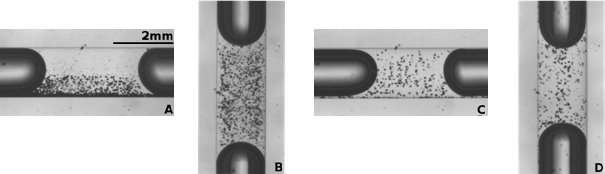
Figure 1) Examples for some typical flow patterns for horizontal (A, C) and vertical (B, D) flow. Materials : gas phase: N2, liquid phase : EtOH, solid phase: SiO2, 40-76 µm, impregnated with NiO2, solid charge 5g/L (C, D) and 10 g/L (A,B). PFA tube, dtube=1.65mm. Total velocity 47 mm/s (A, B) and 150 mm/s (C, D).
In horizontal flow a certain amount of particles remains usually in the liquid film. We therefore search to quantify the amount of particles trapped in the liquid film and investigate the residence time distribution of the solid phase. The main challenge thereby is to handle the tracer injection without disturbing or altering the Taylor-flow. A possible solution is the use of photoactivatable push-pull chromophores. In our approach, a nonfluorescent, blue-shifted azide-π-acceptor fluorogen precursor is photoconverted to a fluorescent, redshifted amine-π-acceptor fluorophore. In this way, functionalised silica particles can be activated using pulsed UV-light and imaged using visible light. A tracer injection is thus not necessary and the stimulus signal can be controlled by the activating tracer impulse.
REFERENCES
[1] D.I. Enache, G.J. Hutchings, S.H. Taylor, R.Natividad, S.Raymahasay, J.M. Winterbottom, E.H. Stitt, Experimental evaluation of a three-phase downflow capillary reactor, Ind. Eng. Chem. Res. 44 (2005) 6295-6303.
[2] A. Ufer, D. Sudhoff, A. Mescher, D. W. Agar, Suspension catalysts in a liquid-liquid capillary microreactor, Chem. Eng. J. 167 (2011) 468-474.
[3] K. Olivon, F. Sarrazin, Heterogeneous reaction with solid catalyst in droplet-flow millifluidic device, Chem. Eng. J. in press, corrected proof.
[4] G. K. Kurup, A. S. Basu, Field-free particle focusing in microfluidic plugs, Biomicrofluidics 6 (2012) 22008-2200810.
5] A.-K. Liedtke, F. Bornette, R. Philippe, C. de Bellefon, Gas–liquid–solid ‘‘slurry Taylor'' flow: Experimental evaluation through the catalytic hydrogenation of 3-methyl-1-pentyn-3-ol, Chem. Eng. J. in press, corrected proof.
[6] F. M. Raymo, Photoactivatable Synthetic Dyes for Fluorescence Imaging at the Nanoscale, J. Phys. Chem. Lett. 2012, 3, 2379-2385.
See more of this Group/Topical: Catalysis and Reaction Engineering Division