
 Google
 Yelp
 Facebook
 Twitter
 ChEnected
334882 Challenges in the Operation of a Fluidized Bed Reactor for Biomass Pyrolysis
Challenges in the Operation of a Fluidized Bed Reactor for Biomass Pyrolysis
Shoucheng Du, George M. Bollas,
Department of Chemical and Biomolecular Engineering, University of Connecticut, Storrs, CT
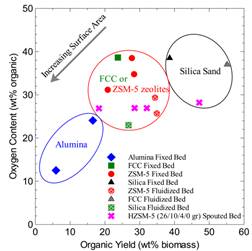
Although micro-pyroprobe reactors have been widely used in studying fast (catalytic) pyrolysis of biomass due to their easiness in operation[1¨C4], they cannot be economically scaled up [5], to satisfy industrial needs. On the contrary, fluidized bed reactors have been extensively utilized in chemical processes across industry due to their scalability, excellent mass and heat transfer properties, good mixing between the solids and the suspending fluid, uniform catalyst distribution, and so forth. Furthermore, as shown in Figure 1, by comparing catalytic pyrolysis using ZSM-5 catalyst in fixed bed reactor and that in fluidized bed reactor, it can be found that improvement of the bio-oil quality of up to 10 wt% in oxygen content can be achieved by exploiting short-contact-time fluidization technologies, such as riser reactors and spouted bed reactors. Therefore, it is beneficial to study biomass pyrolysis in fluidized bed reactors and focus on reflecting more realistic bench scale simulations of an industrially relevant process and improving bio-oil quality.
| |||
Figure 1 Comparison of Bio-oil qualities between different catalysts and different reactor designs (fixed bed vs fluidized bed) |
As one kind of the fluidized bed reactors, spouted-bed reactors are ideal for the characteristics of biomass: they can handle large particle size distributions, larger particles, differences in particle densities, and provide excellent mixing [6]. Moreover, spouted beds can decouple residence times of gas and solids; thus, reducing unwanted secondary biomass reactions [7]. Considering the above advantages, a bench-scale conical spouted-bed biomass catalytic reactor, shown in Figure 2, has been designed, considering different particle properties, geometric factors and important hydrodynamic parameters [8]. Further initial tests with the spouted bed reactor have also been performed.
| |||
Figure 2 Schematic of the existing spouted bed reactor setup for biomass (catalytic) pyrolysis |
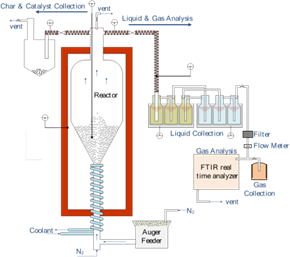
However, a variety of technical challenges during the operation of this reactor have been encountered, such as biomass and catalyst feeding, catalyst entrainment, char separation/filtration, and product (liquid and solid) collection/processing. These challenges are highly possible to contribute to the experimental errors and, directly and significantly affect the accuracy and consistency of the experimental results. This presentation will start with a discussion of the challenges in the operation of the existing spouted bed reactor setup, and then focus on the progress that has been made so far to improve the reactor setup. Experimental results from different biomass feedstocks, catalyst types and catalyst inventories will also be presented and compared with other fluidized bed reactors in the literature, such as spouted and bubbling bed reactors, and risers.
References:
[1] T.R. Carlson, J. Jae, Y.-C. Lin, G. A. Tompsett, G.W. Huber, Journal of Catalysis 270 (2010) 110.
[2] P.R. Patwardhan, D.L. Dalluge, B.H. Shanks, R.C. Brown, Bioresource Technology 102 (2011) 5265.
[3] D.J. Nowakowski, a. V. Bridgwater, D.C. Elliott, D. Meier, P. de Wild, Journal of Analytical and Applied Pyrolysis 88 (2010) 53.
[4] J. Adam, M. Blazso, E. Meszaros, M. Stocker, M. Nilsen, A Bouzga, J. Hustad, M. Gronli, G. Oye, Fuel 84 (2005) 1494.
[5] T.R. Carlson, Y.-T. Cheng, J. Jae, G.W. Huber, Energy & Environmental Science 4 (2011) 145.
[6] H. Cui, J.R. Grace, Bioresource Technology 99 (2008) 4008.
[7] R. Aguado, M. Olazar, M. Jose, G. Aguirre, J. Bilbao, Industrial & Engineering Chemistry Research 39 (2000) 1925.
[8] S. Du, J. Valla, G.M. Bollas, in:, 2011 AIChE Annual Meeting, Conference Proceedings, 2011.
See more of this Group/Topical: Catalysis and Reaction Engineering Division