
 Google
 Yelp
 Facebook
 Twitter
 ChEnected
335402 Chemical-Looping With Oxygen Uncoupling of Coal in a Spouted Bed
The objective of this study is to explore the potential of chemical-looping with oxygen uncoupling (CLOU) for coal. Theoretical models for chemical-looping combustion and unique experimental facilities are utilized for this proof-of-concept study. Chemical-looping refers to indirect combustion and reforming processes for power generation and/or hydrogen production taking place in two reactors (a Reducer and an Oxidizer) with inherent CO2 separation. Combustion is accomplished in the Reducer reactor using an oxygen carrier (metal oxide) instead of air in traditional combustion. The exhaust stream of the Reducer consists mainly of CO2 and H2O; therefore, upon condensation of steam, CO2 is captured without requiring an expensive CO2 separation unit. The metal oxides are re-oxidized with air in the Oxidizer reactor. Of particular interest to the combustion of solid fuels is chemical-looping with oxygen uncoupling, which enables O2 to be dissociated from Cu oxides, thereby overcoming the slow solid-solid reduction reactions in chemical-looping combustion. To achieve excellent mixing of coal with oxygen carrier and subsequent fly ash/oxygen carrier separation via entrainment, a conical spouted-bed (Figure 1) reactor is explored. The experimental setup includes a bench-scale spouted bed reactor connected to a Flourier transform infrared (FTIR) spectrometer and an Agilent 5975C mass selective detector for gas product composition analysis in real time. The hydrodynamics of the spouted-bed are modeled following the basic principles of the Kunii and Levenspiel [1,2] 3-phase model modified for application to spouted-beds.
The focus of this poster is to provide a proof-of-concept of coal chemical-looping, accomplished by optimal design of a spouted-bed reactor, and simulate and analyze the experimental results of chemical-looping reduction in spouted-bed reactors. The potential of in-situ ash separation via entrainment is explored and showcased in the bench-scale setup.
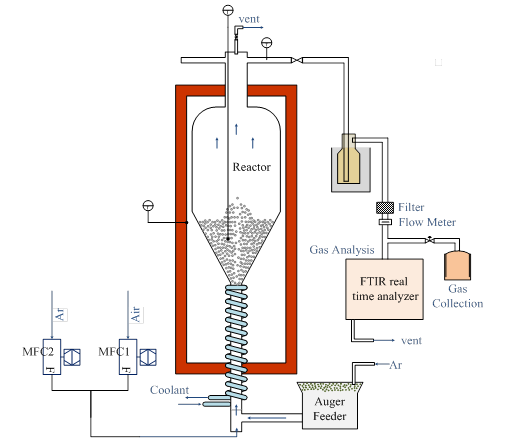
Figure 1: Spouted-bed chemical-looping setup used in this work.
Acknowledgement: This material is based upon work supported by the National Science Foundation under Grant No. 1054718.
[1] D. Kunii, O. Levenspiel, Bubbling bed model: model for the flow of gas through a fluidized bed, I & EC Fundamentals. 7 (1968) 446¨C452.
[2] D. Kunii, O. Levenspiel, Bubbling bed model for kinetic processes in fluidized beds: Gas-Solid Mass and Heat Transfer and Catalytic Reactions, I & EC Process Design and Development. 7 (1968) 481¨C492.
See more of this Group/Topical: Catalysis and Reaction Engineering Division