
 Google
 Yelp
 Facebook
 Twitter
 ChEnected
335672 Effect of Particle Size and Temperature On Woody Biomass Slow Pyrolysis Process
Slow pyrolysis of dried pine spheres was carried out in a flow reactor to study the influence of temperature (378-465 °C) and particle size (2.54-3.81 cm) on the product distribution and temperature profiles. Pyrolysis was performed by inserting spheres into a heated nitrogen flow for a residence time of 40 min. The particle size of the samples used in the experiment is limited by the reactor diameter. The temperature histories within the wood spheres were measured at three radial locations: center (r=0), and two “middle” locations (r= R/2), using three sheathed 0.5 mm OD K-type thermocouple inserted through holes drilled in the particle. Figure 1 shows the installation of thermocouples inside the sphere. The temporal evolution of the species (CO, CO2, CH4, HCHO, CH3OH, HCOOH, and CH3COOH) released during the sample pyrolysis was measured using Fourier Transform Infrared (FTIR) analyzer. TCD and MS detectors on a gas chromatograph were used to analyze the time-resolved concentration of hydrogen, and the tars collected over the course of the entire experiment, respectively.
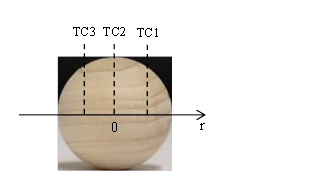
Figure 1: Thermocouples locations within the woody sphere. The arrow indicates the nitrogen flow direction.
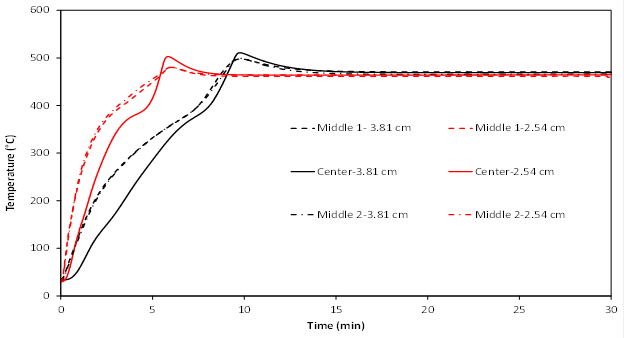
Figure 2 illustrates the temperature history of the two particle sizes (2.54 cm and 3.81 cm) heated with a nitrogen flow at 466 °C. Both profiles show two thermal events; an endothermic reaction, followed by an exothermic reaction. The temperature peak appears early for the 2.54 cm sphere at 5.33 min however for 3.81 cm, it appears at 9.77 min. This trend is reasonable because for the large particle the heat transfer is slower.
 Figure
2: Particle temperature history comparison at a nitrogen temperature of 466 °C.
Figure 3 below illustrates the species time histories at a pyrolysis temperature of 466⁰C and for sphere 2.54 cm diameter, displaying a high degree of dilution caused by the large nitrogen flow (5.8E-03 Kg/s). Different classes of species were identified, including hydrocarbons, aldehydes, alcohols, and carboxylic acids, in addition to CO, CO2 and H2. Good repeatability was obtained over at least two runs. As observed in this figure, the formation of all detected species, except for methane, occurs very early (starting earlier than 1 min after sphere insertion). The peak concentrations of CO2, HCHO, CHOOH and CH3COOH appear earlier than the other measured species. Furthermore, the results indicated the presence of the same main species for the both particle sizes and the three temperature conditions.
Figure 4 shows the char, tar and gases yields measured for the two particle sizes and the three pyrolysis temperatures. Gases are defined as CO, CO2, and CH4 only, and tar yields in the experiment are obtained by difference.
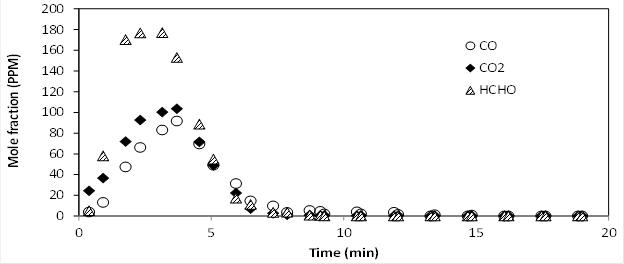
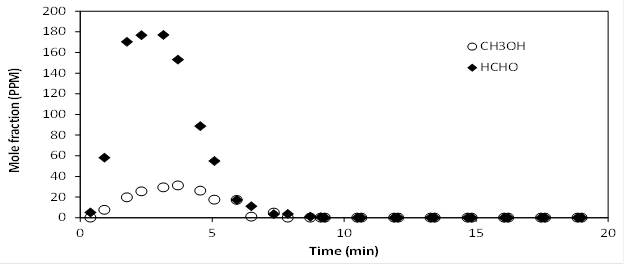
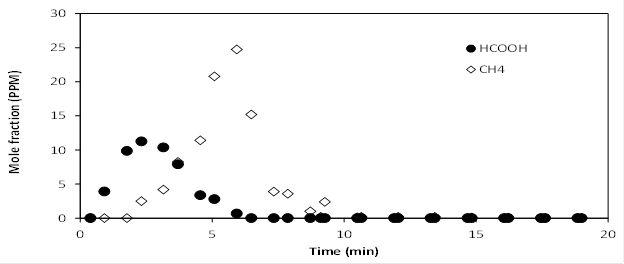
Figure 3: Mole fractions of species released from 2.54 cm pine sphere at a nitrogen temperature of 466 °C.
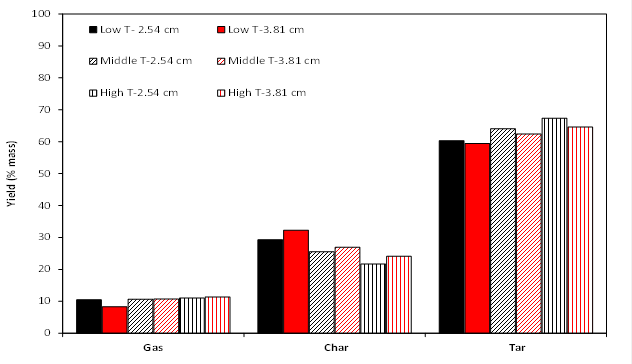
Figure 4: Experimental products yields (mass % as a percent of initial wood mass) obtained for the two particle sizes at three temperatures.
The experimental results were then compared to those calculated with a model developed by Park et al. (2010)1. This model was developed to determine the kinetics involved in the slow pyrolysis of large wood particles under conditions of low temperature and long residence times. It includes transient mass, species, and energy conservation equations, in addition to the Darcy momentum equation. Coupled to these equations is the multistep kinetic mechanism describing direction production of gas and tar, and indirect production of char. Each reaction is assumed to be first order with Arrhenius type rate expression.
Because the pyrolysis model was developed for a specific experimental configuration, changes were made to better represent the results obtained from the experimental setup presented here. Modifications included an adaptation of some wood and char properties, such as thermal diffusivity, and an experimental determination of thermal boundary conditions. The modified pyrolysis model was implemented in COMSOL, a commercial Multiphysics software. ______________________________
[1] W.C. Park, A. Atreya and H.R. Baum, Combustion and Flame 157 (2010) 481-494
See more of this Group/Topical: 2013 International Congress on Energy (ICE)