
 Google
 Yelp
 Facebook
 Twitter
 ChEnected
335753 Optimal Reactor Design for the Hydroformylation of Long Chain Olefins in Thermomorphic Solvent Systems
Optimal Reactor Design for the Hydroformylation of Long Chain Olefins in Thermomorphic Solvent Systems
Benjamin Hentschel1, Andreas Peschel2, Hannsjörg Freund3, Kai Sundmacher1,2
1Process Systems Engineering, University of Magdeburg, Magdeburg/DE
2Max Planck Institute for Dynamics of Complex Technical Systems, Magdeburg/DE
3Chemical Reaction Engineering, University of Erlangen-Nürnberg, Erlangen/DE
The use of thermomorphic solvent (TMS) systems is a promising approach that is currently investigated regarding its applicability for the rhodium catalyzed hydroformylation of long chain olefins. By taking advantage of a temperature dependant miscibility gap, homogeneous reaction and efficient liquid-liquid phase (and thus catalyst) separation can be performed with a single solvent system by using the temperature as “switch” to tune the phase behavior.
On the example of the hydroformylation of 1-dodecene in a TMS it is demonstrated how the optimal reactor for such innovative systems can be derived. The demanding interplay of the thermodynamics of the TMS, complex reaction network, and solvent recycles requires a model based reactor design approach which considers the dynamics of the whole process rather than an isolated reactor design. For this purpose a reference process flow sheet (Fig. 1) was developed in order to allow for the derivation of a process-wide optimal reactor.
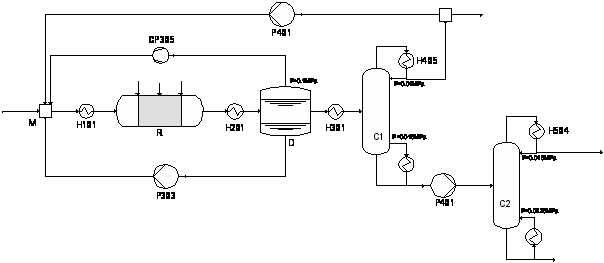
Fig. 1: Flow sheet of the hydroformylation process.
Due to the numerous process constraints and the complexity of the reaction system a heuristic reactor design approach is unlikely to be able to yield the optimal reactor. Hence, to account for the full potential of this innovative reaction and solvent system a reactor design based on the optimal reaction route is pursued. Considering a fluid element of the system which is traveling through the reactor, optimal profiles of energy and material fluxes over reaction time can be calculated as solution of an optimal control problem. This problem is constrained by the dynamic equations of the fluid element, constitutive equations describing phase properties, reaction kinetics, gas solubilities, and the balance equations of the remaining process units. For each unit appropriate cost models are implemented enabling the minimization of the total production costs of the desired linear aldehyde product.
As a result of this optimization it could be shown that the solvent recycle leads to an increase in the selectivity that can be achieved in the reactor. Thus, a separate optimization of the reactor without considering the recycles would lead to a falsified lower reactor performance prediction. Furthermore, the cost optimal solution, considering all recycles, turns out to be a combination of necessary separation efficiency and optimal reaction route. Assuming an annual production of 10.000 tons of product, the advanced reaction route leads to a reduction of the total production costs of 5% compared to an optimized reference case. This corresponds to an annual saving of about 2.2 Mio. US$.
In summary it could be demonstrated that reactor and process have to be optimized as an integrated system in order to find the process-wide optimal solution, rather than focusing on local objectives of the reactor, such as product selectivity. Exemplified on the hydroformylation of long chain olefins in TMS it could be shown that the presented reactor design method can yield a process-wide optimal reactor design based on the cost optimal solution, in which optimal reactant dosing and heat removal is realized along the reactor.
See more of this Group/Topical: Process Development Division