
 Google
 Yelp
 Facebook
 Twitter
 ChEnected
335868 Cells Tune Matrix Metalloproteinase Activity By Sensing Mechanical Inputs
One of the primary mechanisms of tissue microenvironmental remodeling is extracellular matrix (ECM) degradation. ECM degradation is highly controlled during immune response, wound healing and development. When ECM degradation is uncontrolled, pathologies like fibrosis or cancer cell invasion occur. ECM degradation is mediated in large part by the matrix metalloproteinase (MMP) family. MMP level can be controlled through expression; however MMP activity is highly regulated through post-translational modifications, limiting the usefulness of expression studies. Environmental signals, such as growth factor and ECM concentration are known to alter MMP activity. However, another important microenvironmental characteristic is the ECM crosslinking density. Highly crosslinked ECM has small pores, is stiff and constitutes a difficult matrix through which to migrate, while uncrosslinked ECM has larger pores, is softer and constitutes less of a barrier for cell migration. The fibrotic microenvironment as well as the tumor microenvironment tend to be much stiffer than in normal tissue. In the case of the tumor microenvironment this leads to enhanced invasion. How does this occur? One mechanism might include the upregulation of MMP activity in order for cells to migrate through stiff, densely crosslinked networks of ECM.
 We are
interested in determining if cells can sense chemical crosslinks in the ECM
network through the mechanical properties of the ECM. Since cell contractility
generally correlates with ECM stiffness, we are additionally examining how
changes in cell contractility regulate MMP activity. We are using fluorescently
quenched cleavage peptides in a high-throughput live-cell 96-well assay that
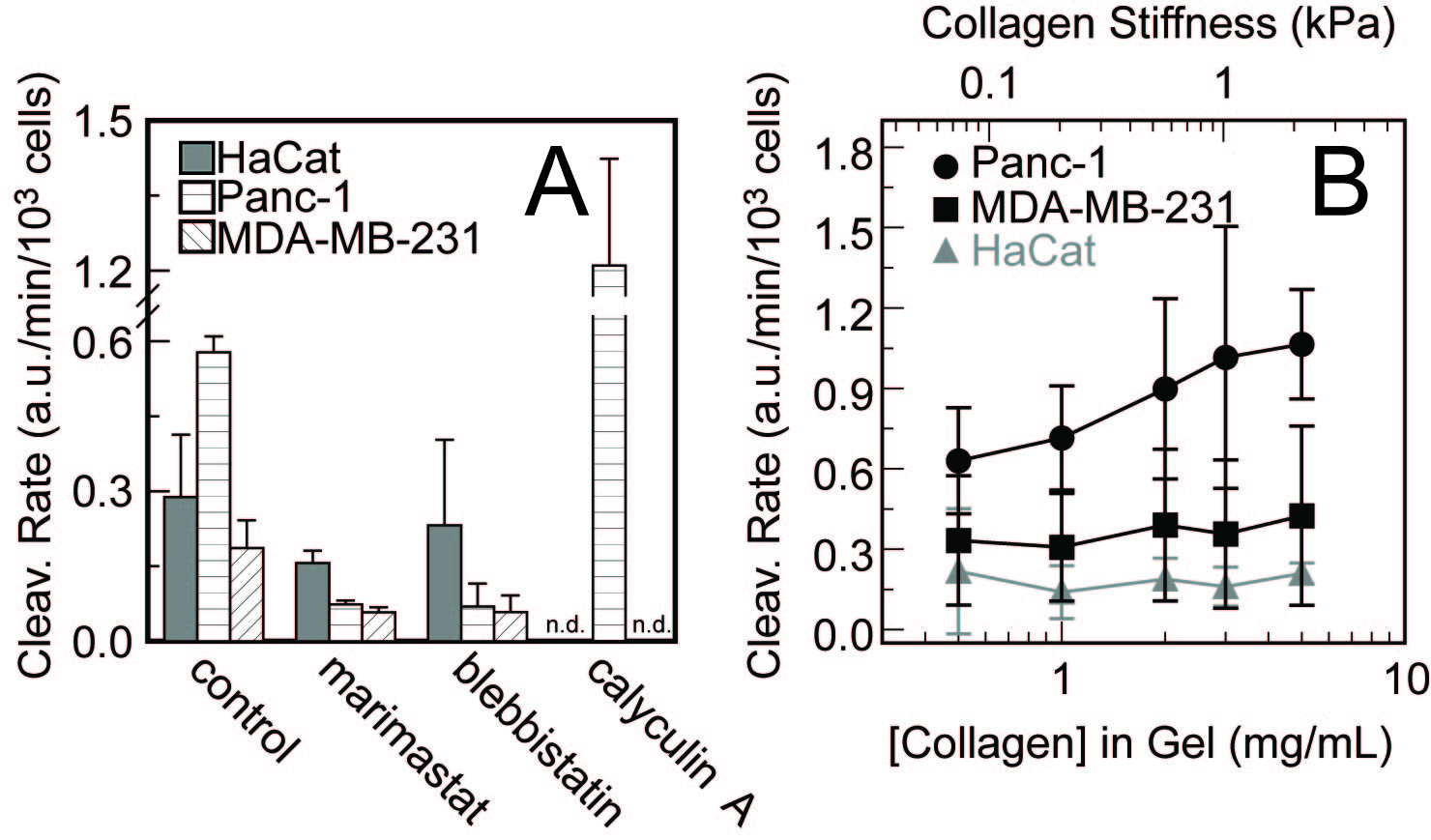
can directly detect changes in MMP activity. MMP activity was higher in cells
plated on high concentration collagen gels (5 mg/mL) as compared to low
concentration collagen gels (0.5 mg/mL) (Fig. 1B). This response was cell-type
specific and more pronounced in highly invasive cancer cells. Because these
gels differ in Young's moduli by over 10-fold, we hypothesized that these
changes in MMP activity were due to changes in the mechanical properties of the
ECM. To test this in part, cells were treated with pharmacological inhibitors
(blebbistatin) and enhancers (calyculin A) of contractility and MMP activity
was measured. As predicted, when cell contractility increased with calyculin A
treatment, MMP activity increased. When cell contractility decreased with
blebbistatin treatment, MMP activity decreased to roughly the same level as
that seen by marimastat, a pan-MMP inhibitor (Fig. 1A). Currently, we are
examining ways to independently control ECM density and mechanical properties
to probe MMP regulation by each. These findings suggest an interesting
mechanism to sense crosslinked ECM. When cells are exposed to a highly
crosslinked ECM network that requires high MMP activity, they sense high ECM
crosslinking density by probing the mechanical properties of the environment
and respond by activating MMPs. Insights into the mechanical control over MMP
activity can guide the design of artificial tissues that can elicit a
particular MMP activity in cells or therapeutic targets that lie upstream of MMP
activity and cancer invasion.
See more of this Group/Topical: Food, Pharmaceutical & Bioengineering Division