
 Google
 Yelp
 Facebook
 Twitter
 ChEnected
335953 On the Kinetics of Ni-Based Oxygen Carrier Reduction and Oxidation Studied in Thermogravimetric Analysis and Fixed-Bed Reactors
On the kinetics of Ni-based oxygen carrier reduction and oxidation studied in thermogravimetric analysis and fixed-bed reactors
Zhiquan Zhou, Oscar Nordness, George M. Bollas
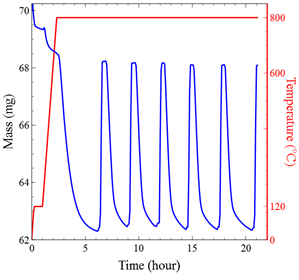
NiO is a promising yet expensive oxygen carrier for chemical-looping combustion (CLC). Knowledge of its inherent kinetics can greatly facilitate the optimization of the Reducer and Oxidizer in chemical-looping combustion systems. Reactivity tests with NiO/Al2O3(汐- and 污-)/SiO2 oxygen carriers were performed in a thermogravimetric analyzer (see Figure 1) at atmospheric pressure to examine the supported NiO reduction kinetics by H2 and CH4 under isothermal conditions (600, 800 and 950 蚓). NiO/Al2O3/SiO2 oxygen carriers were prepared via the incipient wetness impregnation method. Table 1 shows the main properties of the fresh (before CLC) materials.
Table 1: Properties of the fresh NiO-based oxygen carriers
Properties | NiO/污-Al2O3 | NiO/汐-Al2O3 |
BET surface area (m2/g) | 94 | 27 |
Pore size (Å) | 116 | 294 |
Total NiO content (%) | 32 | 24 |
Active NiO content (%) | 25 | 21 |
XRD phases | NiO, NiAl2O4, Al2O3, SiO2 | NiO, NiAl2O4, Al2O3, SiO2 |
Apparent density (g/cm3) | 1195 | 1414 |
Particle size (µm) | 50 每 150 | 50 每 150 |
|
| ||
Figure 1: Typical mass and temperature measurement for NiO/污-Al2O3 oxygen carrier and 4% H2/Ar for reduction and air for oxidation reactions. |
| Figure 2: Effect of reaction temperature and Curve fitting of Avrami-Erofe'ev and shrinking core models to reduction conversion for NiO/汐-, 污-Al2O3 and 4% H2/Ar reaction at 800 and 950 蚓. |
|
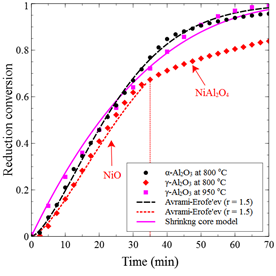
In this presentation, model-fitting (conversion (X) vs. time and dXdt vs. conversion) and model-free methods (Hancock and Sharp [1]) are used to evaluate the kinetics mechanism of the reduction and oxidation processes. Over 20 solid-state reaction models (nucleation, geometrical contraction, diffusion, reaction-order, etc.) [2,3] are applied and compared against reduction and oxidation experiments of bulk Ni and supported Ni carriers reported in the literature [4每8] and generated in this work (Figure 2). The F-test and Akaike Information Criterion [9] are used to statistically compare models with different independent variables. Consistent kinetic mechanisms are derived that are capable of describing the reactivity performance of different Ni-based oxygen carriers.
Acknowledgement: This material is based upon work supported by the National Science Foundation under Grant No. 1054718.
References:
[1] J.D. Hancock, J.H. Sharp, Method of Comparing Solid-state Kinetic Data and Its Application to the Decomposition o, (n.d.) 74每77.
[2] B. Janković, Isothermal reduction kinetics of nickel oxide using hydrogen: Conventional and Weibull kinetic analysis, Journal of Physics and Chemistry of Solids. 68 (2007) 2233每2246.
[3] A. Khawam, D.R. Flanagan, Solid-state kinetic models: basics and mathematical fundamentals., The Journal of Physical Chemistry. B. 110 (2006) 17315每28.
[4] A. Abad, J. Ad芍nez, F. Garc赤a-Labiano, L.F. de Diego, P. Gay芍n, J. Celaya, Mapping of the range of operational conditions for Cu-, Fe-, and Ni-based oxygen carriers in chemical-looping combustion, Chem. Eng. Sci. 62 (2007) 533 每 549.
[5] I. Chen, D.W. Shiue, Reduction of nickel-alumina catalysts, Industrial & Engineering Chemistry Research. 27 (1988) 429每434.
[6] G. Plascencia, T. Utigard, The reduction of Tokyo and Sinter 75 nickel oxides with hydrogen, Chemical Engineering Science. 64 (2009) 3879每3888.
[7] T. a. Utigard, M. Wu, G. Plascencia, T. Marin, Reduction kinetics of Goro nickel oxide using hydrogen, Chemical Engineering Science. 60 (2005) 2061每2068.
[8] R. Chatterjee, S. Banerjee, S. Banerjee, D. Ghosh, Reduction of Nickel Oxide Powder and Pellet by Hydrogen, Transactions of the Indian Institute of Metals. 65 (2012) 265每273.
[9] H. Akaike, A new look at the statistical model identification, IEEE Transactions on Automatic Control. 19 (1974) 716 每 723.
See more of this Group/Topical: Catalysis and Reaction Engineering Division