
 Google
 Yelp
 Facebook
 Twitter
 ChEnected
336034 Controlling Alkene Chain Growth Pathways On Solid Acid Catalysts
Emerging oxygenate feedstocks, such as ethanol and isobutanol, can be produced from renewable resources and dehydrated to alkenes by acid catalysts, which can undergo subsequent chain growth also on catalysts. Product chain length depends on the relative rates of chain oligomerization, hydride transfer, isomerization and β-scission reactions, which reflect, in turn, effects of acid strength and confinement on the stability of the respective transition states.
Weaker acids favor methylation over isomerization or hydride transfer during dimethyl ether (DME) homologation, leading to larger chains on zeolites than on stronger acids, such as Keggin-polyoxometalates [1]. Light alkene conversion on acidic zeolites, however, forms a broad range of products, consistent with concurrent oligomerization, isomerization, cracking, hydrogen transfer and aromatization events. Small, undervalued alkanes can also be incorporated into homologation and oligomerization processes through the use of molecular hydride transfer co-catalysts, such as adamantane, or dehydrogenation-hydrogenation metal sites. The relative rates of the aforementioned events differ among zeolite frameworks with similar acid strengths but different confining voids as is evident from near-linear hydrocarbons produced from oligomerization on medium pore zeolites, like MFI [2]. We probe here the effects of zeolite void structure on alkene oligomerization to advance our mechanistic understanding about the consequences of confinement for propagation and termination rates and chain growth selectivity.
Rates of propene consumption are first order in propene pressure indicating that at operating conditions, adsorbed propene is the most abundant surface intermediate. The rate expression for oligomerization thus simplifies to:
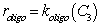 (1)
where koligo is the effective rate constant for propene consumption. H-TON (10-membered ring, one-dimensional) exhibits turnover rates that are an order of magnitude larger than H-MOR (12-membered ring, one-dimensional), which is consistent with the dimeric transition state of oligomerization benefitting from confinement. Comparable turnover rates (within 1.2) are observed on H-MFI and H-BEA in accordance with similar diameters of the channel intersections in H-MFI and 12-membered ring channels in H-BEA.
The relative rates of oligomerization and cracking can be compared through a true oligomer selectivity (χ), which is defined as the fraction of products observed as propene oligomers (C6, C9, C12). This χ value increases with increasing alkene partial pressure on all zeolites, consistent with oligomerization and β-scission proceeding as bimolecular and monomolecular reactions, respectively (Eq. 2):
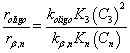 (2)
Here kβ-n is the rate constant for a carbon species of length n undergoing β-scission and K3 and Kn are the equilibrium constants for adsorption/desorption of a given alkene.
One-dimensional zeolites (H-TON, H-MTT, H-MOR) exhibit χ values that are 2 times larger than three-dimensional H-MFI at 77 kPa propene and values that are approximately 3.5 times larger at 26 kPa propene, consistent with Eq. 2. Similar trends are also observed for three-dimensional H-BEA. In H-MFI and H-BEA, intersections of the three-dimensional channel network create voids that are 0.1-0.2 nm larger in diameter than the surrounding channels. These undulations in the diffusional path increase selectivity to lower carbon numbers because large oligomers created in these domains cannot diffuse out of the smaller channels and subsequently undergo β-scission. Transport through the one-dimensional channels in H-TON, H-MTT and H-MOR reduces β-scission rates and forces the oligomers to terminate via isomerization or desorption instead. These results demonstrate the control of alkene chain growth on solid acids by preventing β-scission pathways during oligomerization through confinement as a promising route for the production of higher molecular weight hydrocarbons for fuels.
Financial
support from BP through the XC2 Program and National
Science Foundation Graduate Research Fellowship Programs are gratefully
acknowledged.
See more of this Group/Topical: Catalysis and Reaction Engineering Division