
 Google
 Yelp
 Facebook
 Twitter
 ChEnected
336078 Engineering Novel Tandem Catalytic Reactions Using Organometallic Catalysts and Metalloenzymes
 Organometallic chemistry and bioinorganic chemistry are two
prominent disciplines of chemistry. Organometallic chemistry lies at the
intersection of organic and inorganic chemistry, while bioinorganic chemistry
lies at the intersection of biological and inorganic chemistry. Transition
metal complexes lie at the core of both disciplines, but synthetic chemistry
that exploits the complementary reactivity of the two systems in a cooperative
fashion has rarely been developed. Often, the two classes of catalysts effect
the same transformation with different rates and scope, but more often, they
catalyze completely different types of reactions that are conducted in
different vessels if they are used in the same synthetic sequence. Recently, synthetic
catalysts and enzymes are beginning to be combined in new ways to work in
tandem; however, there have been no reports in which organometallic catalysts
and metalloenzymes have been combined and shown to work cooperatively. Such
reactions are challenging to achieve, in part because the conditions in which
these catalysts operate are typically different, and mutual inactivation of the
catalysts typically occur when they are combined in the same medium. In our
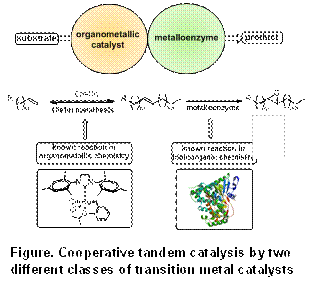
work, we use a biphasic reaction and show that 90% yield of a single epoxide can
be obtained from a mixture of alkenes, a ruthenium metathesis catalyst and a
P450 enzyme by a combination of a dynamic equilibration of alkenes and a
selective epoxidation of the cross-metathesis products (Figure). We have
expanded the scope of this tandem reaction to include unnatural P450
substrates, such as alkenyloxybenzoic acids, and P450 mutants with different
regioselectivities. These results show the potential of combining the two
classes of catalysts as synthetic catalysts become more tolerant of functional
groups and enzymes become more tolerant of organic media. We are also exploring
and evolving new metalloenzymes with different selectivities on internal
alkenes for the selective epoxidation of dynamic cis-trans mixtures of
alkenes established by transition metal catalysts. Lastly, we are creating hybrid
transition-metal-metalloenzyme catalysts to create a P450 enzyme capable of
performing both oxidation and metathesis reactions.
See more of this Group/Topical: Food, Pharmaceutical & Bioengineering Division