
 Google
 Yelp
 Facebook
 Twitter
 ChEnected
336143 Kinetic Model Study in a Photo-CREC Reactor for Photocatalytic Hydrogen Production
Kinetic Model Study in a Photo-CREC Reactor for Photocatalytic Hydrogen Production
Salvador Escobedoa, Benito Serranob, Hugo de Lasaa,*
a Western University, London, N6A 3K7, Canada
b Universidad Autonoma de Zacatecas, Zacatecas, 98000, Mexico
*Corresponding author: hdelasa@eng.uwo.ca
Introduction
A new type of photocatalysts have been studied in different photocell configurations and showed one of the best alternatives to generate environmental-friendly hydrogen. The goal of this study is to demonstrate the feasibility of photocatalytic water splitting for hydrogen production through a Photo-CREC reactor, using a sacrificial agent, acid pH and an optimum modified platinum loaded semiconductor of DP25 (TiO2) [1]. It is also the objective of this study to analyze the byproducts and the kinetic modeling of this photochemical reaction process [2].
Experimental
A modified platinum Degussa P25 (TiO2) was impregnated by incipient wetness impregnation method. This step was followed by calcinations and reduction. A 2.73 eV reduced band gap was observed for the modified semiconductor [1] (see Figure 1). The optimum pH and platinum impregnated photocatalyst were studied in a Photo-CREC-Water II (see Figure 2). A kinetic modeling study is represented by the photocatalytic formation of hydrogen, addressing the reaction network of ethanol diluted in water (see Figure 3).
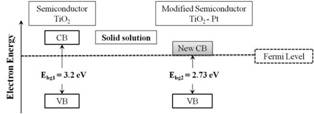
Figure 1. Schematic representation of the band gap shifting by the use of an optimum modified photocatalyst of DP25-1 wt% Pt [1]
Results and Discussion
Impregnation of Pt on TiO2 leads to enhanced particle size distribution with reduction of particle agglomeration, with better distribution of charges on the semiconductor [1]. On the other hand, it is shown that Pt did not affect the anatase and rutile phases as well as the specific surface area of the DP25. Figure 2 reports hydrogen production rates as a function of contact time under free oxygen conditions and pH equals to 4. Runs were developed with excess of Ethanol as OH• scavenger reagent. Hydrogen free of oxygen was produced in all cases with 1wt% Pt on Degussa P25 yielding the best hydrogen production rates (see Table 1).Moreover, it is proven that Ethanol helps averting h+ and e- recombination, with the highest 7.86% quantum yields [3] obtained between 1-6 hours of irradiation [1].
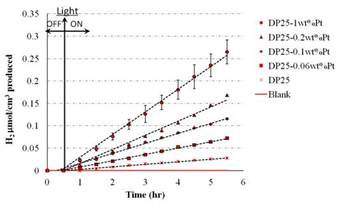
Figure 2. Hydrogen Production under pH=4, Ethanol 2%v/v and Atmosphere of Argon.
Table 1 Reaction Rate at different Loading of Pt on TiO2 and pH=4
Catalyst
| Reaction rate a (mol h-1 gcat-1)
| Quantum Yield (% φ)
|
H2 Production
| ||
DP25
| 36
| 0.7
|
DP25 0.06wt% Pt
| 89
| 1.8
|
DP25 0.1wt% Pt
| 142
| 2.9
|
DP25 0.2wt% Pt
| 200
| 4.1
|
DP25 1wt% Pt
| 383
| 7.9
|
a. Reaction conditions: 298 K, 1 atm.
The results of photocatalytic hydrogen production came along with useful hydrocarbons and CO2. The study of those hydrocarbons and CO2 as byproducts is essential on this photochemical reaction system to understand the reaction network suggested by the authors (see Figure 3),
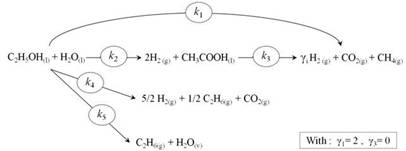
Figure 3. Reaction network for kinetic modelling study
The main assumptions of the proposed heterogeneous kinetic model are stated as a system of differential equations. This valuable approach is used to establish the kinetic model of the reaction network presented above.
The kinetic model adopted in this study includes the Langmuir-Hinshelwood approach. The results of the kinetic model include the kinetic constants and the adsorption constants involved in the generation of hydrogen, the by-products and the intermediate species.
References
1. S. Escobedo, B. Serrano and H. de Lasa, Appl. Catal. B: Environ. accepted April (2013)
2. H. de Lasa, B. Serrano and M. Salaices, “Photocatalytic Reactor Engineering”, Springer Science (2005), pp 187; ISBN 0-387-23450-0
3. B. Serrano, A. Ortiz, J. Moreira and H. de Lasa, Ind. Eng. Chem. Res.48 (2009) 9864
See more of this Group/Topical: Environmental Division