
 Google
 Yelp
 Facebook
 Twitter
 ChEnected
336308 Component Surface Concentrations of Gas Mixtures By Langmuir Theory and Ideal Adsorbed Solution Theory (IAST)
[Introduction] Langmuir theory is used in reaction kinetics to calculate the surface concentration or coverage of each gas component on solid catalysts that are exposed to gas mixtures. However, this theory is only consistent with thermodynamics when the monolayer capacities are the same for all species [1]. In zeolites, there can be spaces a small molecule can occupy but which are too constrained for a bigger species or there are acidic sites where one species can adsorb but which are too weak for a less basic species, which would cause the monolayer capacity to differ for different species. Krishna and Baur [2] have shown using molecular simulation that the different monolayer capacities of different hexane isomers in a MFI zeolite led to erroneous reaction kinetics when Langmuir adsorption isotherms were used, and that ideal adsorbed solution theory (IAST) should be used for surface concentration calculations in place of Langmuir theory. In this study, we used experiments with binary component mixtures to examine whether Langmuir theory or IAST is better for surface concentration calculations. We compared the estimated surface concentrations by Langmuir and IAS theories of binary mixtures of methanol and dimethyl ether (DME) and C3H8 and DME on a SAPO-34 catalyst with experimental measurements. Since the results are of interest for the methanol-to-olefins (MTO) reaction, we also compared the estimated surface concentrations by Langmuir and IAS theories of multicomponent mixtures at 350°C.
[Experiment] Adsorption isotherms of pure gases and binary component gas mixtures on a SAPO-34 zeolite at room temperature to 100°C were measured. Together with the adsorption isotherms, the differential heats of adsorption were also simultaneously measured with a heat flow microcalorimeter in the volumetric manometry apparatus. The total dead volume of the system was 40 ml, which allowed the composition of the gas phase to be sampled by mass spectrometry (MS) after equilibrium was achieved for each dosage. The MS-measured gas phase compositions were used to experimentally verify the calculation of the individual surface concentrations on the sample. The composition of the binary gas mixtures used were methanol/DME = 63/37 [mole%] and C3H8/DME = 68/32 [mol%]. The sample used was a SAPO-34 catalyst powder synthesized using SiO2/Al2O3 = 0.24, which had an acid site density of 1.0 mmol/g. The sample was first pretreated at 400°C for 5 hours under a vacuum of 10-5 Pa. After that, sample was kept at the adsorption temperature of 25, 60, 80 or 100°C.
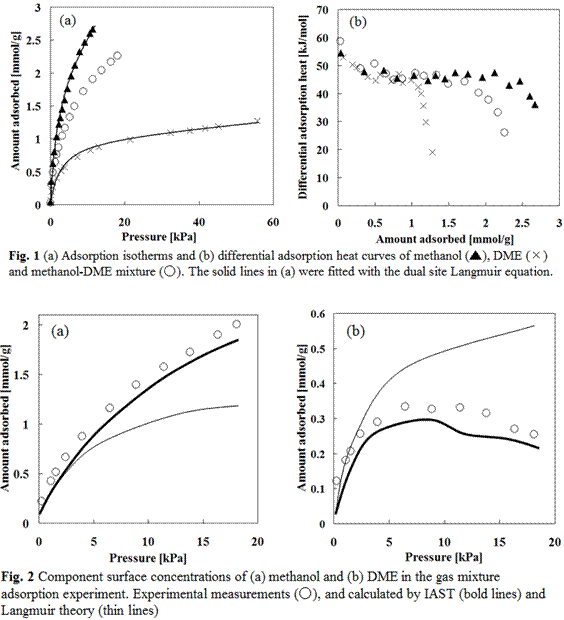
[Results and Discussion] First, pure component adsorption isotherms of methanol, DME, C3H6, and C3H8 were measured at 25, 60 and 100°C. The saturated surface concentration of methanol is quite different from those of the other adsorbates which differ slightly from one another. The saturation coverage of methanol is approximately twice that of the other gases, which may be due to the formation of methanol clusters stabilized by hydrogen-bonded networks of the type reported for HZSM-5 [3]. These isotherms were fitted by the single site Langmuir equation or, when it did not give a good fit, the dual site Langmuir equation. The parameters obtained were used to calculate surface concentrations of binary gas mixtures in the same temperature range using the Langmuir and IAST theories to compare these with experimental measurements. These parameters were also extrapolated to the MTO reaction temperature of 350°C to predict individual surface concentrations at 350°C by both Langmuir theory and IAST. In the methanol and DME adsorption experiments, some irreversible adsorption were observed, and a second measurement after evacuation was performed to get an isotherm without irreversibly adsorbed molecules for curve fitting. The component surface concentrations from the methanol-DME mixture by the Langmuir theory and IAST showed significant deviations, esp. at high pressures. The isotherm and differential adsorption heat curve from methanol-DME binary mixture adsorption at 80°C are shown in Fig. 1, together with the corresponding curves for pure methanol and DME. The pure gas isotherms showed that the methanol saturation coverage is much larger than that of DME. In the calorimetric curves, the initial heat of adsorption was 60 kJ/mole, which decreased to 45 kJ/mole when 0.5 mmole/g had been adsorbed for all the gases used. After that, there was a plateau in the calorimetric curves, which indicated the homogeneity of the adsorption sites in SAPO-34. With methanol, DME and their mixture, falloffs in the heat of adsorption were then observed at 6.5, 27 and 6.5 kPa, respectively, corresponding to surface concentrations of 2.1, 1.0 and 1.5 mmole/g. The falloff in the heat of adsorption indicated the saturation coverage at which regular chemisorption sites were all occupied, and the remaining amount adsorbed after the falloff began was attributed to adsorption on weak sites. This calorimetric trend indicated that the dual site Langmuir equation should be used for fitting the pure component isotherms. The fits are illustrated in Fig. 1a. Figure 2 shows the individual surface concentrations of methanol and DME measured in the mixture adsorption experiment, and the calculated amounts by Langmuir theory and IAST. During adsorption from the gas mixture, there were constant increases in methanol and DME surface concentrations up to 6.5 kPa where the calorimetric curve began its falloff. At higher adsorption pressures, a DME surface concentration decrease with increasing pressure was observed, i.e., there was desorption of previously adsorbed DME. A similar surface concentration decrease with increasing adsorption pressure was simulated by Krishna and Baur [2] who attributed it to entropy effects from the adsorption of molecules with different saturation capacities. Fig. 2 shows that IAST gave good calculated surface concentrations that also included the desorption with increasing pressure, while there were significant deviations in the calculated surface concentrations by Langmuir theory, esp. at higher pressures where it failed to predict the desorption. This result may suggest that Langmuir theory should not be used in the reaction kinetics, which was the conclusion of Krishna and Baur. However, our results also showed that deviations in the calculated surface concentrations by Langmuir theory were significant only after the regular chemisorpion sites were saturated, that is, the deviations appeared when adsorption on the weak adsorption sites became significant. Further work is required to understand if these sites are involved in the reactions.
[Conclusion] Component surface concentrations from gas mixtures calculated using Langmuir theory and IAST that were compared with experimental values showed that the calculated values by Langmuir theory were wrong when the saturation coverages of the individual gases were different and the total adsorbed amount from the mixture exceeded the number of regular adsorption sites.
[References] (1) D.D. Do, Adsorption Analysis: Equilibria and Kinetics, Imperial College Press, London, 1998. (2) R. Krishna, R. Baur, Chem. Eng. Sci. 60 (2005) 1155-1166. (3) C.-C. Lee, R. J. Gorte, W. E. Farneth, J. Phys. Chem. B 101 (1997) 3811-3817.
See more of this Group/Topical: Catalysis and Reaction Engineering Division