
 Google
 Yelp
 Facebook
 Twitter
 ChEnected
336418 Experimental Characterization of the Solubility of High Molecular Weight Liquids in Polydimethylsiloxane (PDMS) in Presence of a Low Molecular Weight Solvent
Experimental characterization of the solubility of high molecular weight liquids in polydimethylsiloxane (PDMS) in presence of a low molecular weight solvent
Giovanni Cocchi, Maria Grazia De Angelis*, Ferruccio Doghieri
Department of Civil, Chemical, Environmental and Material Engineering - University of Bologna, Via Terracini 28, 40131 Bologna, Italy
* Corresponding Author Email Address: grazia.deangelis@unibo.it
In order to characterize the separation performances of polymeric membranes that could be applied in separation processes relevant to food and pharmaceutical industry, experimental values of the solubility of low molecular weight species in the polymer that forms the membrane are required [1]. In this work, the experimental characterization of the solubility of liquids of interest to the food and pharmaceutical industry in a crosslinked PDMS film is discussed, considering the effect of the presence of a low molecular weight solvent that swells the matrix, affecting the transport [2,3]. Crosslinked PDMS was selected for its wide use in applications, especially in membrane separation processes and for its resistance to solvents [4]. The measurement of liquid solubility in PDMS was performed gravimetrically, according to the blot and weight method: samples were immersed in vials filled with liquid, placed in a thermostatic bath and weighted at regular intervals with an analytical balance. In this way the mass uptake as a function of time was obtained. In the case of mixed liquids solubility, we considered solutions formed by a volatile component and a second one with negligible vapor pressure. Firstly the measurement of the total mass uptake of the liquid mixture was performed, according to the previously described procedure. Then, the samples are left under hood to let the volatile component evaporate, until constant weight was obtained. Mass balance calculations provided the separate mass uptake of the volatile and of the non volatile component. It was found that the solubility of the less soluble component is deeply enhanced by the presence of the other, more soluble component, that usually is the low molecular weight solvent. For example, as shown in the figure below, the swelling induced by n-pentane promotes the dissolution of eicosane in PDMS, which shows a maximum at an intermediate mass fraction of n-C5 in the mixture. This behavior has been observed in many other mixtures such as the one formed by: acetone and squalene, pentane and oleic acid, pentane and olive oil, acetone and oleic acid, acetone and olive oil and tertbutanol and PEG 400. The Figure 1 depicts the solubility of pentane and eicosane in PDMS, as a function of pentane concentration. For the case of pentane and eicosane, an approximate thermodynamic analysis has been conducted in order to compare the infinity dilution activity coefficient of pentane in eicosane in this ternary mixture, to the value available in the literature.
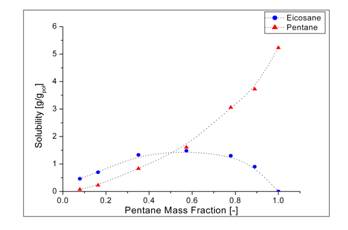
Figure 1: Solubility of Pentane and Eicosane in Crosslinked PDMS at 308 K.
[1] S.P. Nunes, K.V. Peinemann, Membrane Technology in the Chemical Industry, 2nd Edition, 2006, WILEY-VCH Verlag GmbH & Co. KGaA, Weinheim, Germany.
[2] R. Subramanian, M. Nakajima, T. Kawakatsu, Processing of Vegetable Oils Using Polymeric Composite Membranes, Journal of Food Engineering, 38, 1998, 41-56.
[3] R. Subramanian, K. Raghavarao, M. Nakajima, H. Nabetani, T, Yamaghuchi, T. Kimura, Application of Dense Membrane Theory for Differential Permeation of Vegetable Oil Constituents, Journal of Food Engineering, 60, 2003, 249-256.
[4] M.G. DeAngelis, T. C. Merkel, V.I. Bondar, B.D. Freeman, F. Doghieri, G.C. Sarti, Hydrocarbon and Fluorocarbon Solubility and Dilation in Poly(DimethylSiloxane): Comparison of Experimental Data with Predictions of the Sanchez – Lacombe Equation of State, Journal of Polymer Science Part B: Polymer Physics, 37, 1999, 3011-3026.
See more of this Group/Topical: Engineering Sciences and Fundamentals