
 Google
 Yelp
 Facebook
 Twitter
 ChEnected
336632 Comparison of Cu-, Fe- and Ni- Based Oxygen Carriers for Chemical-Looping Combustion
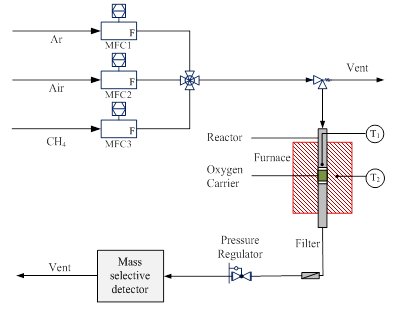
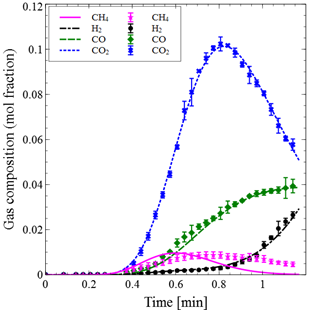
Chemical-looping combustion (CLC) is the indirect combustion of fossil fuels for power generation taking place in two reactors (a Reducer and an Oxidizer) with inherent CO2 separation, which is accomplished in the Reducer reactor using an oxygen carrier (metal oxide) instead of air. Oxygen carriers in a CLC power plant are expected to be carbon-resistant, exhibit high reaction rates and conversions, and be regenerative over successive cycles. Different metal oxides have been proposed and tested as promising candidates for the CLC process, for instance, CuO, NiO, Fe2O3 and Mn2O3. In this study, Cu-, Fe-, and Ni- oxygen carriers, prepared via the incipient wetness impregnation on Al2O3-SiO2 supports are compared in terms of their reactivity, selectivity and stability. A fixed-bed reactor (Figure 1) is used to test the oxygen carrier reactivity and CO2 separation efficiency. A sample of the experiments of this work and the model prediction for Ni-based CLC is presented in Figure 2. Physical and chemical properties of the fresh and used samples, such as active metal oxide loading, available phases, surface structure, surface area and pore volume are characterized by TGA, XRD, SEM and BET, respectively.
Kinetic networks and parameters are presented for all three oxygen carriers. A summary of the fixed-bed experimental data analyzed and utilized to validate the proposed kinetic network, including all the relevant published data for CLC with CH4 and Fe2O3 and CuO as the oxygen carrier, is presented in Table 1 (for the kinetics of Ni-based oxygen carriers, see [1]).
Table 1: CLC fixed-bed units
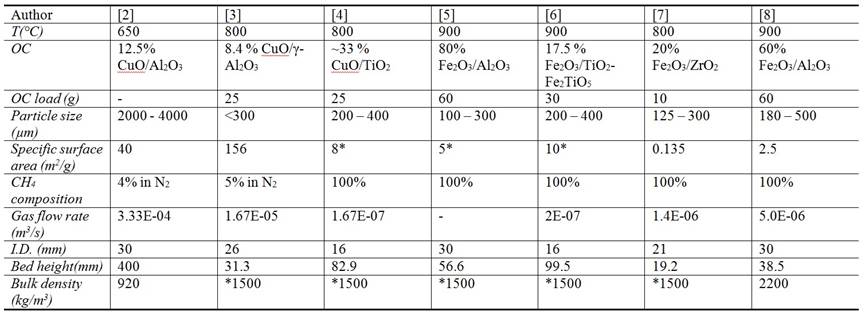
In this presentation, operating conditions, design values and OC characterization is presented for the three most common metal oxides and natural gas. Implementation of the kinetic network in different fixed-bed units of the various CLC laboratories will be shown.
|
|
Figure 1: Fixed-bed chemical-looping setup used in this work. | Figure 2: Chemical-looping reduction selectivity using Ni/NiO and CH4 in fixed-bed reactors; experimental data from UConn fixed-bed reactor at 800蚓. |
Acknowledgement: This material is based upon work supported by the National Science Foundation under Grant No. 1054718.
References:
[1] Z. Zhou, G.M. Bollas, Holistic Kinetic Study of the Reduction of CH4 with NiO in Chemical-Looping Combustion, AIChE Annual Meeting, Pittsburgh, PA. (2012).
[2] S. Noorman, F. Gallucci, M. van Sint Annaland, J.A.M. Kuipers, Experimental Investigation of Chemical-Looping Combustion in Packed Beds : A Parametric Study, Industrial & Engineering Chemistry Research. (2011) 1968每1980.
[3] P. Ammendola, R. Chirone, L. Lisi, G. Ruoppolo, G. Russo, Copper catalysts for H2 production via CH4 decomposition, Journal of Molecular Catalysis A: Chemical. 266 (2007) 31每39.
[4] B. Corbella, L. De Diego, F. Garcia, The performance in a fixed bed reactor of copper-based oxides on titania as oxygen carriers for chemical looping combustion of methane, Energy & Fuels. 19 (2005) 433每441.
[5] F. He, H. Wang, Y. Dai, Application of Fe2O3/Al2O3 Composite Particles as Oxygen Carrier of Chemical Looping Combustion, Journal of Natural Gas Chemistry. 16 (2007) 155每161.
[6] B.M. Corbella, J.M. Palacios, Titania-supported iron oxide as oxygen carrier for chemical-looping combustion of methane, Fuel. 86 (2007) 113每122.
[7] W.C. Cho, M.W. Seo, S.D. Kim, K.S. Kang, K.K. Bae, C.H. Kim, et al., Reactivity of iron oxide as an oxygen carrier for chemical-looping hydrogen production, International Journal of Hydrogen Energy. 37 (2012) 16852每16863.
[8] T. Mattisson, A. Lyngfelt, P. Cho, Possibility of using iron oxide as an oxygen carrier for combustion of methane with removel of CO2 - application of chemical looping combustion, in: Proc. 5th Int Conf Greenhouse Gas Control Technologies (GHGT-5), Cairns, Australia, 2000.
See more of this Group/Topical: Catalysis and Reaction Engineering Division