
 Google
 Yelp
 Facebook
 Twitter
 ChEnected
337307 Investigation of a Novel Platform for Manipulation of Microparticles Using Dielectrophoresis
Investigation of a Novel Platform for Manipulation of Microparticles using Dielectrophoresis
Stephanie Angione1, Derek Croote1, Sara Karlberg2, Anubhav Tripathi1
1Center for Biomedical Engineering, School of Engineering and Division of Biology and Medicine, Brown University, Providence, RI
2 School of Biotechnology, KTH Royal Institute of Technology, Stockholm, Sweden
Introduction:
Dielectrophoresis (DEP) is a commonly used tool for the study and manipulation of micron and sub- micron particles, including biological molecules, in solution. Because biological molecules of interest are often found at concentrations so low that immediate analysis by current methods is not possible, pre-concentration is necessary as a prior step. The field of diagnostics is plagued by the use of off-chip pre-concentration methods, which prevents real-time testing in resource-poor settings at the point of care. Current DEP platforms do not address the needs of diagnostic applications where pre-concentration of sample must be completed in a rapid and simple manner. Our novel platform, is a potential solution to this problem as it combines the established science of DEP for the manipulation of DNA, proteins and cells with a unique electrode material and geometry.
Materials and Methods:
Polystyrene microparticles (FluoSpheres, Invitrogen) were characterized by the manufacturer as being 9.9 ±0.1188 µm in diameter, with a density of 1060 kg/m3. The stock concentration was given as 3.6 x 10⁶ beads/mL, and further diluted in 1000 µl of the appropriate conductivity KCl solution. Experiments were performed on a Nikon Eclipse TE2000 inverted microscope equipped with a Pixelink PL-B681 CMOS camera for image and video acquisition. The polydimethylsiloxane (PDMS) microchip containing micro-channels and reservoirs was designed to allow for imbedding of the pipette tips within the design. PDMS microchip fabrication was done using standard photolithography procedures.
Results and Discussion:
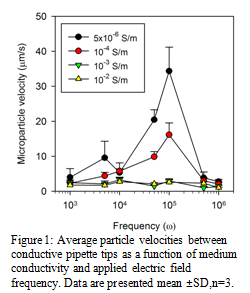 We present the validation of an
innovative electrode material and PDMS microchannel geometry for dielectrophoretic concentration of 10 µm polystyrene beads.
We have implemented carbon black compounded polypropylene pipette tips as
viable electrodes for the generation of electric fields in solution that can be
implemented to concentrate and target particles within the pipette tips for
easy removal. We have performed modeling and experimental validation of the
particle movement, which indicates that microparticle
behavior is a function of conductivity and frequency. The observed relationship
of particle velocity to medium conductivity and applied electric field
frequency has practical implications for particle manipulation using conductive
pipette tips. To accomplish successful trapping, the particle velocities were
maximized and Figure 1 displays the microparticle
velocity as a function of frequency and conductivity, indicating that the 5x10⁻⁶
S/m conductivity solution with an applied electric field frequency of 105
Hz was optimal for increasing the particle motion. This platform provides an
innovative way to improve diagnostic techniques and sensitivity by targeting,
trapping and concentrating particles.
Conclusion:
The aim of this work was to create a platform to utilize and validate carbon black compounded polypropylene pipette tips as viable electrodes for the generation of electric fields in solution. The use of this innovative electrode material for dielectrophoresis of 10 µm polystyrene particles was established as a proof of concept for pre-concentration, trapping and targeting of particles. We characterized the behavior of microparticles in solutions of varying conductivities under the effects of applied electric fields of varying frequencies to optimize particle motion and trapping. Further work will focus on concentrating and trapping DNA from dilute solutions for direct amplification and detection using nucleic acid amplification methods.
See more of this Group/Topical: 2013 Annual Meeting of the American Electrophoresis Society (AES)