
 Google
 Yelp
 Facebook
 Twitter
 ChEnected
337311 Energy Diversification in the Middle East: How to Double a Region's Energy Resources
Energy Diversification in the Middle East: How to double a Region's Energy Resources
Massimiliano Kolbea, Zohreh Ravaghi-Ardebili*b
a Baker Engineering and Risk Consultants, Inc.,11011 Richmond Avenue, Suite 700, Houston, Texas
b Politecnico di Milano, Dipartimento di Chimica, Materiali e Ingegneria Chimica,”Giulio Natta”, Piazza Leonardo da Vinci 32, 20133, Milano, Italy
*zohreh.ravaghi@mail.polimi.it, mkolbe@bakerrisk.com
Due to the favorable climatic conditions, the Middle East is considered as a one of the best candidates for development and production of renewable (particularly solar) resources. It is estimated that during 80% of the year, these regions are exposed to tremendous quantities of solar radiation. In addition, the majority of these regions are desolate, unusable lands where many of the world's largest oil and gas reserves can be found beneath them. Oil and gas has enriched the Middle Eastern economies for decades and provided a quick path to wealth and development. However, not all Middle Eastern countries have this natural abundance of oil and gas, nor does this resource exist equally everywhere in the regions which do have this abundance. Therefore, considerations must be made in the management of this nonrenewable energy source in tandem with the ever present renewable solar energy source in such a way so as to balance the energy production and consumption. In so doing we can protect, strengthen and grow the economics of the region's oil and gas industries which in many cases are by far the largest source of income for many Middle Eastern nations.
Qatar and Saudi Arabia possess vast fields of natural gas; however it is important to trade and export LNG in order to sustain the economies of these regions. Equally as important, the natural gas can be fractionated to produce NGL components for petrochemical feedstock which are later used in the production of polymers. These countries currently do not fully benefit from other durable sources of income (such as: agricultural, manufactured goods, food processing, etc) in order to balance and sustain the national cash flows. Similarly, Kuwait, Oman and the United Arab Emirates are richer in crude oil resources and cannot benefit as much from petrochemical feedstock from natural gas. Although, Saudi Arabia is plentiful in oil and gas, the produced oil is practically sustaining the economy, and a large portion of the produced gas is driven into the generation of power to supply facilities, buildings and desalination plants. Accordingly, Bahrain and Yemen are not as rich in oil and gas as other countries in this region and are therefore strongly dependent in foreign energy supply for their sustainability.
Fortunately all of these regions are extremely rich in sunlight (and heat). Conversely nearly all of these countries are extremely poor in fresh water resources. Ergo, it is necessary to generate power to not just produce the electricity but to run desalination plants to purify salt water into potable water as well as to run the next highest energy consumption devices; air conditioning and chilling systems. Potable water production from desalination and air conditioning/chilling are vital requirements for such climates and geographies given their need and scarcity. Hence, the produced oil and gas which would practically be the main true source of income is being used as a commodity as well as being used to sustain the power production and infrastructure of the country. Oil and gas are non-renewable and finite, fresh water is already a scarcity in these regions; harnessing solar power and developing this technology as part of the infrastructure to the Middle Eastern region is a vital and logical next step in the quest for sustainability and strengthening the region's economies.
Solar radiation at its peak is above 8000 W-h/m2 in Kuwait alone and can be mentioned as being the largest potential for solar power harnessing in this region and consequently benefiting from common solar technologies for power generation such as photovoltaic and concentrated solar power (CSP) plants taking into consideration the available geographic surface area and the need to generate the power without using the only real sellable commodity; crude oil. The UAE is considered as a second potential for solar radiation availability among the other six countries in the region with an average of 7000 W-h/m2; considering the large modern cities, commercial and industrial facilities harnessing solar power would significantly decrease the national consumption oil and gas which could otherwise be sold internationally. Though the Middle East is considering ramping up the installation of CSP plants this goal will be a long term achievement, on the other hand use photovoltaic panels to capture solar energy for domestic, industrial and commercial buildings is completely tangible in the short term.
Electricity is the appealing and clean form of the power, the efforts to produce it via a technology using renewable and abundant resource would be even more promising. Inasmuch, the idea to produce power for commercial buildings and facilities via photovoltaic solar panels should be strongly considered. Photovoltaic cells in the panels which convert the photons (light) to voltage (electricity); power produced from these panels is in the form of direct current and by means of converters it is then converted to alternating current which is the most applicable form of energy in households and buildings. This procedure of generating the power would be managed individually by the building's owners, industrial administrators and for commercial constructers to establish, collect and provide the power units and their installation along with the tie in to the electrical grid system.
Practically speaking, the path to creating simple yet substantial power sources using photovoltaic solar panels is far more obtainable than once thought due to increased size of cities, industrial facilities and use of automobiles. If we simply considered these public and industrial facilities including the petrochemical sites, malls and hotels typically all hold a large area nearby as parking lots (public car parks) all typically equipped with awnings and shading structures with strong metal frames (see Figure 1 below).
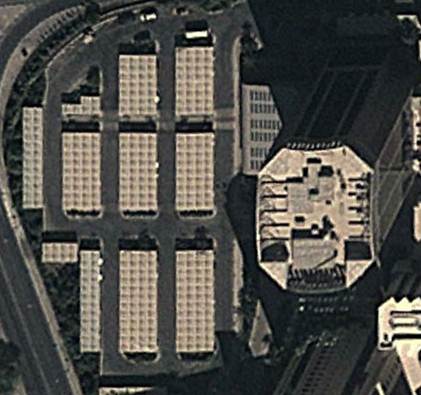
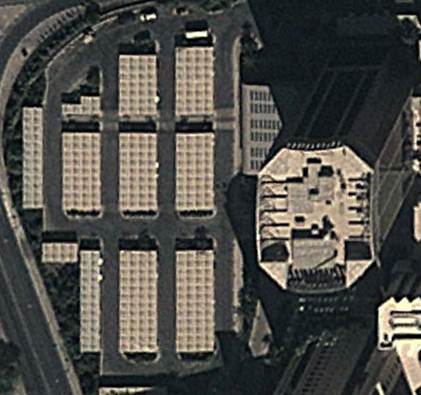
Figure 1. Public building making use of the steel shade parking covers (seen in the red square)
As it can be seen from the typical car park above, these areas are generally very large solid structures made with steel framing and covered with solid material oriented for the purpose of protecting the cars from the sun's radiation. By making use of these strong structures (clearly capable of holding significant loads) and installing photovoltaic solar panels over them, large gathering surfaces can be created. The example above in fact can supply over 1,800 m2 of surface area, with an average solar panel efficiency of 170 W/m2, this particular car park could generate over 300 kW of electrical power. The battery storage or even in some cases grid connections might be easily located in the facility to convert the collected energy and distribute to the nearby building. More importantly in the case of a typical refinery or petrochemical facility, the car parks are much bigger and could potentially produce over 2.5 MW of power with the simple installation of photovoltaic solar panels. Thus, the solar panel collection system would potentially provide all the required lighting or air conditioning for these buildings. It is worth noting that the energy management would not suffer from the logistics of such a system since it is a main part of the energy management.
By prearranged backgrounds, the authors put efforts to propose and plan applicable solutions for the management of energy which could ultimately increase national cash flows going into the country by using photovoltaic solar collecting systems all over cities and in large petrochemical sites throughout Middle East. The discussed and proposed solutions would be provided with detailed calculations for required electrical energy demands, production and consumption, price balances and power generation management to indirectly assist the growth and promote stability in the oil and gas market. Such a movement for using photovoltaic panels or CSP plants could potentially increase the GDP of a typical Middle Eastern country, solve environmental issues and consequently avoid the local use of natural gas to run power plants, petrochemical sites and desalination plants and to divert local high consumption of oil and gas for power generation to the market for sale outside the country and increase cash flows into the country.
In addition, a comparison of energy sources and power generation will be made with the highest energy consumers of the world; USA, China and EU, their energy prices and GDPs and how it relates to their consumption and production of energy. The Middle Eastern countries are generally reliant on oil and gas for their economies and have less consideration of supplementary energy sources. The only approach could be implemented with the integration of energy management which is almost a function of culture and background of this region. Considering the large capital currently produced from the sale of oil and gas from these regions, the available technologies in solar energy generation and the largely available solar radiation in these regions, there is very little risk and high reward in the this solution for increased energy management efficiency.
See more of this Group/Topical: Sustainable Engineering Forum