
 Google
 Yelp
 Facebook
 Twitter
 ChEnected
338109 In-Situ XAS and AP-XPS of Ni-Cu Supported Catalysts Under Ethanol Dehydrogenation Reaction
In-situ XAS and AP-XPS of Ni-Cu Supported Catalysts under Ethanol Dehydrogenation Reaction
Allison Cross1, Shiran Zhang2, Jeff Miller3, Franklin (Feng) Tao2, Alexander Mukasyan1, and Eduardo E. Wolf1*
1Chemistry and Biomolecular Engineering, 2Chemistry, University of Notre Dame, Notre Dame, Indiana 46556 (USA)
3Argonne National Lab, Lemont, Illinois 60439 (USA)
*ewolf@nd.edu
Introduction
Most characterization techniques are conducted ex-situ, which does not account for effects the catalytic reaction or treatments have on the surface structure and composition of catalysts which often change by exposure to different gases or temperature. This study is focused on using several in-situ techniques to determine the active sites of single and bimetallic supported Ni/Cu catalysts. Previous work in our group has shown that these metals are active for ethanol dehydrogenation [1-2], which is the model reaction chosen for this study.
Through collaboration with Tao's group, the near surface oxidation states and concentrations of these supported catalysts during reaction, as well as under reducing and oxidizing conditions were explored with ambient pressure XPS (AP-XPS). These results can be compared with the same catalysts under the standard UHV-XPS, as well as with in-situ XAS available at the Advanced Photon Source at Argonne National Laboratory (APS-ANL). This study will ascertain which technique best correlates the surface properties with the catalyst's activity and selectivity.
Materials and Methods
Catalysts were prepared by the combustion synthesis method, in which metal nitrates (Ni, Cu) and glycine are combined in solution, impregnated onto a support (Al2O3, CeO2, SiO2) and then ignited at one end to begin a combustion front that propagates throughout the sample, producing supported metal/metal oxides in a single-self sustained step [3].
Activity and selectivity results of the ethanol decomposition reaction were obtained in a continuous flow fixed bed reactor [2]. Oxidation states were measured with AP-XPS and in-situ XAS. In both cases, samples were exposed to the reactive gases after pretreatments at temperatures up to 400°C. In the AP-XPS studies only a few torrs of ethanol could be introduced to the system whereas in in-situ XAS, ethanol could flow continuously under similar conditions as those used in the kinetics; however, due to the limitation imposed by x-ray transmission only a small amount of catalyst was used in the XAS studies. Likewise, only a small amount of catalysts was needed for the AP-XPS studies.
Results and Discussion
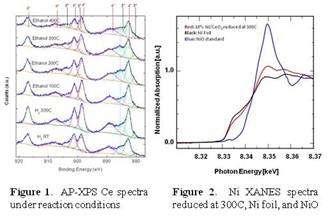
Distribution of active metal on an alumina support was investigated and determined to have a direct correlation with selectivity [1]. Studies varying the support and metal concentration were then characterized by in-situ XAS, UHV-XPS, and AP-XPS for comparison between the techniques and to determine the effect reaction conditions have on the catalysts, as well as effects of active metals and supports. AP-XPS Ni spectrum shows a reduction from initial highly oxidized sample to reduced Ni metal after exposure to H2 at 300°C; however, no other change in Ni oxidation state occurs through the remainder of the experiments. Interestingly, the ‘inert' support cerium spectrum shows changes in oxidation state. Fig. 1 shows cerium AP-XPS spectra collected on a 20% Ni/CeO2 catalyst after H2 reduction and under reaction at various temperatures showing a change between Ce3+ and Ce4+. In-situ XANES data of a 10% Ni/CeO2 catalyst seen in Fig. 2 showed that 85% of the oxidized catalyst is reduced to metallic Ni after hydrogen reduction at 300°C. The oxidation state once exposed to ethanol was slightly more reduced and as temperatures increased there was a decrease in particle size of the nickel crystallites. Other important conclusions of the XAS results are that Ni is more reduced over ceria than silica, and that by adding Cu to Ni, the crystallite size does not change as much with temperature as in the monometallic catalyst. No changes in the oxidation state of ceria could be detected in the XAS studies as these measurements were dominated by signal from bulk instead of near surface results of the AP-XPS results. The results of both AP-XPS and in-situ XAS of all samples will be presented, along with the correlations to activity and selectivity. The techniques appear to give complementary information that helps to elucidate more accurately the changes occurring on both the surface and the bulk.
Significance
Determining the nature of the active sites under reaction conditions, which can differ from the conditions that most characterization techniques must operate under, can lead to a deeper understanding of the effect the role of the reaction has on these sites. This can allow to select pretreatment and operating conditions for optimal oxidation state and activity-selectivity to be established and hence, more selective catalysts to be obtained.
References
1. Cross, A., Kumar, A., Wolf, E. E., and Mukasyan, A. S. Ind. Eng. Chem. Res. 51, 12004-12008 (2012).
2. Kumar, A., Mukasyan, A. S., and Wolf, E. E. Appl. Catal. A: General 372, 175-183 (2010).
3. Mukasyan, A. S. and Dinka, P. Int. J. Self-Propag. High-Temp. Synth.16, 23-35 (2007).
See more of this Group/Topical: Catalysis and Reaction Engineering Division