
 Google
 Yelp
 Facebook
 Twitter
 ChEnected
338160 Ex-Vivo Analysis of Lipid Impact On Intestinal Mucosa Barrier
Ex-vivo Analysis of Lipid Impact on Intestinal Mucosa Barrier
Hasan Yildiz, yildiz.h@husky.neu.edu
Rebecca L. Carrier, rebecca@coe.neu.edu
Introduction:
A heterogeneous mucus layer has evolved to protect exposed epithelial surfaces by trapping environmental microorganisms while allowing the passage of certain compounds (e.g., nutrients) across the epithelium. Our previous results indicate that exogenous lipids that may be associated with food or drug delivery systems significantly impact intestinal mucus barrier properties. However, these studies were conducted using collected (scraped) porcine intestinal mucus, and recent literature indicates that intestinal mucus is not isotropic. The main objective of this work is to analyze the impact of lipids on particle transport across intact mucus on an intestinal explant.
Materials and Methods:
Transport of model drug carriers was investigated using 3 week old wild type FVB/N mouse small intestine. Mice were euthanized via CO2. Intestine fragments were dissected, cut open to expose the intestinal lumen, and placed into a chamber on a concavity slide. 200 nm carboxylate- modified polystyrene microspheres were diluted in maleate buffer or simulated fed state intestinal contents (“FED state”) including maleate buffer, bile salts, phospholipids (lecithin) and a lipid mixture comprised of 35 mM soybean oil, 30 mM sodium oleate and 15 mM monoglycerol for a final particle concentration of 0.0025 wt.-%. 5 µl of diluted particle solutions were then added on top of tissue segments and the system was equilibrated for 1 h at 25 0C prior to microscopy in a humid chamber. Particle diffusion was measured by tracking the positions of diluted microspheres using real- time multiple particle tracking technique (MPT). Positions of particle centroids were used to calculate time-averaged mean squared displacements (MSD) and effective diffusivities (Deff): MSD = [x(t+τ)-x(t)]2 + [y(t+τ)-y(t)]2 and Deff = MSD/(4τ) where x and y are positional data and τ is the time scale.
Results:
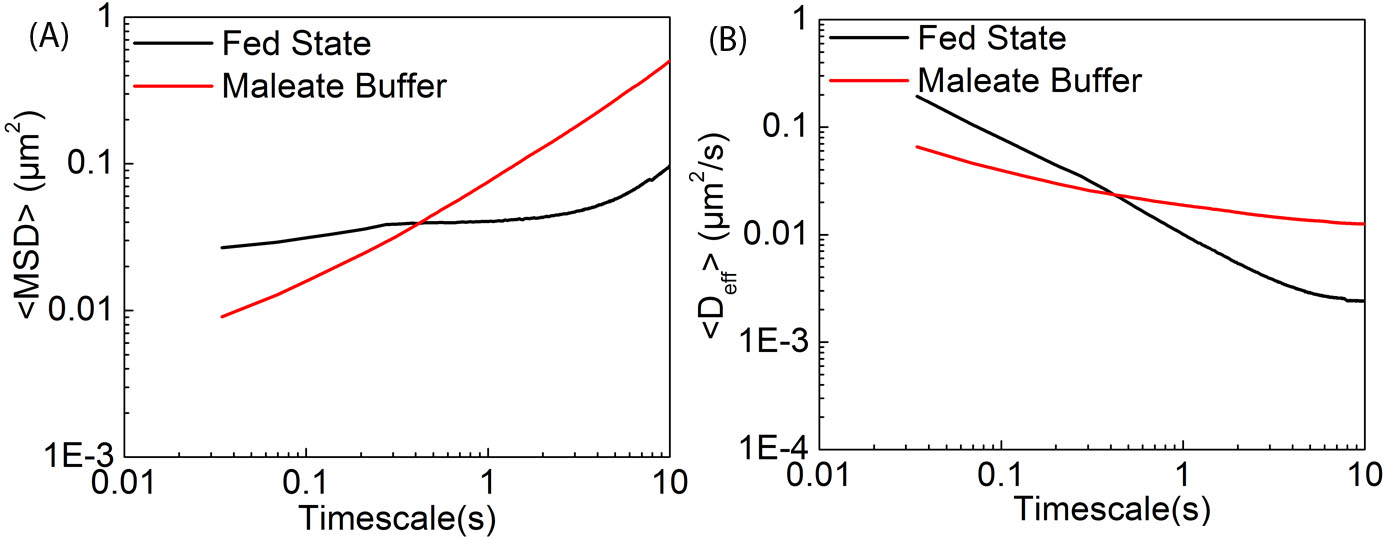 Intestinal
contents characteristic of the fed state, including model bile and lipids,
markedly reduced particle transport rate through intact ex vivo intestinal mucus.
At a time scale of 10
s, transport rates of 200 nm carboxylate-modified particles in FED State were
nearly 5-fold lower than those of same-size particles in maleate buffer. Intermolecular
interactions, potentially including lipid-particle and/or lipid-mucus
interactions, possibly retard particle diffusion in the gastrointestinal tract.
Furthermore, effective diffusivities in maleate buffer in scraped mucus and
intestinal explant were on the same order, whereas in Fed State diffusivities
in explant tissue are an order of magnitude higher than collected porcine
intestine mucus.
Conclusions:
Food-associated lipids strengthen the intestinal mucus barrier to particulate matter. These results motivate in vivo in-depth investigation of the impact of lipids on mucosal barriers to facilitate lipid-based delivery of drugs and potentially enable control of pathogen invasion in disease.
See more of this Group/Topical: Food, Pharmaceutical & Bioengineering Division