
 Google
 Yelp
 Facebook
 Twitter
 ChEnected
338219 Modeling and Optimization of Coupled Fe- and Cu- Based Selective Catalytic Reduction Monolithic Catalyst
Modeling and Optimization of Coupled Fe- and Cu- based Selective Catalytic Reduction Monolithic Catalyst
Bijesh M. Shakya, Michael P. Harold[1], and Vemuri Balakotaiah[2]
Department of Chemical & Biomolecular Engineering
University of Houston 77204-4004
Abstract
Fe- and Cu-exchanged zeolites are two of the leading catalysts for the selective catalytic reduction (SCR) of NOx with NH3 under lean conditions. It is established that Cu-exchanged SCR catalysts exhibit higher activity than Fe- based catalysts at lower temperatures (<350oC) and are comparatively less sensitive towards NO/NOx ratio. However, at higher temperatures (>400oC), NOx conversion in Cu- catalyst is lower compared to Fe- catalyst due to higher rate of undesired ammonia oxidation reaction. This observation that Cu- and Fe- catalysts give higher activity at lower and higher temperatures, respectively, has led to the concept of combined Fe- and Cu-based SCR catalysts [1]. Particularly, two configurations (dual-brick and dual-layer) have been investigated experimentally [1], both of which have shown to yield higher NOx conversion over wider temperature range compared to individual catalyst. However, an in-depth comparison between dual-brick and dual-layer configuration has not been analyzed in the literature. In this study, we use recently developed kinetic models for Fe-ZSM5 and Cu-CHA SCR catalysts [2] to perform detailed analysis of brick and layered configuration of combined catalysts [3].
We use conventional 1D+1D mathematical model of catalytic monolith that accounts for the diffusion of species in the washcoat phase. The species diffusion in the washcoat plays crucial role in determining the optimal configuration of the combined system. Simulations were performed to identify temperature range over which diffusional limitation becomes important. Fig 1(a) shows the comparison of standard SCR reaction (NH3+NO+O2) on Cu-CHA and Fe-ZSM5 [2]. The dashed lines represent the conversion when the washcoat diffusivities are increased by a factor 2. It can be seen that washcoat diffusion for standard SCR reaction is important in the temperature range of 180-300oC and 290-470oC for Cu-CHA and Fe-ZSM5 catalysts respectively. Above these temperature ranges the system is essentially in external mass transfer controlled regime. To compare the performance of different configurations of dual-layer and brick under standard SCR reaction conditions, we define a function “f” which is the normalized square of difference between calculated conversion and maximum measured conversion i.e. maximum of conversion obtained by Cu-CHA and Fe-ZSM5 (circled data points in Fig 1(a)). Fig 1(b) shows the computed f-values for different composition of Fe- and Cu- catalyst both dual-layer and dual-brick. In all cases, either Fe- layer is coated on top of Cu- (dual layer) or Fe- brick is followed by Cu- brick (dual brick) [2]. It can be seen that dual-brick performance is always better than that of dual-layer. This behavior can simply be explained in term of diffusional limitation that is created in the dual-layer catalyst. As we can see from Fig 1(a) diffusional limitations for standard SCR reaction arises in the temperature range of 180-350oC in which Cu- catalyst outperforms Fe-. As a result, the underlying Cu layer in the dual-layer catalyst experiences severe diffusional limitation lowering the conversion.
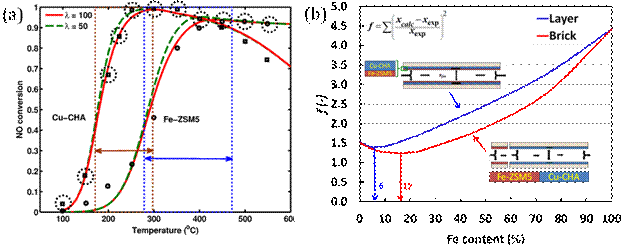
Fig 1 (a) Comparison of model predicted and experimental NO conversion during the standard SCR reaction on Fe-ZSM5 and Cu-CHA catalyst for different values of diffusivity ratios (λ=Df/De) (b) Comparison of dual layer and dual brick configuration of Fe-ZSM5 and Cu-CHA catalyst for different Fe-ZSM5 content (volume fraction) during standard SCR reaction Condition: 500 ppm NO, 500 ppm NH3, 5% O2 and 2% H2O
Finally, we also analyzed the impact of feed composition on the performance of combined system. Based on these analyses, an optimal loading of Fe- and Cu- washcoat is identified for the case of dual-layer and dual-brick configuration.
References:
1. P.S. Metkar, M.P. Harold and V. Balakotaiah, Appl Catal B: Environ, 111–112 (2012) 67
2. P.S. Metkar, M.P. Harold and V. Balakotaiah, Chem Eng Sci, 87 (2013) 51
3. B.M. Shakya, M.P. Harold and V. Balakotaiah, in preparation
[1]Corresponding author: Tel.: +1 713 743 4322; Fax: +1 713 743 4323; Email: mharold@uh.edu (M. P. Harold)
[2]Corresponding author: Tel.: +1 713 743 4318; Fax: +1 713 743 4323; Email: bala@uh.edu (V. Balakotaiah)
See more of this Group/Topical: Catalysis and Reaction Engineering Division