
 Google
 Yelp
 Facebook
 Twitter
 ChEnected
338420 A Systematic Methodology for the Modeling of Intrinsic Chemical Reaction Kinetics: N-Hexane Hydroisomerization On a Bifunctional Zeolite
Kinetic modeling of chemical reactions is, among others, an important item of chemical engineering education. The presented work focuses on a systematic methodology for modeling the non-isothermal intrinsic kinetics of chemical reactions allowing their later incorporation into more complex reactor models. While a dedicated experimental campaign should typically aim at the acquisition of intrinsic kinetics, transport phenomena at the industrial reactor scale can be accounted for via well-known correlations from literature [1].
The proposed methodology start with an analysis of the experimental data as a function of the operating conditions, see Figure 1. Insights in the actual reaction mechanisms are pursued and first considerations with respect to the structure of the corresponding rate equations can be made. As a second step in the construction of a kinetic model, a preliminary determination of the kinetic parameters is performed. This is necessary since the response surface determined by the objective function, i.e., the sum of squares of residuals of the responses, may contain multiple maxima and minima. This can be done via a literature survey or quantum chemical calculations. An alternative method to determine good initial parameter values for pre-exponential factors and activation energies/reaction enthalpies, is to perform an isothermal regression for each temperature and fit the results to the Arrhenius equation. Thirdly, the actual non-isothermal regression is performed. Lastly, the regression results are analyzed. This is based on a statistical analysis and verification if the kinetic model and parameters obtained are physically viable. The statistical analysis comprises the investigation of the confidence intervals, binary correlation coefficients, test for model adequacy, regression and parameter significance and residual analysis (performance plots, residual figures, parity diagrams and Q-Q plots).
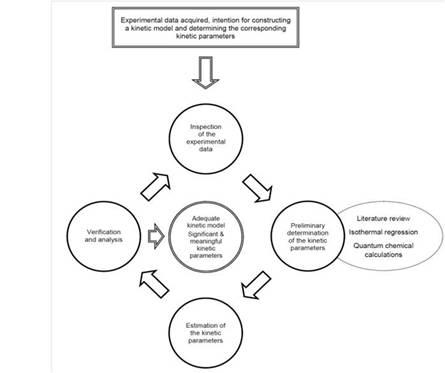
Figure 1: Proposed methodology for kinetic modeling
A simple, yet challenging, reaction is taken as example through this contribution, i.e., the hydroisomerization of n-hexane on a bifunctional catalyst MC-389, i.e., a with platinum impregnated USY derived catalyst. The metallic function of the catalyst allows to operate at milder conditions. This is due to the dehydrogenation of the physisorbed alkanes which occurs on the Pt sites and results in the formation of olefins, see Figure 2. It also provides resistance against coking.
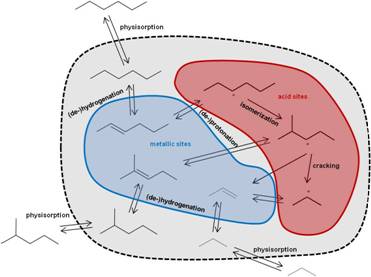
Figure 2: Schematic overview of (ideal) hydroisomerization of n-hexane over a bifunctional zeolite
These olefins are then relatively easily protonated on the acid sites, where the actual conversion to isomers and cracked products occurs. Only 3 reaction products are observed: 2-methyl-pentane, 3-methyl-pentane and propane. The experimental conditions ranged from 493 to 573 K, 1.0 to 2.0 MPa and a molar hydrogen to hydrocarbon ratio of 50 to 100 mol mol-1 at a space-time of 191.0 kgcat s molC6-1. These reaction conditions resulted in so-called ideal hydrocracking [2-4]. Ideal hydrocracking occurs if the acid catalyzed conversion reactions are the rate determining steps, which leads to very specific kinetic behavior. Figure 3 shows the experimental and simulated conversion of n-hexane by hydroisomerization on MC-389 catalyst as function of temperature at different hydrogen to n-hexane molar feed ratios. With increasing hydrogen to n-hexane ratio, the conversion is decreasing which indicates that (de-)hydrogenation is in quasi-equilibrium.
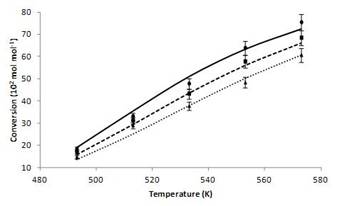
Figure 3: Conversion of n-hexane by hydroisomerization on MC-389 catalyst as function of temperature at different hydrogen to n-hexane molar feed ratios. Lines are calculated by the kinetic model. Circles, full line: F0H2 / F0C6 = 50 mol mol-1; squares, dashed line: F0H2 / F0C6 = 75 mol mol-1; triangles, dotted line: F0H2 / F0C6 = 100 mol mol-1.
The reaction network was constructed under the validated assumptions of ideal hydrocracking kinetics and the corresponding rate equations were derived:
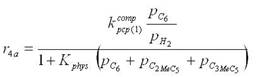 Eq.1
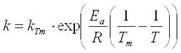
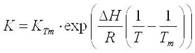
in which pC6 is the partial pressure of n-hexane, Kphys is the equilibrium coefficient for physisorption, kicomp is the composite rate coefficient for pcp-branching or beta-scission. The rate coefficients and equilibrium coefficient are described by a reparametrized Arrhenius or Van ‘t Hoff equation in order to decrease the binary correlation between the pre-exponential factor and activation energy:
In
total, 8 kinetic parameters are determined, i.e., the rate and equilibrium
coefficients at the mean temperature, i.e., kTm and KTm, and the corresponding activation
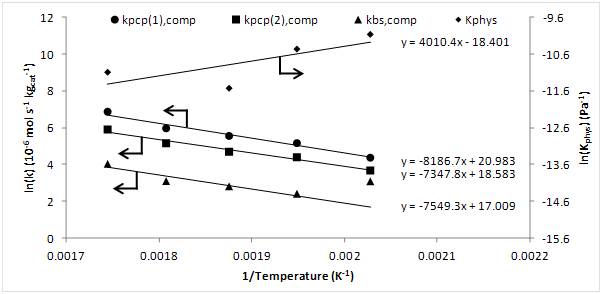
energy and reaction enthalpy. Good initial guesses were acquired via isothermal
regression, see Figure 4 and Table 1.
Figure 4: Arrhenius plots, ln(k)
and ln(K) as function of the reciprocal of
temperature for which an initial guesses for the pre-exponential factors and
activation energies/reaction enthalpy are obtained for non-isothermal
regression.
Table 1: Determined values of the kinetic/equilibrium
coefficient at average temperature and activation energy and reaction enthalpy
by the isothermal regression and the Arrhenius plots, see Figure 4.
kTm or KTm (10-6 mol s-1 kgcat-1 or Pa-1) Ea or ΔH (kJ mol-1) kpcp(1),comp 264.9 68.0 kpcp(2),comp 116.5 61.1 kbs,comp 16.5 62.8 Kphys 1.2 10-5 -79.5 Non-isothermal
regression, i.e., regression taking into account of all experimental data at
once, led to the significant determination of all 8 kinetic parameter, see
Table 1.
Table 2: Parameter estimates, corresponding
confidence interval and t values of the kinetic/equilibrium coefficients at
average temperature and activation energies and reaction enthalpy determined by
non-isothermal regression.
kTm or KTm (10-6 mol s-1 kgcat-1 or Pa-1) Ea or ΔH (kJ mol-1) k4a,obs 258.6 ± 38.9 65.5 ± 9.2 k4b,obs 115.7 ± 17.8 57.1 ± 8.8 k5,obs 15.4 ± 5.8 65.8 ± 24.2 K1 (1.1 ± 0.9) 10-5 -83.4 ± 34.4 The
model has a higher F value for the global significance of the
regression, i.e., 758.4, than the corresponding tabulated F value, i.e.,
3.9. All parameters are estimated significant as indicated by the relatively
narrow confidence intervals. The parameter estimates also have a clear physical
meaning. All binary correlation coefficient were lower than 0.95 which
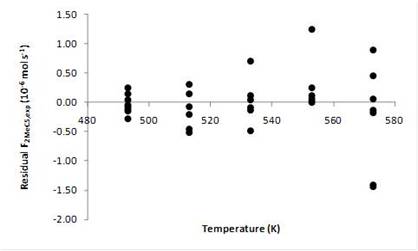
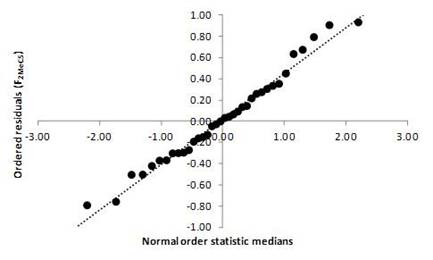
indicates that all parameters are uncorrelated with each other. A residual
analysis showed that the model is capable of predicting the experimental
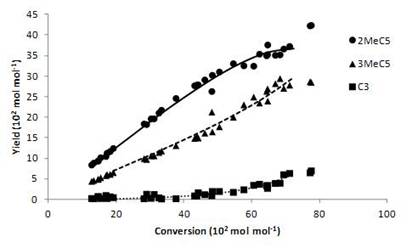
observations, as shown the performance figure (Figure 5). Also the residuals
seem to be normally distributed with an expected value equal to 0 and without
having any systematic deviations as function of the independent variables as
shown by the residual figure (Figure 6) and Q-Q plot (Figure 7).
Figure 5: Product yield of
n-hexane hydroisomerization on MC-389 catalyst as function conversion. Lines
calculated by the kinetic model. Circles, full line: 2-methyl-pentane; squares,
dashed line: 3-methyl-pentane; triangles, dotted line: propane.
Figure 6: Residual figure for the molar outlet flow
rate of 2-methyl pentane temperature determined by the kinetic model.
Figure 7: Q-Q plot of the residuals of the molar
outlet flow rate of 2-methyl pentane determined by the kinetic model.
In
summary, a systematic methodology for non-isothermal modeling of intrinsic
chemical kinetics has been proposed. Inspection of the experimental data leads
to an increased insight in the reaction mechanism and corresponding rate
equations. Good initial parameter values are essential to obtain the optimal
parameter values during non isothermal regression and can be acquired via
isothermal regression. After regression, statistical tools can be used to
evaluate the significance of the regression and performance of the model. This
methodology has been successfully applied to n-hexane hydroisomerization
on a bifunctional zeolite.
[1]
G.F. Froment, K.B. Bischoff, Chemical reactor
analysis and design (1990) [2] T.F. Degnan,
C.R. Kennedy, AIChE Journal. 39 (1993) 607-614. [3] G.E. Gianetto,
G.R. Perot, M.R. Guisnet, Ind. Eng. Chem. Res. 25 (1986) 481-490. [4] J.W. Thybaut, C.S.L. Narasimhan, J.F. Denayer, G.V. Baron, P.A. Jacobs, J.A.
Martens, G.B. Marin, Ind. Eng. Chem. Res. 44 (2005) 5159-5169.
See more of this Group/Topical: Education Division