
 Google
 Yelp
 Facebook
 Twitter
 ChEnected
338448 Membranes With Sulfonated Perfluorocyclobutane (PFCB) Ionomer for Fuel Cells
Membranes with Sulfonated Perfluorocyclobutane (PFCB) Ionomer for Fuel Cells
Ruichun Jiang, Timothy Fuller, Craig Gittleman
Global Fuel Cell Activities, General Motors Company
895 Joslyn Ave, Pontiac, MI 48340, USA
Ruichun.Jiang@GM.com
Polymer electrolyte fuel cells (PEFC) have been regarded as one of the most promising power sources for various applications. As the heart of PEFC, the proton exchange membrane, or PEM, plays a critical role in proton transport, electrical isolation and reactant gas separation between anode and cathode components of a fuel cell. Perfluorosulfonic Acid (PFSA) ionomers, such as Nafion® from Dupont, are the most commonly used materials for PEMs because of their favourable proton conductivity, and mechanical and chemical durability characteristics. There are, however, drawbacks associated with the use of PFSA membranes. These include high cost and high gas permeability which contributes to reductions in both fuel cell efficiency and durability. To overcome these deficiencies, hydrocarbon membranes with aromatic backbones have received considerable attention as PEM materials due to their lower gas permeability and decreased production costs.
A new class of hydrocarbon block copolymer membrane based on perfluorocyclobutane (PFCB) chemistry was developed at General Motors for fuel cell PEM applications. The PEMs with sulfonated PFCB ionomer demonstrate benefits of low production costs, good proton conductivity, and lower gas (H2, O2, N2) permeability than PEM with PFSA ionomer. One of the challenges for sulfonated PFCB based PEMs is enhancing their mechanical stability. Several strategies, including blending PFCB ionomer with a poly(vinylidene fluoride) (PVDF) elastomer, and introducing reinforcement layer containing expanded polytetrafluoroethylene (ePTFE) have been investigated to develop composite PFCB PEMs with improved mechanical properties.
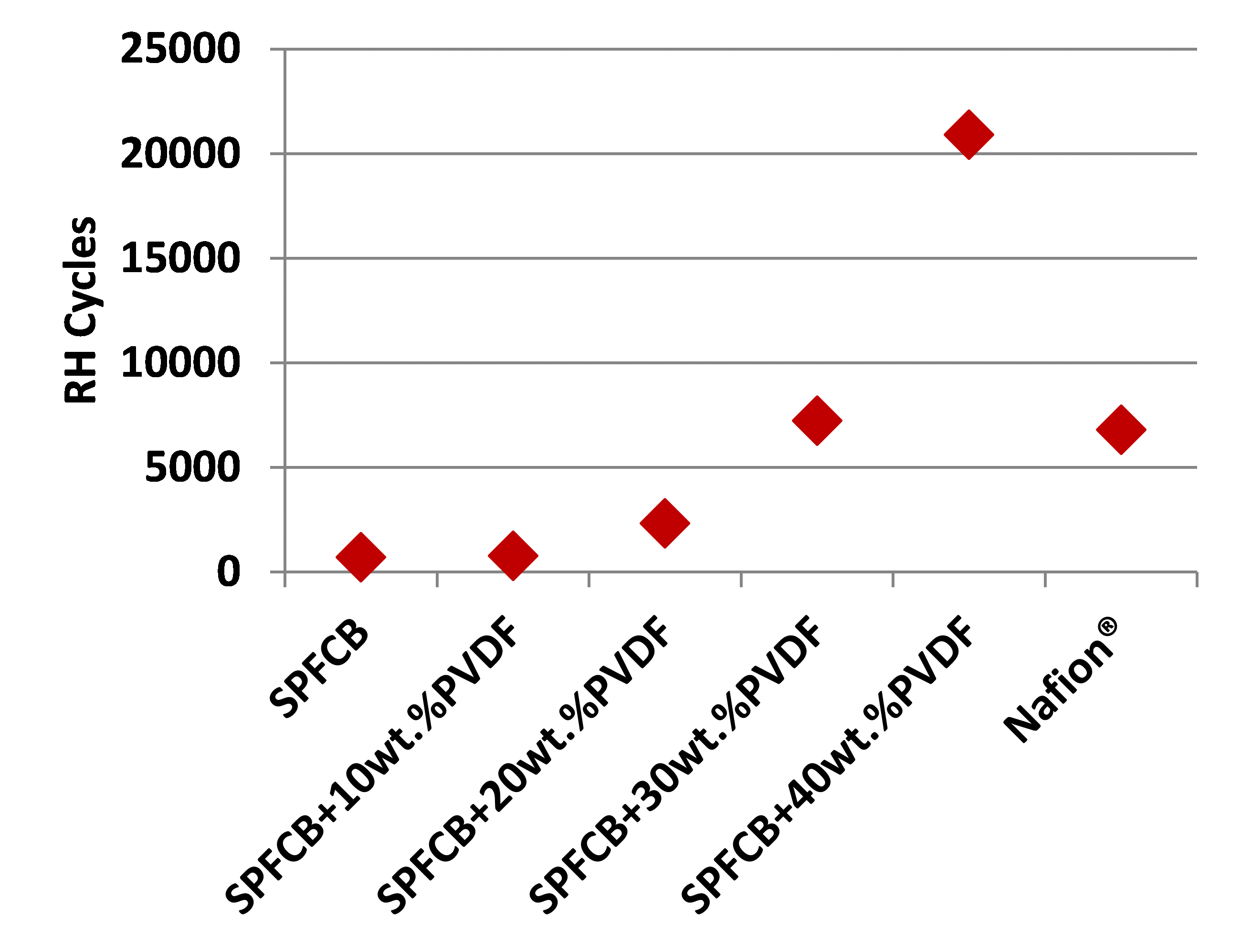 Performance
and durability of fuel cell membranes based on PFCB ionomer are greatly
influenced by the content of PVDF, as well as by the properties of ePTFE
reinforcement layer. The figure on the right shows that the mechanical
durability in RH cycling tests of the sulfonated PFCB/PVDF blend membranes were
improved with increasing level of PVDF content. More performance and durability
information of PFCB/PVDF and PFCB/PVDF-ePTFE types of fuel cell membranes will
be reported and discussed.
See more of this Group/Topical: Separations Division