
 Google
 Yelp
 Facebook
 Twitter
 ChEnected
338493 Modeling and Analysis of Coupled NOx Storage and Reduction and Selective Catalytic Reduction Monolithic Catalysts
Modeling and Analysis of Coupled NOx Storage and Reduction and Selective Catalytic Reduction Monolithic Catalysts
Bijesh M. Shakya, Michael P. Harold[1], and Vemuri Balakotaiah[2]
Department of Chemical & Biomolecular Engineering
University of Houston 77204-4004
Abstract
The combination of NOx storage and reduction (NSR) and selective catalytic reduction (SCR) catalyst has emerged as a promising technology for the reduction of NOx emission from the exhaust of lean-burn or diesel engine vehicles. NSR is operated in periodic fuel-lean and fuel-rich cycles in which NOx is stored on the storage component of the catalyst, also called a lean NOx trap (LNT), during the lean-mode and is reduced during the rich-mode. It is widely accepted that ammonia is formed as an intermediate during the regeneration of stored NOx which further reacts to form N2. On the other hand, SCR technology uses transition metal (Cu, Fe) exchanged zeolite catalyst and utilizes NH3 generated from external source to reduce the NOx from the lean exhaust. In the combined NSR/SCR system, NH3 generated in LNT during the rich phase is stored in the SCR which is used to reduce the NOx during the subsequent lean phase. In this way, the integrated system not only eliminates the need to have external source of NH3, as required in standalone SCR system, but also provides an opportunity to lower the volume of expensive PGM based LNT catalyst, both of which lower the overall cost of the aftertreatment system.
Many experimental and modeling works have been done addressing various aspects of the combined system [1, 2]. Notwithstanding these recent developments, a detailed modeling study focusing on the dual-layer LNT/SCR configuration is still lacking. In this study, we developed a new global kinetic model for low Pt dispersion (8%) LNT and used it in conjunction with previously developed kinetic model for Cu-Chabazite SCR catalyst [3] to perform simulations of combined LNT/SCR catalyst [4]. Specifically, we analyzed the impact of washcoat loading of individual component and effect of temperature in the dual-layer architecture. These results were then compared with the brick configuration under identical operating conditions and catalyst composition (i.e. same fraction of LNT and SCR). Fig 1 shows the model predicted cycle-averaged NOx conversion and N2 selectivity as a function of SCR fraction in dual-layer and dual-brick LNT/SCR catalyst at 230oC and 300oC. The simulation results show that NOx conversion attains a maximum as the SCR loading is increased in dual-layer catalysts. At higher SCR loading, the number of adsorption sites in SCR is much larger than the amount of NH3 that is generated in LNT and as a result only a fraction of SCR layer close to LNT are utilized while the rest act as an inert layer or a diffusional barrier thereby lowering the conversion. Such a diffusional barrier is not significant for the case of brick configuration at these temperatures (230oC and 300oC). Fig 1 also shows that maximum NOx conversion is obtained by dual-layer configuration at both temperatures. This is due to the improved utilization of in-situ generated NH3 on the SCR layer which can be clearly seen by the relatively higher selectivity of N2 obtained in dual layer catalyst compared to that of dual brick. However, at higher loading of SCR, NOx conversion obtained by dual-layer catalyst is lower than that by dual brick for the reasons mentioned above.
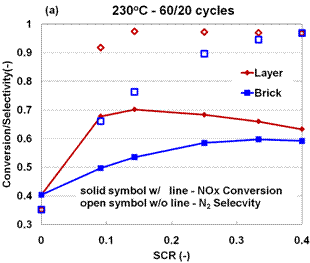
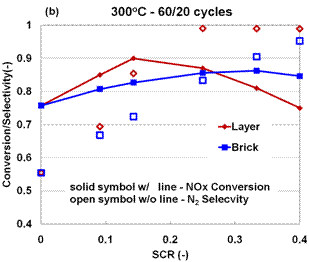
Fig 1 Simulated NOx conversion and N2 selectivity as a function of SCR loading fraction for dual layer (LNT=30μm) and dual brick configuration at (a) 230oC and (b) 300oC; Conditions: lean feed: 500 ppm NO+5% O2 in balance Ar for 60s; rich feed: 5000 ppm H2 in balance Ar for 20s, flow rate=1000 sccm (GHSV=60,000 hr-1)
To this end, we performed a detailed numerical analysis of coupled LNT/SCR system explaining trends in terms of complex spatiotemporal coupling occurring within the washcoat.
References:
1. D. Chatterjee, P. Kočí, V. Schmeißer, M. Marek, et al., Catal Today, 151 (2010) 395
2. Y. Liu, M.P. Harold and D. Luss, Appl Catal B: Environ, 121–122 (2012) 239
3. P.S. Metkar, M.P. Harold and V. Balakotaiah, Chem Eng Sci, 87 (2013) 51
4. B.M. Shakya, M.P. Harold and V. Balakotaiah, in preparation
[1]Corresponding author: Tel.: +1 713 743 4322; Fax: +1 713 743 4323; Email: mharold@uh.edu (M. P. Harold)
[2]Corresponding author: Tel.: +1 713 743 4318; Fax: +1 713 743 4323; Email: bala@uh.edu (V. Balakotaiah)
See more of this Group/Topical: Catalysis and Reaction Engineering Division