
 Google
 Yelp
 Facebook
 Twitter
 ChEnected
338680 In-Situ Drifts Studies of Selective Catalytic Reduction of NO With C3H6 On Cu-Chabazite Catalyst
In-situ DRIFTS Studies of Selective Catalytic Reduction of NO with C3H6 on Cu-chabazite Catalyst
Richa Raj, Michael P. Harold[1], and Vemuri Balakotaiah[2]
Department of Chemical & Biomolecular Engineering, University of Houston, Houston, TX, United States.
Abstract
In-situ DRIFTS studies were carried out to elucidate the underlying mechanism of NOx reduction with C3H6. In-situ DRIFTS was performed using a Nicolet Nexus 470 spectrometer, equipped with a small collector with a dual sample environmental chamber (Thermo Fisher Scientific). The sample of catalyst powder was prepared by scraping the washcoat off the monolith channels. The feed gas, at a total flow rate of 50 cm3/min at STP, was mixed using Bronkhorst mass flow controllers; and its composition, with all gases present, was 500 ppm C3H6, 500 ppm NO, 1% or 5% O2, 0 or 2.5% H2O balanced by He. Before each experiment, the catalyst sample of 60 mg was treated with 5% O2 in He for 1 hour at 600oC.
Fig. 1 shows the evolution of surface species with time for C3H6 + O2 reaction. The growth of the bands around 1550 cm -1 and 2900 cm-1 correspond to stretching of C-C and C-H bonds of adsorbed hydrocarbon species, respectively. The broad band near 3060 cm-1 corresponds to vibration of C-H bond of condensed aromatic rings. The growth of these bands with time suggest the formation and accumulation of coke like species on the catalyst surface formed via oligomerization of adsorbed C3H6 derived hydrocarbon species. The appearance of band at 1660 cm-1 corresponds to C=O stretching of acrolein like species. Similarly, the peak at 1450 cm-1 corresponds to adsorbed carboxylate species. Hence, oxygenates are the intermediates in C3H6 oxidation. Fig. 2 shows the spectra obtained for different times on introduction of NO in feed after exposure to C3H6 + O2. On exposure to NO a new peak at 2250 cm-1 is observed which is attributed to –NCO species. There is increase in the peak intensity corresponding to –NCO species with time suggesting its accumulation on the catalyst surface. It clearly indicates that N-containing hydrocarbon species act as intermediate in NOx reduction with C3H6.
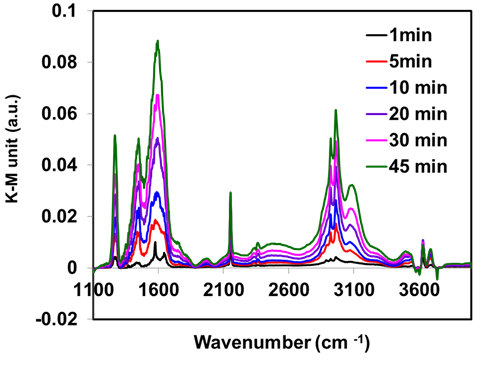
Figure 1 DRIFTS spectra obtained at different times upon Cu-SSZ13 exposure to 500 ppm C3H6 at 380 oC (500 ppm C3H6, 1% O2, balanced by He)
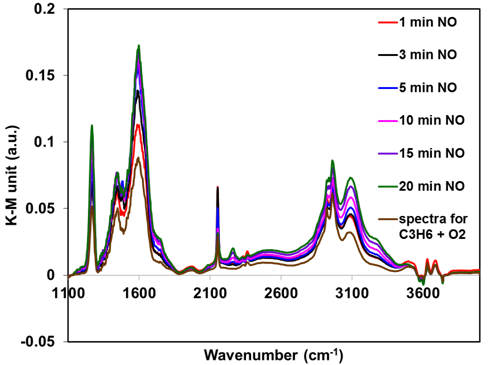
Figure 2 Emergence of new peak upon exposure to 500 ppm NO after 45 minutes of exposure to 500 ppm C3H6 at 380 oC (500 ppm C3H6, 500 ppm NO, 1% O2, balanced by He)
[1]Corresponding author: Tel.: +1 713 743 4322; Fax: +1 713 743 4323; Email: mharold@uh.edu (M. P. Harold)
[2]Corresponding author: Tel.: +1 713 743 4318; Fax: +1 713 743 4323; Email: bala@uh.edu (V. Balakotaiah)
See more of this Group/Topical: Catalysis and Reaction Engineering Division