
 Google
 Yelp
 Facebook
 Twitter
 ChEnected
339039 Formation of Carbonaceous Deposits During Thermal Cracking of Light Hydrocarbons
Formation of carbonaceous deposits during thermal cracking of light hydrocarbons
A.Y. Ramírez1, A. Molina 1, M.Kraft2, J.C. Vivas3
1 Universidad Nacional de Colombia – Sede Medellín, Facultad de Minas, Bioprocesos y Flujos reactivos, Medellín, Colombia
2 University of Cambridge, Department of Chemical Engineering, Computational Modelling Group, Cambridge, England
3Instituto Colombiano del Petróleo, Piedecuesta, Colombia
A model that predicts coke deposition during steam cracking of light hydrocarbons was developed. Steam cracking of light hydrocarbons, such as ethane and propane, is the main route for the production of ethylene and propylene. Associated with cracking, normally conducted at high temperatures in a tubular reactor located in a furnace that supplies heat, there is undesirable coke deposition on interior walls of the reactor. This deposit builds up to a point in which pressure drop and heat transfer reduction are so significant that maintenance stops are mandatory [1].
Simulation, by a reliable model, of coke deposition in the thermal cracking furnace for different inlet conditions is necessary if one wants to understand the effects that changes in process conditions and raw materials have on process performance. A typical model for coke deposition includes two independent submodels: one that considers cracking of steam/hydrocarbons mixtures in gaseous phase and a second one that predicts coke deposition. Both models have to be integrated in order to simulate olefins production and the reduction in the diameter during thermal cracking of light hydrocarbons [1,2].
At last year AIChE Annual Meeting we presented a gas-phase mechanism that predicts the production of olefins and coke precursor's [3,4] during the steam-cracking of light hydrocarbons. This year we propose a model that predicts coke deposition.
The available models in the literature for the prediction of coke deposition during thermal cracking of ethane or ethane/propane mixtures are either based on empirical theories which have limited application to the experimental condition in which they were developed [1,2] or do not present any kinetic information [5]. However, some of them give information about the process of coke formation. Ranzi et al.[5] and Albright et al.[6], present a very good description of the mechanism of coke deposition. After analyses of various coke deposits, these authors proposed two main mechanisms of coke formation: initial catalytic growth prompted by metals present on the coil surface and growth after the first polymeric layer is formed by radical contributions from the homogeneous phase. The second mechanism starts when simple aromatic compounds are deposited over the polymeric layer. Despite this interesting model insight from Ranzi's and Allbright's groups, they do not provide specific kinetics for modeling coke deposition. Without the kinetic information, it is not possible to predict the rate of coke deposition in the walls of the reactor
Based on the aforementioned understanding of coke formation during ethane pyrolysis and carrying out an analogy from other mechanisms, such as the HACA[7] mechanism, that consider the formation of a solid substance, such a soot, from a gas phase hydrocarbon, we propose a two-reaction mechanism that represents coke formation. The first reaction considers the formation of an active A* aromatic intermediate by reaction of A1, a dummy species that represents the total aromatic concentration in the gaseous mixture, with hydrogen. This active intermediate builds, by reaction with acetylene, the coke layer.

Although it would be desirable that the model includes the phase of catalytic growth prompted by metals in the coil surface, the period of catalytic coke formation is very short when compared to the typical thermal cracking furnace operation cycle. Therefore, for modeling purposes the catalytic growth phase could be neglected without incurring in a significant error.
The coke formation mechanism was calibrated based on data obtained from a pilot plant which consist in a tubular reactor over a range extending from 400°C to 900°C and with data from the literature about the coke deposition in pilot and industrial plants.
To evaluate the ability of the model to predict coke deposition, an industrial steam-cracker of ethane and ethane/propane mixtures was simulated. The solid phase model predicts, in agreement with industrial data, that a 700-hours period before shutdown is required due to coke deposition during thermal cracking of ethane. Figure 1 shows the reduction in the diameter because of coke layer formation for 50, 200, 400 and 700 hours.
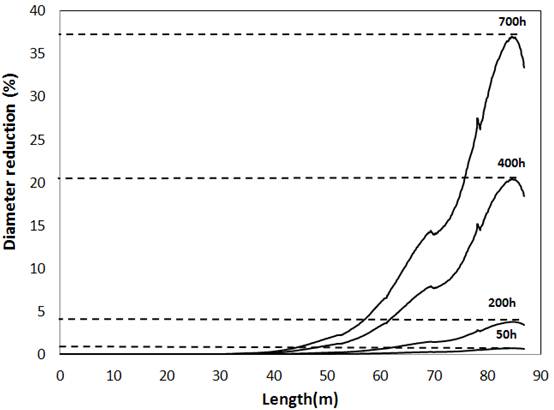
Figure 1. Coil diameter reduction because of coke deposition during steam cracking of ethane
The model was used to address the effect that changes in the C/H ratio, residence time and dilution factor had on the rete of coke deposition. To increase the C/H ratio, the proportion of propane in the mixture was increased from 0.2 to 0.8 kg propane/kg hydrocarbons. The maximum reduction in coil diameter because of coke production increased from 22% (without propane) to 34% (0.2 kg propane/kg hydrocarbons) and 58% (0.8 kg propane/kg hydrocarbons) after 500 hours of furnace operation. In the case of the residence time and dilution factor, the model predicts typical trends observed for coke formation during thermal cracking such as the increase in coke production as both parameters increase.
REFERENCES
[1] Sundaram KM, Froment GF. Kinetics of coke deposition in the thermal cracking of propane. Chemical Engineering Science. 1979;34(5):635-44.
[3] Ramirez A, Almanza L, Molina A, Kraft M, Vivas J., "Comparison of gas phase mechanisms for the prediction of coke deposition during thermal cracking of light hydrocarbons". Oral presentation. AIChE annual meeting 2012.
[4] Ramirez A, Almanza L, Molina A, Kraft M., A model for the prediction of olefin production and coke deposition during thermal cracking of light hydrocarbons. 2013:1-12"
[5] Ranzi E, Dente M, Pierucci S, Bussani G. New improvements in modeling kinetic schemes for hydrocarbons pyrolysis reactors. Chemical Engineering Science. 1992;47(9-11):2692-34.
[6] Albright LF, Crynes RL, Corcoran WH. Pyrolysis of Ethane and Propane. In: Press A, editor. Pyrolysis: Theory and Industrial Practice; 1983, p. 25-87
[7] Frenklach M. On surface growth mechanism of soot particles. Symposium (International) on combustion. 1996;26(2):2285-93
See more of this Group/Topical: Catalysis and Reaction Engineering Division