
339110 Parameterization of Coarse-Grained Models for Simulation of Self-Assembly: the Role of Molecule Rigidity

Thursday, November 7, 2013: 1:38 PM
Union Square 16 (Hilton)
Ming-Tsung Lee, Aleksey Vishnyakov and Alexander V. Neimark, Chemical and Biochemical Engineering, Rutgers, The State University of New Jersey, Piscataway, NJ

Micellization of surfactant solutions is a ubiquitous phenomenon in natural systems and technological processes, and its theoretical description is a cornerstone problem in physical chemistry of colloidal systems. However, successful attempts of quantitative modeling confirmed by experimental data remain limited. We devised a novel approach to parameterization of coarse-grained models: binary interaction parameters are fitted to the infinite dilution activity coefficients of binary solutions formed by reference compounds that represent coarse-grained fragments of surfactant molecules. Using this protocol, we derived dissipative particle dynamics (DPD) models of several surfactants of different chemical structures and obtained a quantitative agreement with experimental critical micelle concentration (CMC) and aggregation number (AN).
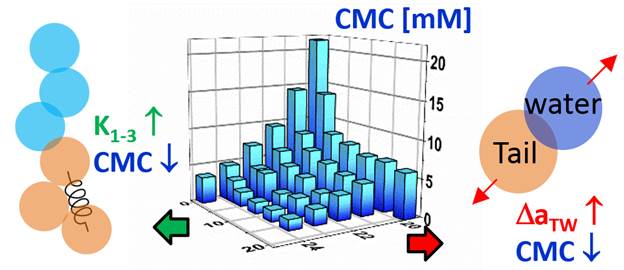
Another factor determining micellization in surfactant solutions is the rigidity of the molecules. For the first time, we present a systematic study of chain rigidity effect on CMC and AN using DPD simulations. Molecule rigidity was controlled by second-neighbor (“1-3”) harmonic bonds, or the harmonic angle potential between the nearest neighbor bonds. Compared to flexible molecules with the nearest neighbor bonds being the only type of bonded interactions, rigid molecules exhibited a lower critical micelle concentration, larger and better-defined micelles. By varying the strength of head-tail repulsion and chain stiffness, we constructed two-dimensional diagrams presenting how the critical micelle concentration and aggregation number depend on these parameters. We found that solutions of flexible and rigid molecules that exhibited approximately the same critical micelle concentration could differ substantially in the micelle size and shape depending on the chain stiffness. With the increase of surfactant concentration, primary micelles of more rigid molecules were found less keen to agglomeration and formation of non-spherical aggregates characteristic to flexible molecules.

Overall, our parameterization methodology can be recommended for studies of self-assembly and dynamics in a wide range of soft matter systems. However, rigidity has to be accurately accounted for in coarse-grained modeling of self-assembly.


Extended Abstract: File Not Uploaded
See more of this Session: Computational Studies of Self-Assembly II
See more of this Group/Topical: Engineering Sciences and Fundamentals