
 Google
 Yelp
 Facebook
 Twitter
 ChEnected
339124 DEM Studies of the Ordering and Force Transmission in Packings of Non-Spherical Particles
DEM studies of the ordering and force transmission in packings of non-spherical particles
So far most studies concerning the packing of granular materials have only considered systems composed of spherical particles, irrespective of the fact that granular materials are commonly of non-spherical shape and show highly anisotropic characteristics [1]. However, very recently, Hidalgo et al. [2, 3] and Lu et al. [4] reported that in packings of 2D, elongated particles a more uniform stress distribution than in packings of spheres can be observed. Due to the preferred horizontal alignment of the particles, the force in the vertical direction of the bed does not saturate with height. Instead, the vertical stress profile becomes similar to the linear hydrostatic pressure profile in a liquid.
However, despite the observations summarized above, the influence of the particle surface roughness on the packing characteristics of non-spherical grains remains an open question. In this study, non-spherical particles of different aspect ratios were modeled in a discrete element method (DEM) framework by either gluing together of spheres or using the super-quadric equation [5, 6]. The surface roughness of the non-spherical particles was adjusted by the number of spheres used to construct their non-spherical shape. On the other hand, a super-quadric equation-based particle possesses a smooth surface. In total 4500 elongated particles of aspect ratio five were simulated. It was found that the surface roughness of the particles crucially influenced both the orientational ordering of the particles and the force transmission within the bed of grains. Super-quadrics-based particles showed horizontal alignments (Fig. 1a), with local clusters of elongated particles forming (Fig. 1b). In addition, a smooth particle surface favored the direct transmission of the bed weight to the bottom of the container (Fig. 1c). On the other hand, the horizontal alignment of grains was less pronounced in packings of elongated particles constructed by gluing together spheres with, surprisingly, coarser particle surfaces resulting in a more pronounced horizontal alignment. Finally, the stresses measured at the bottom of a container filled with particles constructed by gluing together spheres were much smaller than for the case that the container was filled with smooth super-quadric particles.
References
[1] Aranson, I. S., & Tsimring, L. S. (2006). Patterns and collective behavior in granular media: Theoretical concepts. Reviews of modern physics, 78(2), 641.
[2] Hidalgo, R. C., Zuriguel, I., Maza, D., & Pagonabarraga, I. (2009). Role of particle shape on the stress propagation in granular packings. Physical review letters, 103(11), 118001.
[3] Hidalgo, R. C., Zuriguel, I., Maza, D., & Pagonabarraga, I. (2010). Granular packings of elongated faceted particles deposited under gravity. Journal of Statistical Mechanics: Theory and Experiment, 2010(06), P06025.
[4] Lu, G., Third, J. R., & M¨ıller, C. R. (2012). Packing and discharging of non-spherical particles in hoppers. In: Proceedings of the 7th International Conference for Conveying and Handling of Particulate Solids, Friedrichshafen, Germany, 10-13 September 2012.
[5] Third, J. R., Scott, D. M., Scott, S. A., & M¨ıller, C. R. (2010). Tangential velocity profiles of granular material within horizontal rotating cylinders modelled using the DEM. Granular Matter, 12(6), 587-595.
[6] Lu, G., Third, J. R., & M¨ıller, C. R. (2012). Critical assessment of two approaches for evaluating contacts between super-quadric shaped particles in DEM simulations. Chemical Engineering Science, 78, 226-235.
| (c)
|
| (a) (b) |
| +
|
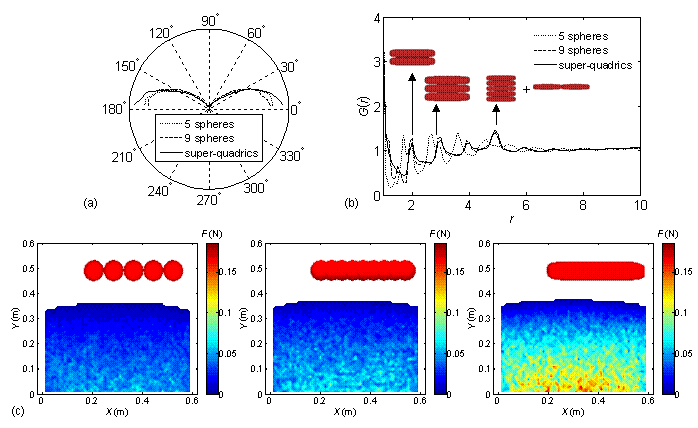
Fig. 1 DEM simulations of granular packings of
elongated particles with different surface roughnesses in a 2D, flat bottom
container: (a) Particle orientation distribution, (b) radial distribution
function (




See more of this Group/Topical: Particle Technology Forum