
 Google
 Yelp
 Facebook
 Twitter
 ChEnected
339147 About The Interaction Between Cpls and CO2: A DFT and ONIOM-EE Study
ABOUT THE INTERACTION BETWEEN CPLs AND CO2: A DFT and ONIOM-EE STUDY
Paul de Jesus Meza-Morales, Radamés Irizarry-Castillo, and María C. Curet-Arana
Department of Chemical Engineering, University of Puerto Rico, Mayagüez, PR
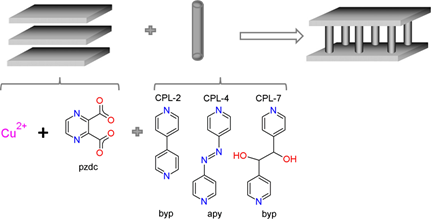
Coordination polymer-ligands (CPLs) are porous-crystalline materials consisting of metal ions linked to organic bridging ligands as shown in figure 1. Because of the flexibility in their synthesis, a range of novel structures has been rationally designed with high surface area, large pores and distinct gas adsorption properties. The objective of this project is to study CO2 - CPLs (CPL-2, CPL-4, & CPL-7) interactions using quantum mechanical (QM) and ONIOM-EE calculations, the last one is an integrated quantum mechanical molecular mechanical method linked via electronic embedding. We have used two representative models for the CPLs pores to reproduce binding sites in order to quantify energies of adsorption and characterize the nature of the interaction. For the QM calculations, we have compared two exchange/correlation functionals B3LYP and wB97XD, which has a specific treatment for non-covalent interactions. We have used a mix of 6-311+G and LANL2DZ for the basis sets. The latter basis set was used solely on the transition metal atom. For the ONIOM-EE calculations, we have used UFF to describe the low level part of the system. In addition, charges from electrostatic potential using a grid based method (CHelpG), natural bond orbitals population analysis and electric field gradient calculations were performed to describe the partial atomic charge distribution and electric field properties of the framework.
|
Figure 1. Schematic representation of CPLs structure |
See more of this Group/Topical: Separations Division