
 Google
 Yelp
 Facebook
 Twitter
 ChEnected
339208 Mechanistic and Kinetic Analysis of the Aqueous Phase Hydrogenation of Levulinic Acid Over Ru/C
Mechanistic and kinetic analysis of the aqueous phase hydrogenation of Levulinic Acid over Ru/C
Omar A. Abdelrahman and Jesse Q. Bond
The conversion of Levulinic Acid (LA) to gamma-Valerolactone (GVL) via catalytic hydrogenation has been shown to be a viable pathway for turning LA into a more versatile feedstock chemical. The capability to produce GVL from LA in a dilute aqueous solution as it is currently produced would provide a cost effective conversion strategy, hence warranting the investigation of the aqueous phase hydrogenation of LA. This could possibly be achieved by the use of Ruthenium supported on Carbon in a reducing environment. In order to evaluate this option, the poorly understood aqueous phase hydrogenation of LA was investigated by undertaking a kinetic as well as a mechanistic study of the process. Experiments considered two pathways from LA to GVL, which differ according to the order in which subsequent hydrogenation and dehydration occur (Figure 1). Through aqueous phase kinetic experiments, the pathway in which hydrogenation precedes dehydration is proposed to be dominant for the production of GVL, particularly at low temperatures. A kinetic model for the overall hydrogenation is proposed, and estimated reaction orders and apparent activation energies are reported. Significant loss in activity was observed with the Ru/C catalyst, which warranted an investigation into the nature as well as extent of deactivation. Remedies for the severe deactivation of the catalyst primarily involve rational selection of catalyst support to minimize deactivation via attrition and leaching.
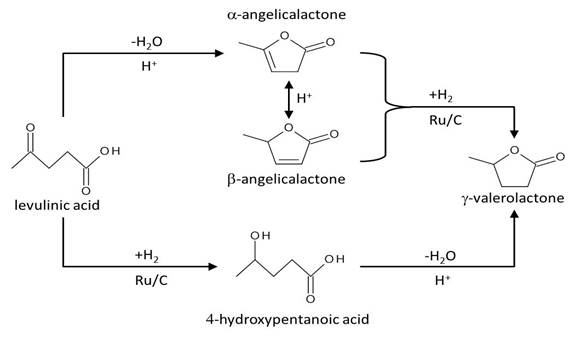
Figure 1 - Proposed mechanistic pathways for the production of GVL from LA
See more of this Group/Topical: Catalysis and Reaction Engineering Division