
 Google
 Yelp
 Facebook
 Twitter
 ChEnected
339359 CFD-Aided Characterization Of A Spinning Disc Reactor (SDR)
Background
In the last years spinning disc reactors (SDR) are becoming more and more popular in the field of chemical reaction engineering. The radial acceleration of the liquid caused by the centrifugal forces generates a very thin film on the disc, typically in the range of 20 – 300 μm. This thin film not only has superior micromixing properties when adding reagents to the film but also creates large heat transfer coefficients from the disc to the film and mass transfer coefficients from gas to liquid. These properties make the SDR technology attractive for many reactions such as polymerization, organic synthesis, photocatalysis and precipitation reactions. The film thickness and regime and as a result the performance of a SDR is strongly affected by the operating conditions, e.g. rotational speed, volumetric flow rate, feeding point locations, disc diameter and disc design. Although there is an increasing research in academia on the use of SDRs for various reactions, still very little is known about the film properties and most researchers rely on either experimental methods, which only provide film heights but do not disclose local film properties and factors affecting the film structure and regime, or very simplistic models such as the Nusselt film model [1]. Understanding and predicting the film properties is crucial for optimization of the operating conditions.
Aims
In this work we aim at characterizing and predicting film properties with CFD. In a recent publication of our group the micromixing efficiency was experimentally determined by use of the iodide-iodate reaction [2]. Focus in this work is also set on testing the predictability of CFD in terms of describing the micromixing efficiency by numerically modeling the reaction kinetics.
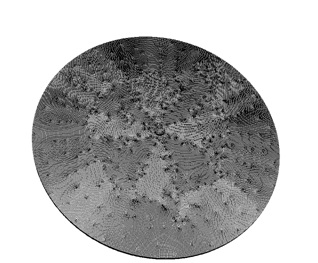
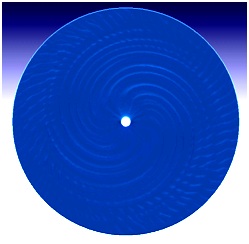
Fig. 1: Computational mesh (left); waves and ripples at n = 500 rpm (right).
|
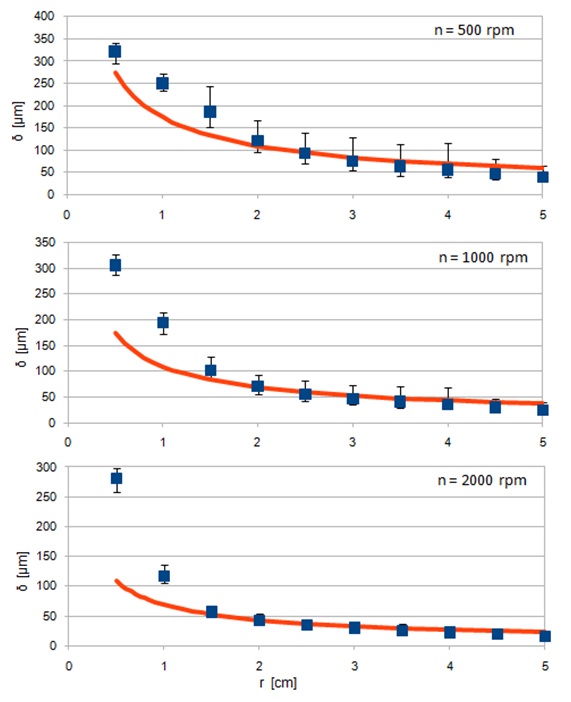
Fig. 2: Nusselt model thickness (orange) [2] and simulated film thickness (marks) for different rotational speeds; error bars indicate radially minimum and maximum film height in the simulation.
|
 Results
Creating a computational mesh is very challenging due to the very large disc radius compared to the very small scales, which need to be resolved. One of the meshes used in this study is shown in Fig. 1 (left). In Fig. 1 (right) we present the top view of the liquid film at a rotational speed of n = 500 rpm. The disc diameter is d = 5 cm and the volumetric flow rate is Q = 3 mL/s. Close to the inlet spiral waves can be found, while further away from the inlet ripple structures prevail. The mean film height is generally in good agreement with the Nusselt film thickness at all rotational speeds for r ≳ 2 cm, see Fig. 2. For r ≲ 2 cm the influence of the inlet is still large. The height of the waves and ripples can be depicted from the error bars in Fig. 2 denoting the radial minimum and maximum film height. For higher rotational speeds the height of the waves and ripples decreases.
Conclusions
The hydrodynamics of the liquid film on a SDR were predicted with CFD. We point out that, to our knowledge, this is the first CFD study on SDRs to present a mesh convergence study to determine the influence of the numerical grid on the results. Current investigations focus on validation of the model with experimental film heights and on determining the micromixing efficiency by modeling the reaction kinetics of the iodite-iodate reaction.
References
[1] Wood,
R.M., and Watts, B.E.: Trans. Inst. Chem. Eng. 51, p. 315 (1973).
[2] Jacobsen, N.C., and Hinrichsen, O.:
Ind. Eng. Chem. Res. 51, p. 11643 (2012).
See more of this Group/Topical: Engineering Sciences and Fundamentals