
 Google
 Yelp
 Facebook
 Twitter
 ChEnected
339578 An Industrial Reactor Design for Heterogeneously Catalyzed Ethene Oligomerization
An Industrial Reactor Design for Heterogeneously Catalyzed Ethene Oligomerization
K. Toch, J.W. Thybaut, G.B. Marin
Laboratory for Chemical Technology, Ghent University, Krijgslaan 281 – S5, 9000 Ghent, Belgium
Heterogeneously catalyzed ethene oligomerization has, compared to the current homogeneous based technologies, the advantages of being a solvent free process, a decreased energy requirement and an increase in product flexibility. By tailoring the reaction conditions simultaneously with the catalyst properties, the product distribution can be altered from chemicals, e.g., α-olefins, to liquid fuels, e.g., diesel and gasoline. This research fits within OCMOL, a large-scale European FP7 project funded by the European Commission [1]. OCMOL is the acronym for Oxidative Coupling of Methane followed by the Oligomerization to Liquids. The main advantages of this integrated process are an economic operation at relative small to medium scale, i.e., 100kTon/y, the low to zero CO2 emission, the use of either methane or biogas as a process feedstock and the flexibility of the product stream containing either chemicals or fuels.
An industrial reactor is designed for ethene oligomerization employing bifunctional, heterogeneous catalysts that comprise nickel as active metal on an acid support such as amorphous silica-alumina or zeolites, i.e., MCM-41 and Beta. The bifunctional nature of the catalyst, i.e., having both metal-ion as acid functions, has as advantage that the reaction proceeds at much milder conditions then when only an acid functionality would be present on the catalyst. The Ni metal ion dimerizes ethene to butene, which is more easily protonated and subsequently alkylated and/or isomerized on the acid sites, see Figure 1.
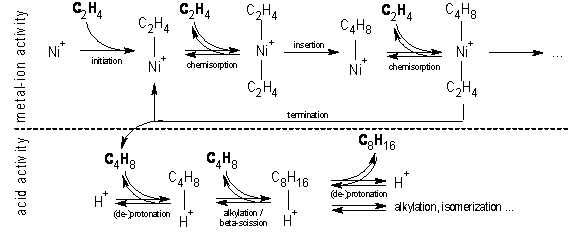
Figure 1: Reaction scheme for ethene oligomerization on a bifunctional heterogeneous catalyst
For industrial applications, three reactor types are possible: fixed bed, slurry or monolith reactors. The industrial reactor modeled in this work is of the fixed bed type. The model is capable to describe an isothermal, adiabatic or even cooled/heated multi catalytic bed with/without cooling/heating between the catalytic beds. Additionally, throughout the reactor more heavier oligomerization products are formed which are in liquid phase. Therefore, a gradual transition from gas-solid to gas-liquid-solid operation is included. It is also possible to simulate the use of a solvent in the feed in which the reactants are dissolved. At industrial scale, transport limitations at the pellet scale are more common compared to laboratory scale where it is commonly aimed at to obtain intrinsic kinetics. To account for these transport limitations, intraparticle mass and heat transport phenomena are included in the industrial reactor model. Axial and radial dispersion is not accounted for.
The individual components' mass balances over the reactor is given by the plug flow reactor equation:

in which Fi is the molar flow rate of component i, W the catalyst mass and Ri the net rate of formation of component i. The net rate of formation corresponds to the intrinsic, chemical kinetics as calculated by the Single-Event MicroKinetics (SEMK) [2]. Kinetic and catalyst descriptors have been determined by regression to experimental data acquired on amorphous silica-alumina and zeolites MCM-41 and Beta.
To be able to describe the adiabatic behavior of the reactor, the following energy balance over the reactor is implemented:
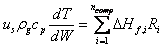
T is the temperature of the catalyst bed, ΔHf,i is the enthalpy of formation of every component, us is the linear velocity through the reactor and ρg and cp are resp. the molar volume and the thermal capacity of the gas, all at the reactor conditions. us is determined via the volumetric gas flow rate assuming it is an ideal gas and the cross sectional area of the reactor. cp and its temperature dependency is determined using thermodynamic data available from literature [3].
To incorporate intraparticle diffusion, for every component i, a one-dimensional unsteady-state mass balance over an infinitesimal volume of the crystallite is considered. Even it is expected not to have a significant influence, intraparticle conductivity has also been included in the model using an analogous balance.

Csat is the saturation concentration, L is the
crystallite dimension in the direction of the diffusion path, ξ is
a dimensionless diffusion length, i.e.,  , s
is the particle shape factor, i.e., 0, 1 or 2 for resp. a slab, cylinder or
sphere, D is the intracrystalline diffusion coefficient and θ
is the fractional occupancy of the catalyst surface by the component
considered. R, the net rate of formation, is affected by the shape of
the crystallite assumed and is determined as follows:
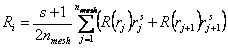
For this set of partial differential equations, the following boundary and initial conditions were considered:
-for all t, except t=0
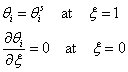
-for t=0
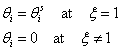
θs is the fractional occupancy of the catalyst surface at the outer surface of the crystallite.
This set of partial differential equations is solved using finite differences by dividing the crystallite in a number of meshes (nmesh). From the initial conditions, this set of equations is solved until convergence, i.e., steady state.
Figure 2 shows the comparison between an adiabatic multi bed reactor to an isothermal and adiabatic single fixed bed reactor. All three reactor types have an equal total amount of catalyst mass loaded. The criterion for determining the catalyst bed size in the multi bed reactor was a maximum temperature increase by 30 K. They were not dimensioned based on the attainment of thermodynamic equilibrium since this is not reached. As can be observed in Figure 2, a total of 4 catalytic beds is required to obtain a conversion of 96%. The conversion and, hence, temperature, increases gradually less steep with increasing bed number, e.g., the last bed used for the final 30% conversion is 20 times larger than the first one. The isothermal single fixed bed reactor has a slightly lower conversion at the reactor exit, i.e., 94%. A conversion amounting to 96% is already obtained halfway the catalyst bed in the single bed adiabatic reactor, but is accompanied with a temperature increase exceeding 100 K, which may be detrimental for the product selectivity, catalyst stability or even process equipment.
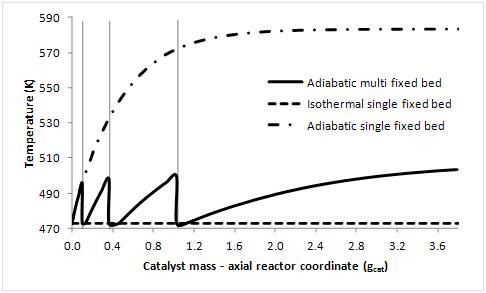
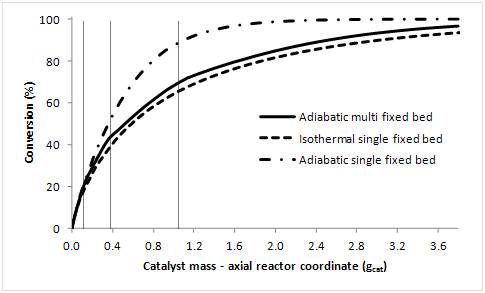
Figure 2: Comparison of an adiabatic multi fixed bed reactor with an isothermal and adiabatic single fixed bed reactor for ethene oligomerization. Temperature (left) and ethene conversion (right) as function of the axial reactor coordinate given by the catalyst mass. The inlet temperature at each catalytic bed is 473 K. The inlet partial pressure and molar flow rate of ethene is equal to resp. 0.35 MPa and 100 mol s-1.
Figure 3 shows the effect of the pellet geometry and efficacy on the fractional coverage of ethene on the catalyst surface as a function of the dimensional length of the pellet. It is clear that a spherical geometry has a negative effect on the catalyst efficacy (45.2%) compared to the slab (91.2%) and cylindrical geometry (79.8%).
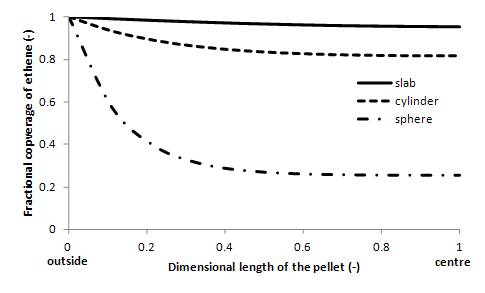
Figure 3: Influence of the pellet geometry (left) and efficacy (right) on the fractional coverage of ethene on the catalyst surface as function of the dimensional length of the pellet, i.e., from the outside to the center of the pellet at 473 K, 0.35 MPa ethene
The transition of fixed bed to trickle bed behavior has been implemented by accounting for the vapor pressure of every component throughout the axial coordinate of the reactor. If only gasses are present, the components concentration at the catalyst outer surface are directly given by a Langmuir isotherm including competitive adsorption. If liquids are formed, they will (partially) wet the catalyst surface, and hence, the concentration on the catalyst outer surface will be determined by the composition of the liquid phase. The solubility of the gasses, mainly ethene, in the liquid phase is accounted for.
“This abstract reports work undertaken in the context of the project “OCMOL, Oxidative Coupling of Methane followed by Oligomerization to Liquids”. OCMOL is a Large Scale Collaborative Project supported by the European Commission in the 7th Framework Programme (GA n°228953). For further information about OCMOL see: http://www.ocmol.eu “
[2] G.F. Froment, Catalysis Today. 52 (1999) 153-163
[3] Reid, Prausnitz and Poling, The Properties of Gases and Liquids
See more of this Group/Topical: Catalysis and Reaction Engineering Division