
 Google
 Yelp
 Facebook
 Twitter
 ChEnected
339601 Modular and Injectable Poly(Oligoethylene glycol methacrylate)-Based Hydrogels With Tunable Protein and Cell Interactions
Modular and Injectable Poly(Oligoethylene glycol methacrylate)-Based Hydrogels With Tunable Protein and Cell Interactions
Emilia Bakaic, Niels M.B. Smeets, and Todd Hoare
Department of Chemical Engineering, McMaster University, Hamilton, Ontario, Canada L8S 4L7
E-mail: bakaice@mcmaster.ca | hoaretr@mcmaster.ca
ABSTRACT SUMMARY
A highly tunable, in situ-gelling covalently gelling hydrogel platform based on poly(oligoethylene glycol) methacrylate (POEGMA) has been developed. The POEGMA hydrogel composition was systematically varied to achieve control over the physiochemical and mechanical properties, protein absorption and cell adhesion, while maintaining high cell viability both in vitro and in vivo. These hydrogels provide an advantageous alternative to the commonly used poly(ethylene glycol) (PEG) for use as biomaterial scaffolds or drug delivery vehicles.
INTRODUCTION
Injectable hydrogel formation through the use of dynamic covalent bonds (DCBs), bonds that can be rapidly formed and subsequently broken under chemical equilibrium, has been receiving increasing attention for enabling non-invasive delivery of hydrogels into the body for many biological applications including drug delivery and tissue engineering. Our particular interest lies in investigating the use of hydrazone cross-links that are reversible in aqueous media, formed via the condensation of an aldehyde group with a hydrazide group. The use of hydrazone bonds for cross-linking enables the design of novel degradable biomaterials without the need for use of UV, heat, catalyst or photoinitiator to induce gelation, important for maximizing cell viability in vitro and in vivo.
In this contribution, we report on the synthesis and properties of injectable, in situ-gellable POEGMA-based hydrogels crosslinked via hydrazone bond formation. These hydrogels can be prepared to display all common characteristics of PEG-based materials (i.e. non-adhesive, bio-inert, non-cytotoxic, etc.); in addition, via copolymerization with functional monomers or with EOGMA monomers of different PEG chain lengths not possible with conventional PEG-based hydrogels, properties such as thermoresponsivity, mechanical strength, and degradability can also be readily tuned. We will show how the design of these polymer precursors can be used to engineer these injectable materials for biomedical applications.
EXPERIMENTAL METHODS
POEGMA hydrogels were prepared by co-extrusion of a hydrazide-functionalized POEGMA (POEGMA-hzd) and aldehyde-functionalized POEGMA (POEGMA-ald) dissolved in PBS through a double barrel syringe. The molecular weight of these polymer precursors was limited below the renal clearance limit to ensure complete clearance of the hydrogel from the body after gel degradation.
The hydrazide and aldehyde functionalized POEGMA polymers were synthesized by free-radical polymerization. POEGMA-hzd was prepared from the free-radical copolymerization of diethylene glycol methacrylate (M(EO)2MA; n=2 EO units), oligo ethylene glycol methacrylate (OEGMA475; n = 7-8 EO units), and acrylic acid (AA), followed by functionalization through EDC coupling of adipic acid dihydrazide to AA residues. POEGMA-ald was synthesized from the free-radical copolymerization of M(EO)2MA, OEGMA475, and N-(2,2-dimethoxyethyl)methacrylamide (synthesized in our laboratory) and functionalized by deprotection of the acetal protecting group. Gelation was performed at polymer concentrations of 15wt% in PBS. We tuned the M(EO)2MA:OEGMA475 molar ratio to prepare two distinctly different hydrogels: one (90:10) with an LCST of approx. 32°C (mimicking N-isopropylacrylamide (NIPAAm) gels) and one (0:100) with an LCST > 90°C (mimicking PEG gels).
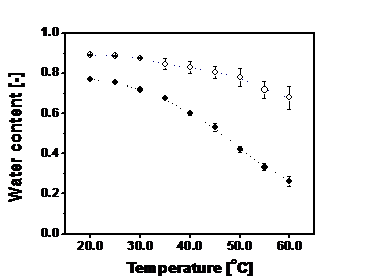
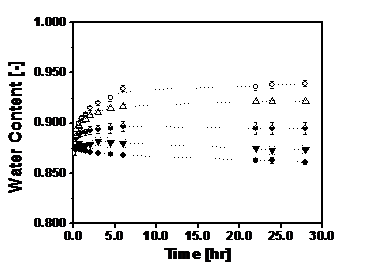
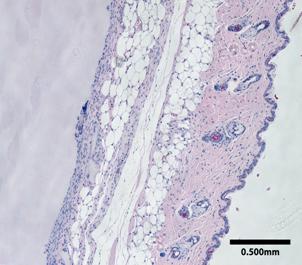
Fig. 1: Deswelling as a function of temperature: POEGMA (●, 90:10) and (○, 0:100). Fig. 2: Swelling test of the POEGMA hydrogels as a function of polymer incorporation. Effect of (90:10):(0:100) composition. (D, 25/75), (○, 0/100), (♦ 50/50) , (▼, 75/25) and (● , (100:0). Hydrogel Fig. 3: Chronic in vivo result after implantation in Balb-c mice with POEGMA 0:100
| RESULTS AND DISCUSSION Control over volume phase transition temperature (VPTT) of the polymers can be achieved by varying the M(EO)2MA and OEGMA475 copolymerization ratio. The large VPTT range that can be achieved by using oligoethylene glycol methacrylate monomers provides an advantage over the use of e.g. NIPAAm. The effect of the precursor composition on the thermosensitivity of the POEGMA hydrogels is shown in Fig. 1. Both POEGMA hydrogels display a volume phase transition; however, the temperature response from the 90:10 hydrogel occurs at lowertemperature, lower initial water content, and with a higher deswelling ratio relative to the 0:100 hydrogel, as expected based on the LCST values of the precursor polymers. The equilibrium water content of the hydrogels can easily be controlled by mixing the 0:100 and 10:90 polymer precursors at different ratios (see Fig. 2) As the weight fraction of 0:100 precursors was increased, swelling of the hydrogels also increased. Control over the water content of these hydrogels allows for control over the pore size and diffusion within the hydrogel matrix. Analogously, the elastic moduli of the POEGMA hydrogels can be tuned by modulating the polymer concentration used to prepare the hydrogels, with significantly higher elastic moduli achieved at higher polymer weight fractions. In this way, the mechanical properties of the hydrogels can be controlled to match a range of stronger tissues, such as muscles, cartilage, and bone tissues as well as softer tissues such as neural and adipose tissue within the body. The release of model proteins BSA (MW = 66 kDa) and fibrinogen (MW = 342 kDa) from POEGMA hydrogels can be controlled by the polymer precursor composition by exploiting differences in the swelling behaviors of the different hydrogels. POEGMA hydrogels (90:10) release both BSA and fibrinogen at a slower rate when compared to the 0:100 POEGMA hydrogels.. The rate of release is governed by the intermolecular interactions within the two gels; the 90:10 hydrogel collapses when warmed from room temperature (as injected) to 37°C (as inside the body), trapping the proteins within the gels, while the 0:100 hydrogel continuously swells at 37°C to enable fast release. Improved performance can be achieved by mixing the polymer precursors at intermediate ratios, enabling both prolonged release with minimal long-term entrapment. Finally, both the high and low transition temperature POEGMA-based hydrogels exhibit highly favorable protein and cell adhesion properties. Adsorption/adhesion of proteins (BSA and fibrinogen) as well as cells (NIH 3T3 fibroblasts) to the 90:10 and 0:100 hydrogels was measured to be comparable to conventional PEG-based hydrogels. Furthermore, in vitro MTT assays performed on NIH 3T3 fibroblasts grown in the presence of POEGMA precursors and hydrogels show that high cell viability and non-cytotoxicity is maintained over a large range of concentrations. In vivo studies on BALB-c mice show successful implantation with a mild inflammatory response at the acute time point but with no significant inflammation persisting at the chronic time point of 28 days post-implantation (Fig. 3, suggesting that these hydrogels are highly bioinert. Degradation of the hydrogels is also confirmed both in vitro and in vivo, enabling clearance of the hydrogel over time frames as short as a few days or as long as a few months depending on the precursor polymer composition. CONCLUSIONS POEGMA-based polymers functionalized with hydrazide and aldehyde groups can be used for the synthesis of modular injectable and degradable hydrogels for drug delivery and tissue engineering applications. The physiochemical and mechanical properties can be controlled by tuning the precursor composition (i.e. the M(EO)2MA:OEGMA475 molar ratio) as well as by mixing polymeric precursors with different compositions to achieve intermediate hydrogel properties. Protein and cell adhesion assays show low adsorption and adhesion comparable to conventional PEG-based systems. Furthermore, the polymer precursors display no significant in vitro or in vivo cytotoxicity.
 ACKNOWLEDGMENTS: Funding from NSERC CREATE-IDEM and 20/20: NSERC Ophthalmic Materials Research Network is gratefully acknowledged. REFERENCES: 1. Patenaude, M.; Hoare, T. Biomacromolecules, 2012, 13 (2), 369–378 2. Lutz, J. Journal of Polymer Chemistry, 2008, 46, 3459-3470.4.
| |||||||||||||

See more of this Group/Topical: Materials Engineering and Sciences Division