
 Google
 Yelp
 Facebook
 Twitter
 ChEnected
339717 Thermo-Responsive Bottlebrush Polymers
Bottlebrush polymers are highly branched macromolecules with polymeric side-chains on each repeat unit. The dense grafting of polymeric side-chains results in both backbone and side-chain extension, giving rise to large, highly extended macromolecules with individual molecules exceeding 100 nm in backbone length in some cases. The novel structure of bottlebrush polymers may make them particularly useful in specialty applications, and here we explore the surface and solution properties of model thermoresponsive poly(N-isopropylacrilamide) (PNIPAAM) bottlebrush polymers. PNIPAAM macromonomers are prepared through reversible addition-fragmentation chain transfer using a norbornenyl-chain transfer agent, and PNIPAAM bottlebrush polymers are subsequently prepared using a "grafting-through" ring opening metathesis polymerization scheme (Figure 1(a)). This synthetic method gives fully grafted bottlebrush polymers with controlled backbone and side-chain lengths. The resulting PNIPAAM bottlebrush polymers are fully soluble in water after removal of the terminal chain transfer agent, reflecting a disproportionately strong effect of the side-chain end groups on bottlebrush polymer solubility. Small-angle neutron scattering (SANS) measurements of PNIPAAM bottlebrush polymers in D2O demonstrate that the side-chains collapse as the temperature increases towards the lower critical solution temperature (LCST) (Figure (b)); both the LCST and the collapse of the side-chains is dependent on the side-chain length. Above the LCST, PNIPAAM bottlebrush polymers aggregate, and we find that PNIPAAM bottlebrush polymers with 9 kg/mol side-chains form a lyotropic liquid crystal phase (Figure 1 (e) and (f)), evidenced by low-angle scattering peaks and birefringence under polarized optical microscopy at temperatures above the LCST. Bottlebrush polymers may also be applicable to non-fouling and non-toxic surfaces due to the high density of polymer chains. Bottlebrush thin films with poly(N-isopropylacrylamide) (PNIPAM) and 4-acryloylbenzophenone crosslinkable side-chains were prepared by spin casting followed by UV irradiation. Cell attachment studies were conducted for bottlebrush polymers at varying side-chain lengths and solution temperatures.
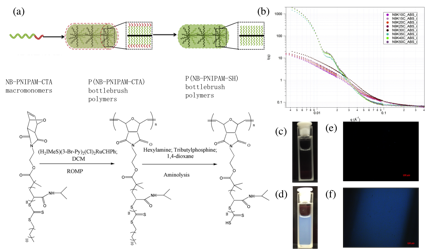
Figure1 Schemetic for the synthesis of P(NB-PNIPAM-SH) (a); SANS data for bottlebrush PNIPAM in D2O with temperature (b); Photographs of the aqueous solution of P(NB-PNIPAM-SH) taken below LCST (c) and above LCST (d); POM images of P(NB-PNIPAM-SH) aqueous solution taken below LCST (e) and above LCST (f).
See more of this Group/Topical: Materials Engineering and Sciences Division