
 Google
 Yelp
 Facebook
 Twitter
 ChEnected
339937 Simulation Of Viscoelastic Flows In Complex Geometries At High Elasticities
Simulation of viscoelastic flows in complex geometries at high elasticities
Florian Habla1, Johannes Hasslberger1, Laura J. Dietsche2 and Olaf Hinrichsen1
1Catalysis Research Center and Chemistry Department, Lichtenbergstraße 4, D-85748 Garching b. München, Germany
2The Dow Chemical Company, Midland, MI 48674, USA
Introduction
Viscoelastic flows can be found in a wide range of industrial applications such as food processing, injection molding or polymer blending. It is of major importance to understand and predict such type of flows.
Flows of viscoelastic fluids are very complex in nature and often result in complex secondary flows and transient flow patterns even in very simple geometries. Thus, a numerical method for viscoelastic flows must necessarily be transient and three-dimensional. Due to that, finite volume methods are becoming more and more popular in the field of numerical rheology due to their efficiency in time and memory savings.
Our research focuses on developing a comprehensive finite-volume CFD method for the open-source software OpenFOAM® to simulate complex viscoelastic flows including multi-phase flows1-2 and non-isothermal flows3. In this work, we will provide an overview of our developments and show simulation results for various complex problems.
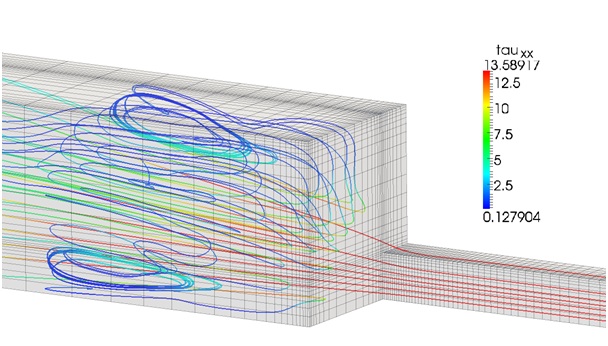
Fig. 1: Three-dimensional simulation of the flow of a simplified Phan-Thien-Tanner fluid through a 4:1 square-square contraction at Wi = 500. Streamlines are colored with the axial normal stress.
Simulation of single-phase flows
The high Weissenberg number problem (HWNP) is probably the central problem in the numerical simulation of viscoelastic flows for over three decades now. The Weissenberg number is a measure of elasticity of the flow. In critical regions of the domain stresses show exponential profiles. Due to the deficiency of approximating these profiles with polynomial-based discretization schemes, a recent contribution by Fattal and Kupferman4 suggests to logarithmize the constitutive equation to overcome this issue. Use of this technique perceivably extenuates the HWNP, however, the problem still remains at hand.
Additionally to using that method, we developed a reformulation, which allows to handle the constitutive equation semi-implicitly, which strengthens the diagonal-dominance of the matrix and thereby strongly increases the stability of our numerical method5. In Fig. 1 the flow of a viscoelastic fluid through a three-dimensional contraction at a very large Weissenberg number is shown proofing the robustness of our method.
Simulation of multi-phase flows
In many applications multi-phase flows of viscoelastic fluids are present such as polymer blending or extrusion processing. In Fig. 2 a fully three-dimensional simulation of a droplet deforming in a viscoelastic matrix due to an external shear flow is shown using a highly accurate two-phase model derived from conditional volume averaging2. Validation of our method with experimental data shows generally good agreement.
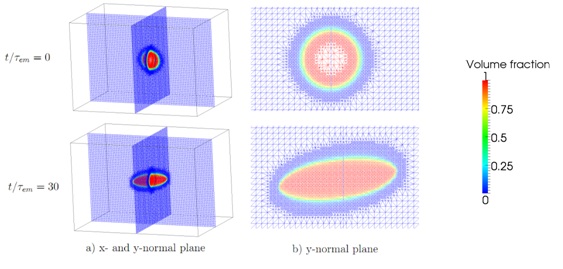
Fig. 2: Three-dimensional simulation of a droplet deforming due to a shear flow in a viscoelastic matrix with adaptive mesh refinement of the interfacial region.
Besides the conditionally volume-averaged two-phase model, another method to simulate multi-phase flows of viscoelastic fluids based on the well-known volume-of-fluid (VoF) approach was implemented. The method was validated with a number of different flows such as the die-swell effect, the Weissenberg effect and droplet deformations1. In Fig. 3 the VoF model is used in to simulate the flow in a partially filled twin-screw extruder. The complex movement of the screws is coped with a transient Immersed Boundary Method (IBM).
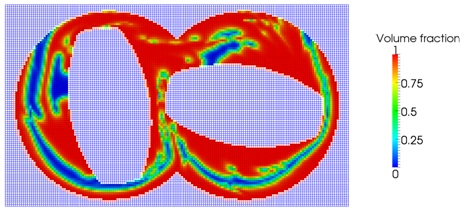
Fig. 3: Two-dimensional simulation of a partially filled twin-screw extruder using the Immersed Boundary Method (IBM). The blue phase is air, the red phase is the extruded viscoelastic fluid governed by the Oldroyd-B equation.
References
[1] Habla, F., Marschall, M., Hinrichsen, O., Dietsche, L.: Numerical simulation of viscoelastic two-phase flows using OpenFOAM®. Chem. Eng. Sci. 66 (2011) 5487-5496.
[2] Habla, F., Dietsche, L., Hinrichsen, O.: Modeling and simulation of conditionally volume averaged viscoelastic two-phase flows. AIChE Journal. DOI: 10.1002/aic.14095.
[3] Habla, F., Woitalka, A., Neuner, S., Hinrichsen, O.: Development of a methodology for numerical simulation of non-isothermal viscoelastic fluid flows with application to axisymetric 4:1 contraction flows. Chem. Eng. J. 207-208 (2012) 772-784.
[4] Fattal, R., Kupferman, R.: Constitutive laws for the matrix-logarithm of the conformation tensor. J. Non-Newtonian Fluid Mech. 123 (2004) 281-285.
[5] Habla, F., Obermeier, A., Hinrichsen, O.: Semi-implicit formulation for viscoelastic models: Application to three-dimensional contraction flows. Submitted to Journal of Non-Newtonian Fluid Mechanics.
See more of this Group/Topical: Engineering Sciences and Fundamentals