
 Google
 Yelp
 Facebook
 Twitter
 ChEnected
340485 Generation of Novel Diesel Additives Via Furan Condensation and Partial Hydrogenation of Biomass-Derived Molecules
Generation of Novel Diesel Additives via Furan Condensation and Partial Hydrogenation of Biomass-Derived Molecules
Eric R. Sacia, Madhesan Balakrishnan, and Alexis T. Bell
Department of Chemical and Biomolecular Engineering,
University of California-Berkeley, Berkeley, California 94720
Production of alternative fuels from biomass sources remains one of the greatest contemporary challenges for catalysis. Due to its many advantages for growth and production, lignocellulosic biomass has been identified as a beneficial source of chemical energy for biofuels.1 However, in order to synthesize fuels of the desired size and properties for blending into the diesel fuel supply, catalytic C-C bond formation is required. Towards this aim, 5-hydroxymethylfurfural (HMF) and furfural, dehydration products from the glucose and xylose sugars generated by cellulose and hemicellulose hydrolysis, have been broadly identified as useful platform molecules.2-3
While several pathways exist to produce diesel-range fuel additives through C-C bond formation, including aldol condensation and acid-catalyzed alkene oligomerization, the condensation of 2-methylfuran with biomass-derived aldehydes provides an innovative, high-yield pathway to fuel precursors.4-5 The products of furan condensation have thus far been subjected to extensive hydrodeoxygenation to form branched 6-alkyl undecanes. In order to improve the feasibility of these reactions, we have elucidated methods for solvent-free acid-catalyzed furanylation at low temperatures followed by partial hydrogenation. We have demonstrated that this scheme generates products that display attractive fuel characteristics while requiring 38% less H2 input than full hydrogenation to alkanes due to the beneficial effect of ethers on cetane number.6
The overall scheme for furfural condensation with 2-methylfuran is provided in Figure 1. By performing the furan condensation with furfural and a 10% stoichiometric excess of 2-methylfuran, 93% yields to the targeted product, 1, could be achieved within 2 hours at 65°C with homogeneous catalysts under solvent-free conditions. In order to better facilitate acid catalyst recovery, heterogeneous Brønsted and Lewis acids were also screened. Brønsted acidic ionic liquids (IL) of tunable hydrophilicity were synthesized in order to create a liquid/liquid bi-phasic catalyst system in which the hydrophobic reactants and products would separate from the hydrophilic catalyst phase. Through modification of the hydrophilicity of the IL's anion, the acidic IL phase could catalyze the furan condensation with activity equal to that of homogeneous sulfonic acids.
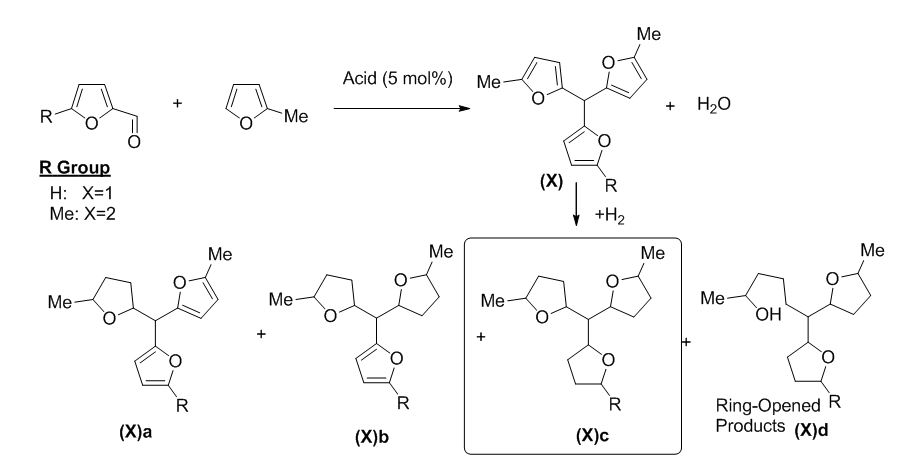
Figure 1. Scheme for furan condensation followed by partial hydrogenation to targeted products
Heterogeneous catalysts, such as sulfated zirconia and Amberlyst-15, were also tested for activity in furan condensation reactions but were demonstrated to display lower activity than the tested homogeneous counterparts. In order to more efficiently catalyze the furan condensation, several alkyl “linkers” were used to tether sulfonic acid groups to high surface area silica. The resulting catalysts achieved complete conversion within 30 minutes while maintaining high selectivity and recyclability. Furan condensation reactions were also tested under these optimized conditions with 5-methylfurfural (97% yield), HMF (78% yield), and 5-methylfurfuryl alcohol (89% yield).
It was determined that condensation product 1had a cetane number of 25, significantly below the target of 40, and also had too high of a viscosity to readily blend into diesel by itself. Therefore, we sought to exploit the high cetane number of ethers compared to aromatics to generate previously unreported diesel fuel candidates, 1c and 2c. Palladium supported on traditional supports proved unselective for the partial hydrogenation of 1 and 2 to their tetrahydrofuranyl analogs, often producing ring-opened products before complete ring saturation. However, we found that Pd supported on a surface-tethered ionic liquid on SiO2 gave high selectivity to 1c and 2c (92 and 85% respectively), even in solvent-free conditions. Further, the products of partial hydrogenation were tested and found to have significantly improved cetane numbers and viscosities compared to the starting materials. The unique selectivity of these catalysts and their mechanism of production of high-value additives will be further discussed. The role of surface hydrophobicity and dispersion on the selectivity of this hydrogenation will also be explored.
References
1. Somerville, C.; Youngs, H.; Taylor, C.; Davis, S. C.; Long, S. P., Feedstocks for Lignocellulosic Biofuels. Science 2010, 329 (5993), 790-792.
2. Huber, G. W.; Iborra, S.; Corma, A., Synthesis of transportation fuels from biomass: Chemistry, catalysts, and engineering. Chem Rev 2006, 106 (9), 4044-4098.
3. Alonso, D. M.; Bond, J. Q.; Dumesic, J. A., Catalytic conversion of biomass to biofuels. Green Chemistry 2010, 12 (9), 1493-1513.
4. Corma, A.; de la Torre, O.; Renz, M.; Villandier, N., Production of High-Quality Diesel from Biomass Waste Products. Angewandte Chemie International Edition 2011, 50 (10), 2375-2378.
5. Corma, A.; de la Torre, O.; Renz, M., High-Quality Diesel from Hexose- and Pentose-Derived Biomass Platform Molecules. ChemSusChem 2011, 4 (11), 1574-1577.
6. Murphy, M. J.; Taylor, J. E.; McCormick, R. L., Compendium of Experimental Cetane Number Data. NREL, Golden, Colo., 2004. ADDIN EN.REFLIST
See more of this Group/Topical: Catalysis and Reaction Engineering Division