
 Google
 Yelp
 Facebook
 Twitter
 ChEnected
340607 Fast Lean-Rich Cycling for Enhanced NOx Conversion
Abstract
Conventional NOx storage and reduction (NSR) has emerged as an important emission aftertreatment technology for reducing NOx (NO and NO2) to N2 under lean conditions typical of diesel or lean-burn gasoline vehicles [1]. Typical cycle timing is 1-2 minutes for the lean phase and 3-20 seconds for the rich phase. In the past year, Toyota Inc. has presented the “Di-Air” technology which involves much faster cycling and the use of hydrocarbon reductant. Published data show a large expansion in the temperature operating window for achieving high NOx conversion [2]. In this study we have carried out NSR over a wide range of cycle timing to examine the generality of rapid cycling and to understand causative mechanisms for conversion enhancement.
NOx reduction experiments have been carried out using the rapid injection of C3H6 over a NSR catalyst containing Pt/Rh/BaO/Ce/Al2O3 combined with a fast switching valve in close proximity to the catalyst. The injection frequency was varied for a fixed cycle-averaged propylene concentration. In contrast to traditional NSR cycling systems, NOx conversion was observed to increase as injection frequency increases, up to an injection frequency of 0.5 Hz. The shorter cycle times result in a steadier rate of exothermic catalytic oxidation of propylene, characterized by nearly pseudo steady state values for the catalyst temperature and O2 concentration. This also allows a higher conversion of propylene to be obtained throughout the length of the cycle. In addition, the effect of the lean phase length and thermal durability were studied. High conversions were obtained using less reductant (>90% conversion for a cycle-averaged stoichiometric number of 6) and over a wider temperature range (>90% conversion for a catalyst temperature of 250-550°C) than previous literature values. Figure 1 shows typical results. The extension of the high conversion temperature window implies that the decomposition of barium nitrate is not the limiting factor, likely due to the diminished role of NOx storage. Furthermore, the inhibitory effect of Ba carbonate formation on NOx conversion was determined to be less significant at high injection frequencies. This can be attributed to low utilization of dynamic storage sites, which reduces the impact of carbonate formation. These results are consistent with hydrocarbon intermediates on the catalyst surface providing competition for the propylene oxidation reaction and reducing NOx.
References
[1] Harold, M.P., “NOx Storage and Reduction in Lean Burn Vehicle Emission Control: A Catalytic Engineer's Playground,” Current Opinion in Chemical Engineering, 1, 303-311 (2012).
[2] Bisaiji, Y., Yoshida, K., Inoue, M., Umemoto, K., Fukuma, T., "Development of Di-Air - A New Diesel deNOx System by Adsorbed Intermediate Reductants," SAE Int. J. Fuels Lubr. 5(1):380-388, 2012, doi:10.4271/2011-01-2089.
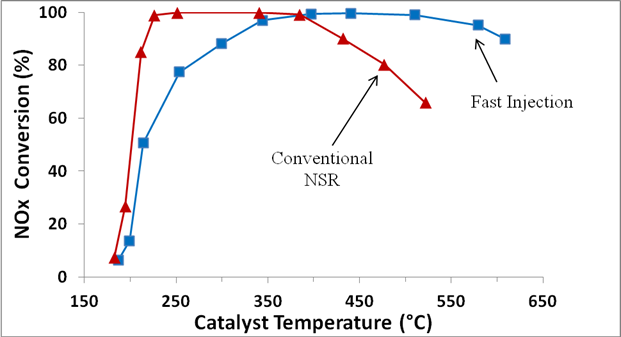
Figure 1. Comparison of temperature effect on NOx conversion using conventional NSR and fast injection method.
See more of this Group/Topical: Catalysis and Reaction Engineering Division