
 Google
 Yelp
 Facebook
 Twitter
 ChEnected
340690 Characterization of New Pd, Pd-Au and Pd-Au-Pt Large Scale Membranes in Actual Coal Derived Syngas Atmospheres
Characterization of new Pd, Pd-Au and Pd-Au-Pt large scale membranes in actual coal derived syngas atmospheres
Yi Hua Ma, Federico Guazzone, Ivan Mardilovich, Jacopo Catalano and Nikolas K. Kazantzis
Center for Inorganic Membrane Studies
Department of Chemical Engineering
Worcester Polytechnic Institute
Worcester, MA 0109, USA
Abstract
Composite Pd alloy membranes are highly suitable for the production of H2 in membrane reactors due to their high stability at elevated temperatures and the infinite theoretical selectivity of dense Pd alloys towards H2. The methane steam reforming (MSR) and water gas shift (WGS) reactions have been carried out in Pd-alloy membrane reactors by several researchers. In the effort to develop a WGS catalytic membrane reactor, our group at Worcester Polytechnic Institute has been studying the characteristics and stability of several composite Pd based membranes in actual coal derived syngas atmospheres at the National Carbon Capture Center (NCCC) in Wilsonville, Alabama. The H2 flux, H2 permeance and H2 purity of pure Pd and Pd-Au alloy membranes have been studied at 450°C, 12.6 bar and an average H2 feed concentration of 35%. It was demonstrated that Pd-Au membranes were characterized by an outstanding long term permeance and selectivity stability at 450°C in coal derived syngas for at least 473 h and H2 purities as high as 99.9%. However, all tested membranes at NCCC showed a sharp initial decrease in H2 permeance (in the order of 30-60% of the initial permeance) indicating the possible adsorption of contaminants on the Pd surface. XPS analysis of a Pd film exposed to the same syngas as that of the membranes showed the presence of Hg, Na, Mg, O, S and C.
The study of three membranes (Pd-Au, Pd-Au-Pt and pure Pd) at NCCC led to the following observations: (1) extended exposure (>150 h) of pure Pd membranes in coal derived syngas might have led to the appearance of cracks (seen in SEM micrographs) and subsequent drastic loss in selectivity, (2) Pd-Au membranes with high Au content at the surface did not show signs of brittleness/cracking, however, their permeance showed to be negatively affected by H2S concentration (up to 10.6 ppm), but it was unexpectedly recovered up to a 100% after only 30 min in syngas without H2S, and (3) the initial H2 permeance loss of the Pd-Au-Pt membrane was only 25% indicating that Pt might be a possible alloy element for H2S resistance.
Preliminary experiments in our laboratories with the Pd-Au and the Pd-Au-Pt membranes showed that at the operating conditions (450°C and 12.6 bar) and at the maximum ethylene and propylene concentrations in the syngas (< 1000 ppm) at NCCC, ethylene and propylene had no or negligible effect on the H2 permeance of Pd-Au and Pd-Au-Pt membranes. Since the pure Pd membrane showed a 80% decrease in initial permeance when tested at NCCC, it appeared that the main reason for the initial H2 permeance loss were sub-ppm levels of H2S not possible to detect with the on site GC.
The mechanical stability of composite Pd membranes was also studied with a fourth membrane which was subjected to 150 temperature cycles between 250 and 450°C (shown in Figure 1(a)) and 100 additional temperature cycles between 250 and 400°C. During the first 150 cycles the H2/He ideal selectivity declined from approximately 10,000 to around 2,000. However, during the additional 100 temperature cycles the selectivity (or N2 leak permeance as seen in Figure 1(b)) remained unchanged indicating that the decrease in selectivity was mainly associated with the short dwell times at 450°C and not caused by the temperature cycles. The temperature cycling test showed the outstanding robustness of the prepared composite Pd membranes.
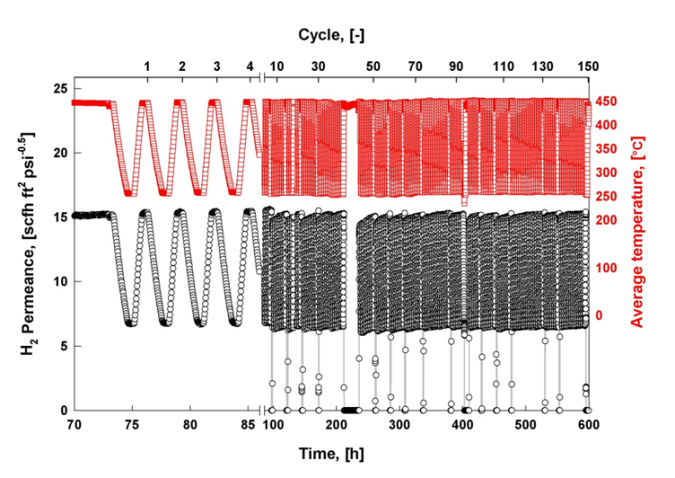
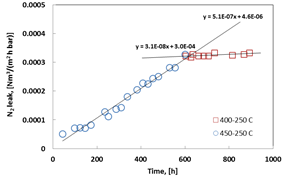
Figure 1. (a) H2 permeance and temperature profile during the 150 cycles between 250-450°C. (b) N2 leak permeation as a function of time during the first 150 cycles between 250-450°C and the additional 100 cycles between 250-400°C
See more of this Group/Topical: Separations Division