
 Google
 Yelp
 Facebook
 Twitter
 ChEnected
341132 Spatiotemporal Studies of Methane Conversion On Pt/Pd Catalytic Monoliths
Spatiotemporal Studies of Methane Conversion on Pt/Pd Catalytic Monoliths
Gregory S. Bugosh, Michael P. Harold
University of Houston
Houston, TX 77204
The current price advantage toward natural gas over petroleum is leading to increased utilization to power vehicles with compressed natural gas (CNG) and liquefied natural gas (LNG). Methane is the primary component of natural gas and some small but significant amount of it survives the combustion chamber and “slips” into the exhaust. Among the hydrocarbons, methane (CH4) is particularly difficult to oxidize due to its low reactivity. Since methane is a greenhouse gas with global warming potential 20 times that of carbon dioxide (CO2), work must be done to ensure its emission is at low as practicably possible. Moreover, methane emissions have historically been ignored in the design and operation of the three-way catalytic converter. When methane conversion is added to the list of required reactions, this necessarily changes the design and operation of conventional emission control devices and will complicate the behavior of emerging emission control systems.
In the current study we examine the conversion of methane in model feeds representative of exhaust mixtures of a natural gas powered vehicle run under stoichiometric or lean feed conditions. Many fundamental questions are raised about the performance and design of precious metal catalysts for methane oxidation. The experiments were carried out in a bench-flow reactor system equipped with a mass spectrometer having spatially resolved sampling. This technique enables measurement of chemical species concentration profiles along the length of the monolith channel.
During scouting measurements of the oxidation of hydrocarbons with a diesel oxidation catalyst (DOC) comprising Pt/Pd/Al2O3 washcoated monolith, an increase in hydrocarbon conversion was observed with decreasing O2 concentration near the stoichiometric point. A peak in the methane conversion occurred at intermediate O2 feed concentration, which interestingly exceeded the methane conversion in excess O2 (10%). The conversion peak could be shifted by varying the oxygen and co-reductant (CO) concentrations. However, when O2 levels were decreased below a point there was not enough available to complete the oxidation and the conversion declined. Similar results had been reported in the early 90's when investigating natural gas engine emission aftertreatment at GM [1] and at Ford [2]. The peak in conversion was explained to be a result of oxygen blocking the access of methane to the active catalyst sites as inlet oxygen concentrations increase. The existence of the methane conversion maximum complicates the design of a catalyst capable of achieving a high methane conversion over a wide range of conditions.
In order to better understand the origin of the peak in methane conversion at low O2 concentration, spatially resolved profiles were obtained. The spatial dependence of the reacting species provides new insight about the coupling between the conversions of CH4 and CO in stoichiometric levels of O2. Typical results are shown in Figure 1 for a feed gas containing 800 ppm CH4, 2000 ppm CO, 2000 ppm O2 and a feed temperature of 482oC. The CO first reacts with the O2, which forms CO2 leading to a reduction in the O2 concentration. When the O2 concentration is at a sufficiently low level, CH4 conversion commences with a notable increase in H2 and CO, presumably formed by the partial oxidation of CH4 and steam reforming. Since methane is the target species for removal in this case, due to its low reactivity, the production of H2 and CO can be tolerated, since they can be easily removed in a subsequent reactor with addition of air. Adjusting the O2 and CO feed concentrations, as well as the inlet gas temperature, results in different concentration profiles, and this information is very helpful toward the eventual design of a methane removal system.
These and other integral conversion data will be presented over a range of feed temperatures and compositions in order to elucidate the catalyst performance. Additional kinetics experiments provide important information about the underlying mechanism. Supporting unsteady state (dynamic) experiments will be described that address the methane conversion under conditions encountered during warmup and transient operation.
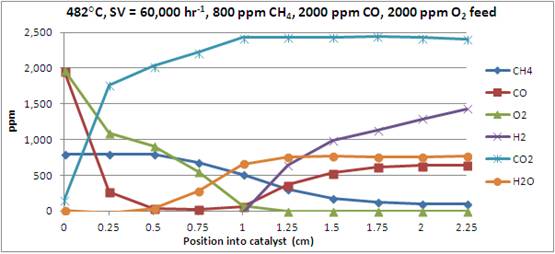
Fig. 1. Spatially resolved species measurements through the length of the monolith channel.
References
1. Oh et. al, Journal of Catalysis, 132, 287-301, 1991.
2. Subramanian et. al, Ind. Eng. Chem. Res., 31, 2460-2465, 1992.
See more of this Group/Topical: Catalysis and Reaction Engineering Division